Key takeaways
- Base and bulb shape: Nearly every chandelier uses an E12 candelabra base, but the glass profile matters visually. B10 and B11 are torpedo-shaped, CA10 is the bent flame tip. Measure your existing bulb before ordering a 12-pack.
- Color temperature: Stick to 2700K for chandeliers. It’s the incandescent-adjacent warmth that flatters wood, brass, and skin tones. Anything at 3000K and above starts feeling like a hallway fixture.
- Dimmer compatibility: Older leading-edge dimmers were built for resistive incandescent loads and often stutter with LEDs. If you’re keeping the existing dimmer, look for bulbs that explicitly list smooth dimming, and expect to swap to a CL-rated dimmer if flicker persists.
- CRI: Color rendering index gets skipped constantly. Anything below 80 will make fabrics and wall paint look slightly off. 90+ CRI is worth the small premium in dining rooms.
- Frosted vs. clear filament: Clear glass shows off the filament and suits vintage or exposed-bulb fixtures, but it glares if the bulb sits at eye level. Frosted diffuses better under shades.
What's inside
Standing on a ladder with your neck craned back, holding a bulb that’s a hair too big for the socket cup, is a specific kind of frustration. Chandeliers are unforgiving fixtures: the bulbs are visible, often exposed, and any mismatch in shape, color, or brightness broadcasts itself across the whole room. Swap in the wrong candelabra bulb and you get a fixture that reads cold and clinical, or worse, one that flickers and hums every time you touch the dimmer.
This guide walks through the candelabra bulbs worth putting in a fixture you actually look at. I’ve pulled together options across the three shapes you’ll encounter most (B10, B11, and flame-tip CA10), plus one incandescent holdout for anyone chasing that specific warm falloff. Below you’ll find what to check before you buy, honest notes on each pick, and answers to the questions that come up mid-installation.
As an Amazon Associate we earn from qualifying purchases.



How to Choose a Bulbs For Chandelier (2026)
- Base and bulb shape: Nearly every chandelier uses an E12 candelabra base, but the glass profile matters visually. B10 and B11 are torpedo-shaped, CA10 is the bent flame tip. Measure your existing bulb before ordering a 12-pack.
- Color temperature: Stick to 2700K for chandeliers. It’s the incandescent-adjacent warmth that flatters wood, brass, and skin tones. Anything at 3000K and above starts feeling like a hallway fixture.
- Dimmer compatibility: Older leading-edge dimmers were built for resistive incandescent loads and often stutter with LEDs. If you’re keeping the existing dimmer, look for bulbs that explicitly list smooth dimming, and expect to swap to a CL-rated dimmer if flicker persists.
- CRI: Color rendering index gets skipped constantly. Anything below 80 will make fabrics and wall paint look slightly off. 90+ CRI is worth the small premium in dining rooms.
- Frosted vs. clear filament: Clear glass shows off the filament and suits vintage or exposed-bulb fixtures, but it glares if the bulb sits at eye level. Frosted diffuses better under shades.
The Best Bulbs For Chandelier (2026)s Reviewed
E12 Candelabra LED Flame Tip, 4W 460 LM, 12-Pack
The flame-tip silhouette does a lot of quiet work here, filling out socket cups on traditional fixtures where a straight torpedo bulb looks stubby. At 460 lumens and 2700K across twelve bulbs, this is the straightforward choice for a full-fixture replacement in one pass.
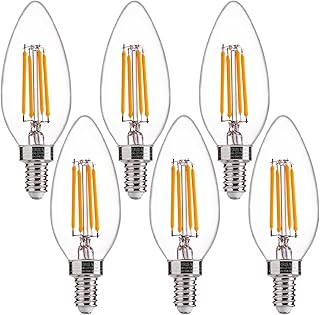
60W Equivalent Clear B11 LED Filament, 6-Pack
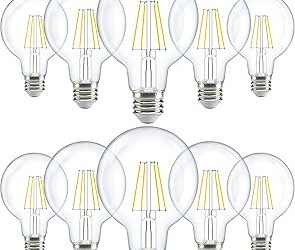
Brighter than the 40W-equivalent field, which matters in open-plan dining rooms or entryways with tall ceilings where a chandelier is doing real illumination work. The clear B11 glass and visible filament suit modern fixtures with exposed sockets.
12-Pack Dimmable E12 LED Vintage B11 Filament
A solid value play at 450 lumens per bulb with clear glass and genuine filament styling. I’ve had good results with these on ceiling fan light kits, where the shorter B11 body clears the glass shade without pressing against it.
60W Candelabra Incandescent B10, 12-Pack
Sometimes you want actual incandescent, and this is the honest reason: 600 lumens with that gradual warm dimming curve no LED fully replicates, and zero dimmer compatibility guesswork. The tradeoff is heat, a shorter lifespan, and a real energy penalty across twelve sockets.
Hizashi 90+ CRI LED Flame Tip CA10, 12-Pack
The 90+ CRI is the differentiator, and it shows in rooms with saturated color: wood tones deepen, upholstery reads accurately, and the light feels less flat. UL listing plus flame-tip CA10 shaping makes this my default recommendation for dining room chandeliers.
Frequently Asked Questions
Can I mix LED and incandescent bulbs in one chandelier?
It works electrically, but it looks off. LEDs and incandescents dim at different rates and rarely match in tone even at identical rated color temperatures, so you’ll see uneven brightness across the arms. Replace all sockets at once.
Why do my LED chandelier bulbs buzz on the dimmer?
Almost always a dimmer mismatch. Older TRIAC dimmers designed for high-wattage incandescent loads can’t read the low draw of six or twelve LEDs. Swapping in an LED-rated (CL) dimmer resolves it in most cases.
Should the bulbs point up or down?
Follow the fixture. Uplight chandeliers benefit from clear filament bulbs since the shape stays visible, while downlight sockets with shades hide the bulb entirely, so frosted glass and diffusion matter more than looks.
How many lumens do I need per bulb?
Add it up rather than guessing per socket. A six-arm chandelier at 450 lumens each gives you roughly 2,700 lumens, which suits most dining rooms. Larger spaces or taller ceilings call for the 60W-equivalent bulbs closer to 600 lumens.
Final Thoughts
For most chandeliers, the Hizashi 90+ CRI flame tip bulbs are the pick worth spending on, since accurate color rendering changes how an entire room reads. If you need more output, the 60W Equivalent Clear B11 filament bulbs deliver it without losing the warm 2700K tone, and the 12-Pack E12 Vintage B11 filament bulbs cover full-fixture replacements on a tighter budget.