Key takeaways
- Match CFM to square footage: Budget roughly 1 CFM per square foot for standard 8-foot ceilings, with a 50 CFM floor for small powder rooms. Enclosed tub or shower alcoves benefit from a dedicated 50 CFM on top of the main room calculation, and higher ceilings need you to work from cubic volume instead.
- Read the sone rating, not the marketing: Sones scale linearly with perceived loudness, so a 1.0-sone fan genuinely sounds half as loud as a 2.0. Anything at or below 1.0 sones disappears into the background; above 3.0 and you’ll hear it through a closed door.
- Measure your existing cutout first: Housing footprints vary from roughly 7 inches square up to 10 inches or more. Pulling the old grille and measuring the rough opening before you order saves you from patching drywall between joists on a Saturday afternoon.
- Check duct diameter and run length: A 4-inch port bolted onto a fan rated for 6-inch duct will strangle the airflow no matter what the spec sheet claims. Keep the run short, use smooth rigid pipe where you can, and terminate outside the building envelope rather than in the attic.
- Decide on sensors and extras up front: Humidity sensors, motion detection, nightlights, and heaters each change your wiring needs. Some require a second switch leg or additional conductors, so confirm what’s in the ceiling box before committing.
What's inside
Standing on a ladder with a drywall saw in one hand and a fan housing in the other, you learn quickly that not all bathroom fans are built for the same job. The unit that came with your house was probably chosen by a builder optimizing for cost, which means it moves too little air, rattles like a coffee grinder, and casts a dim yellow glow over the whole room. Meanwhile the mirror fogs solid every morning, paint starts peeling near the shower, and the grout in the corner has gone a suspicious shade of gray. That combination of weak airflow and bad light is the reason so many DIYers end up replacing a fan that technically still works.
The fix is a combination unit that handles ventilation and lighting in a single ceiling cutout. This guide walks through the specs that actually change your experience day to day: CFM matched to room size, sone ratings you can live with, LED color temperature options, and the housing dimensions that determine whether you’ll be reframing joists or dropping the new unit straight into the old hole. Below are six fan-and-light combos worth your attention in 2026, along with the installation details that rarely make it onto the box.
As an Amazon Associate we earn from qualifying purchases.



How to Choose a Bathroom Ceiling Fan With Light (2026)
- Match CFM to square footage: Budget roughly 1 CFM per square foot for standard 8-foot ceilings, with a 50 CFM floor for small powder rooms. Enclosed tub or shower alcoves benefit from a dedicated 50 CFM on top of the main room calculation, and higher ceilings need you to work from cubic volume instead.
- Read the sone rating, not the marketing: Sones scale linearly with perceived loudness, so a 1.0-sone fan genuinely sounds half as loud as a 2.0. Anything at or below 1.0 sones disappears into the background; above 3.0 and you’ll hear it through a closed door.
- Measure your existing cutout first: Housing footprints vary from roughly 7 inches square up to 10 inches or more. Pulling the old grille and measuring the rough opening before you order saves you from patching drywall between joists on a Saturday afternoon.
- Check duct diameter and run length: A 4-inch port bolted onto a fan rated for 6-inch duct will strangle the airflow no matter what the spec sheet claims. Keep the run short, use smooth rigid pipe where you can, and terminate outside the building envelope rather than in the attic.
- Decide on sensors and extras up front: Humidity sensors, motion detection, nightlights, and heaters each change your wiring needs. Some require a second switch leg or additional conductors, so confirm what’s in the ceiling box before committing.
The Best Bathroom Ceiling Fan With Light (2026)s Reviewed
Ultra Quiet 120 CFM Fan with 1000 Lumens LED
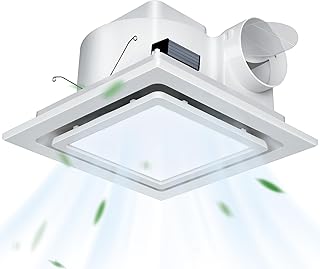
At 1.0 sone with 120 CFM on tap, this unit hits the sweet spot for a typical full bath — enough extraction to clear steam in a few minutes without the drone. The 1000-lumen output is genuinely usable as primary lighting, and the 10″ × 10″ ceiling mount drops cleanly into most retrofit openings with minimal patching.
Panasonic WhisperFit FV-0511VFL1
Panasonic’s Pick-A-Flow selector lets you dial in 50, 80, or 110 CFM after installation, which is a real advantage when you’re not certain how your duct run will perform. The shallow housing fits tight joist bays where deeper units won’t clear, and the dimmable LED plus Panasonic’s motor reputation make this the safe long-term choice.
110 CFM Round Fan with Light and Nightlight
The round black trim is a welcome break from the standard white square, and it reads as an intentional design element rather than an appliance. Airflow is strong at 110 CFM, the dimmable main light handles daily use, and the integrated nightlight means no more squinting at 3 a.m.
80 CFM Fan with 3CCT Shower Light
This one is damp-rated for installation directly over a shower or tub, where a standard fan-light combo isn’t approved to go. The 3CCT switch lets you shift between warm and cool white without swapping fixtures, and the brushed nickel acrylic cover holds up better than painted steel in constant humidity.
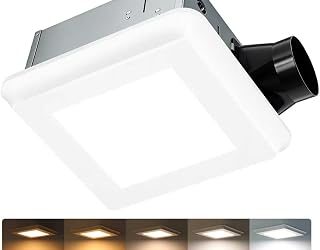
130 CFM Fan with Humidity Sensor and 5CCT
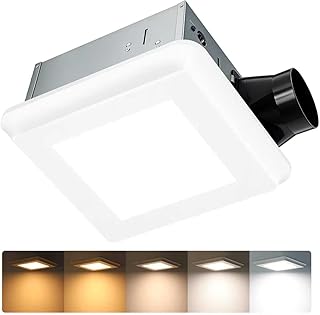
The adjustable humidity sensor is the standout here — set your threshold and the fan runs itself, which matters most in bathrooms used by people who never touch the switch. With 130 CFM at 1.0 sone plus five color temperature options and ETL/FCC certification, it’s a strong pick for larger master baths.
Frequently Asked Questions
Can I install a bathroom fan with light myself?
If you’re comfortable working in an attic, cutting drywall, and making basic wiring connections, yes — most units are designed for retrofit installation. That said, bathroom circuits are often GFCI-protected and code requirements vary by jurisdiction, so check local rules and pull a permit if one is required.
How long should the fan run after a shower?
Plan on 15 to 20 minutes after you’re done to clear residual moisture from surfaces and framing. A timer switch or humidity-sensing model handles this automatically, which is far more reliable than remembering to flip a switch on your way out.
Do I need a separate heater, or is a combo unit enough?
Combo units like the Broan-NuTone with heater take the chill off a small to medium bathroom nicely, but they draw significant amperage and often need a dedicated circuit. For large or poorly insulated spaces, in-floor heat or a wall unit will outperform a ceiling-mounted resistive heater.
Why does my new fan seem weaker than the specs suggest?
Almost always the ductwork. Long flexible runs, sharp bends, crushed sections, and undersized pipe all cut real-world airflow well below rated CFM, so straighten and shorten the path wherever possible.
Final Thoughts
For most retrofits, the Panasonic WhisperFit FV-0511VFL1 is the one I’d install in my own house — the adjustable CFM and shallow housing solve the two problems that derail DIY replacements most often. If you want set-it-and-forget-it operation, the 130 CFM humidity sensor model earns its keep in a busy family bathroom, and the Broan-NuTone heater combo is the practical answer for anyone tired of stepping out of the shower into cold air.