Ten-inch band saws sit in an awkward spot on the shelf. They cost more than a jigsaw, take up real bench space, and every listing throws the same numbers at you: FPM, amps, throat depth, resaw height. Meanwhile the actual question in your head is simpler. Will this thing cut a clean curve through 4/4 walnut for the cabriole legs I sketched last weekend, or will it bog down, drift off the line, and leave me sanding for an hour? Spec sheets are terrible at answering that. Blade tension, frame rigidity, and table flatness matter far more than the headline horsepower, and none of those show up in a bullet list.
This guide is written from the perspective of someone who has actually fought with a wandering blade at 10pm. Below you’ll find the 10-inch saws worth considering in 2026, sorted by who they suit rather than by price alone. I’ll cover the buying criteria that genuinely change your results in the shop, then give a short, honest read on each machine, including where corners were cut. If you build furniture, curved aprons, bracket feet, or shop jigs, this is the size class that earns its footprint.
Our top picks




As an Amazon Associate we earn from qualifying purchases at no extra cost to you.
🛒 Best Price Today on Amazon
Prime members get fast, free shipping on everything above, plus member-only deals. New members get a 30-day free trial — cancel anytime.
How to Choose a/an 10 Inch Band Saw (2026)
- Resaw height: This is the number that limits what you can actually build. Around 4-1/2 inches handles most furniture stock; 5-1/8 to 6 inches lets you slice book-matched panels or split thick offcuts into usable veneer. If drawer sides and shop-sawn banding are in your future, pay for the extra headroom now.
- Frame stiffness over motor size: A flexy cast frame flexes under tension, and a blade that can’t be properly tensioned will bow and barrel-cut no matter how many amps you feed it. Look for heavier castings, a solid trunnion, and a tension mechanism that doesn’t feel like it’s bottoming out.
- Two-speed drive: Wood tolerates a fast blade; brass, aluminum, and thicker acrylic do not. A saw with a low range near 1,500 FPM plus a high range around 3,000 FPM lets you cross into non-ferrous work without scorching or gumming the teeth.
- Table and fence quality: A ground cast-iron table beats stamped steel every time, and it should sit dead flat with a trunnion that returns to 90 degrees reliably. Check that the fence locks square without lifting at the far end, because a fence that pivots under hand pressure makes resawing a guessing game.
- Guides, dust, and access: Tool-free doors, a workable dust port, and adjustable upper and lower guides save real time. Ball-bearing guides run cooler and last longer than plain blocks, and quick blade changes mean you’ll actually swap to a 1/8-inch blade for tight curves instead of forcing a wide one.
The Best 10 Inch Band Saw (2026)s Reviewed
Laguna V:10 Bandsaw
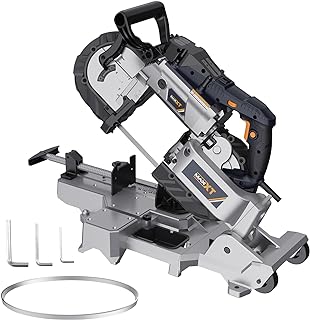
The V:10 is the machine to buy if you resaw seriously, with a full 1 HP motor and 5.75 inches of capacity backed by a frame that holds tension properly. It costs substantially more than the rest, but the difference shows up as straight cuts through hard maple rather than a slow, wandering crawl.
JET JWB-10 Band Saw with Stand
JET’s 1/2 HP JWB-10 is the sensible middle ground, pairing a rigid build and a genuinely square fence with the aftermarket support and parts availability that budget brands rarely offer. Single-speed operation is the tradeoff, so it’s a wood-first saw rather than a metals dabbler.
WOODSKIL 10-Inch Benchtop Bandsaw
With 5-1/8 inches of cutting height, a quick tension lever, and tool-free doors, the WOODSKIL punches above its price for blade changes and panel work. Fit and finish is merely fine, but the geometry and capacity are right where a furniture maker wants them.
WEN BA3962 10-Inch Two-Speed
The 3.5-amp WEN with stand remains the value benchmark: two speeds, a workable cast table, and a price that leaves budget for decent blades. Plan on tuning the guides and swapping the stock blade, and it will handle curves and light resawing without complaint.
VEVOR 10-Inch Two-Speed Benchtop
VEVOR leans on a 6-inch max cutting height and a 13-by-13-inch cast-iron table, which is unusually generous support for a benchtop saw. The 360-degree work light is a nicer touch than it sounds when you’re tracking a pencil line, though setup takes patience out of the box.
Frequently Asked Questions
Is a 10-inch band saw enough for furniture work?
For curved legs, arched rails, tenon cheeks, template blanks, and shop jigs, yes. Where you’ll feel the ceiling is resawing wide boards, since a 6-inch capacity caps how tall a panel you can slice in one pass.
What blade should I start with?
A 1/4-inch, 6 TPI blade covers most furniture curves and general ripping. Add a 1/8-inch for tight radii and a 1/2-inch, 3 TPI skip-tooth if you plan to resaw regularly.
Do I need the stand?
If you have bench space and clamps, no. If you don’t, a stand raises the table to a comfortable working height and keeps vibration from walking the saw across your bench mid-cut.
Why does my saw cut a curve when I want straight?
Usually low tension, a dull blade, or drift caused by uneven set on the teeth. Tension properly, then find your blade’s natural drift angle and skew your fence to match rather than fighting it.
Final Thoughts
If resawing panels and veneer is the goal, the Laguna V:10 is worth the stretch and will outlast the hobby phase. For most furniture builders, the JET JWB-10 is the balanced pick with the best long-term support, while the WEN BA3962 delivers the most capability per dollar if you’re willing to tune it and feed it a good blade.