Key takeaways
- Tooth count: Higher counts remove less material per tooth, so 60T handles general furniture crosscuts, 80T sharpens up plywood and trim, and 100T or 120T is for veneered panels and moldings where zero tearout matters. Below 40T, expect to sand.
- Kerf width: Thin kerf blades (around 0.070–0.090″) ask less of a 15-amp motor and waste less stock, but they can flex on deep bevels. Full kerf stays truer if your saw has the power to push it.
- Grind geometry: ATB (alternate top bevel) teeth slice wood fibers and give clean crosscuts. TCG (triple chip grind) is what you want for aluminum and non-ferrous metal, since flat-topped teeth resist chipping.
- Arbor and plate quality: Nearly all 10-inch blades use a 5/8″ arbor, but check that the plate is laser-cut and tensioned. Expansion slots and a hardened body keep the blade from warping when it heats up mid-cut.
- Carbide grade: Micrograin C3 or C4 carbide holds an edge far longer than budget tips and survives resharpening. If a blade is cheap enough to be disposable, treat it as disposable.
The blade that shipped with your miter saw was never meant to be the last one you’d use. Stock blades usually run 24 to 40 teeth, which is fine for framing lumber but leaves torn end grain and fuzzy edges on the poplar face frame you spent an afternoon milling. If you’ve ever flipped a workpiece to hide a chipped shoulder, you’ve already met the limits of a general-purpose blade.
This guide covers 10-inch blades worth bolting onto a home shop saw, whether you’re crosscutting hardwood for a dining table, chopping prefinished trim, or trimming aluminum extrusion for a shop cart. I’ve focused on tooth count, kerf thickness, and grind geometry, since those three specs decide almost everything about the cut quality you get.
Our top picks


As an Amazon Associate we earn from qualifying purchases at no extra cost to you. Ratings are shown as listed on Amazon.
🛒 Best Price Today on Amazon
Prime members get fast, free shipping on everything above, plus member-only deals. New members get a 30-day free trial — cancel anytime.
How to Choose a 10 Inch Miter Saw Blades (2026)
- Tooth count: Higher counts remove less material per tooth, so 60T handles general furniture crosscuts, 80T sharpens up plywood and trim, and 100T or 120T is for veneered panels and moldings where zero tearout matters. Below 40T, expect to sand.
- Kerf width: Thin kerf blades (around 0.070–0.090″) ask less of a 15-amp motor and waste less stock, but they can flex on deep bevels. Full kerf stays truer if your saw has the power to push it.
- Grind geometry: ATB (alternate top bevel) teeth slice wood fibers and give clean crosscuts. TCG (triple chip grind) is what you want for aluminum and non-ferrous metal, since flat-topped teeth resist chipping.
- Arbor and plate quality: Nearly all 10-inch blades use a 5/8″ arbor, but check that the plate is laser-cut and tensioned. Expansion slots and a hardened body keep the blade from warping when it heats up mid-cut.
- Carbide grade: Micrograin C3 or C4 carbide holds an edge far longer than budget tips and survives resharpening. If a blade is cheap enough to be disposable, treat it as disposable.
The Best 10 Inch Miter Saw Blades (2026)s Reviewed
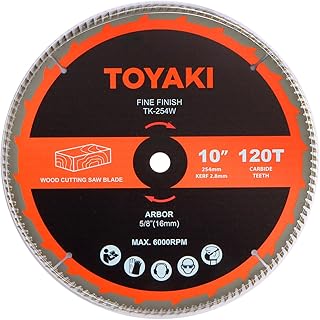
120-Tooth Fine-Finish Professional Blade
With 120 teeth on a 10-inch plate, this is the blade you reach for when cutting prefinished plywood or wrapping a table apron in veneer, since the tiny bite per tooth practically eliminates chipping. Feed it slowly and keep the cuts shallow, because heat buildup is the main enemy at this tooth count.
WEN BL1080 80-Tooth Carbide-Tipped
The BL1080 hits the sweet spot for furniture work, leaving glue-ready edges on maple and oak without the sluggish feel of an ultra-high-tooth blade. Carbide tips are thick enough for at least a couple of sharpenings, which makes it a genuinely low-cost blade over its life.
KENDO 2-Pack 40T + 60T Set
Buying a 40T and 60T together covers the two jobs most home shops actually do: fast ripping and clean sheet goods work. Swapping blades takes ninety seconds and beats forcing one blade to do both badly, making this the smartest starting point for a new saw owner.
Benchmark Abrasives 100-Tooth TCT
This is a purpose-built non-ferrous blade, and the triple chip carbide handles aluminum angle and extrusion without grabbing or throwing hot chips. Use a wax stick lubricant and clamp your work, and it will cut cleaner than any abrasive wheel.
ANGELSWORD 60T Fine Finish, 2-Pack
Sixty teeth is the everyday workhorse count for hardwood crosscuts, and getting two blades means you keep cutting while one goes off for sharpening. Nice value for someone building out a first real blade collection.
Frequently Asked Questions
Does a higher tooth count always mean a better cut?
Only up to a point. Past about 80 teeth, blades struggle to clear sawdust in thick hardwood, which causes burning. Match the count to the material thickness rather than buying the highest number available.
Can I use a table saw blade on my miter saw?
Yes, if the arbor and diameter match and the blade is rated for the saw’s RPM. Crosscut and combination blades transfer fine between the two, though dedicated rip blades are wasted on a miter saw.
How do I stop tearout on the back edge?
Add a zero-clearance backer. A scrap of MDF clamped against the fence supports the fibers where the teeth exit, and it costs nothing.
When should I replace instead of sharpen?
Sharpen if the carbide tips are still tall and the plate is flat. Replace once tips are chipped or ground down near the shoulder, or if the blade wobbles when spun by hand.
Final Thoughts
For most home furniture builds, the WEN BL1080 is the blade I’d install and leave on, with the KENDO 40T/60T set covering rougher stock and sheet goods. Add the Benchmark Abrasives TCT blade only if aluminum shows up in your projects, and save the 120-tooth for delicate veneered work.