Key takeaways
- Tooth count and the trade-off: Somewhere around 60 to 80 teeth is the sweet spot for furniture crosscuts in hardwood. Push to 120 teeth and edges get glassier, but each tooth removes less material, so heat builds fast in thick stock. Reserve the very high counts for plywood, veneer, trim, and thin material.
- Hook angle matters more on sliders: Sliding compound saws want a neutral or slightly negative hook so the blade doesn’t self-feed and lift the workpiece. A blade ground for a table saw with an aggressive positive hook will feel twitchy and unsafe on a slider, even if the diameter and arbor match.
- Kerf width versus your motor: Thin kerf around 3/32 inch asks less of a 10 to 12 amp saw and wastes less wood on repeat cuts. Full 1/8 inch kerf plates are stiffer and deflect less in wide bevels. Cordless and older saws generally benefit from thin.
- Grind geometry: ATB (alternate top bevel) severs wood fibers cleanly and is the default for crosscutting. TCG (triple chip grind) is the one you want for aluminum, PVC, and laminate, where a shearing bevel would chip or grab.
- Plate quality over sticker specs: Look for expansion slots, laser-cut stabilizer vents, and tensioned plates. A cheap blade with 120 teeth on a warped body will cut worse than a well-made 60-tooth. Check the arbor is a true 5/8 inch and that any bushings are machined, not stamped.
The blade that shipped with your miter saw was never meant to be the one you keep. Factory blades are usually 24 to 40 teeth of thin, soft carbide chosen to keep the saw’s price point down, and they announce themselves the moment you crosscut poplar for a bookcase side: fuzzy edges, torn grain on the bottom face, and a sanding session you didn’t budget for. Anyone who has glued up a face frame only to find hairline gaps at the joints knows the culprit usually isn’t the saw. It’s the steel spinning on the arbor.
This guide covers ten-inch blades worth swapping in, judged the way a shop actually judges them: how clean the cut looks straight off the saw, whether the plate stays flat through a long afternoon of repetitive cuts, and how the blade behaves in a sliding saw where a grabby hook angle can climb into the work. There’s a mix here of high-count finish blades, thin-kerf options for underpowered or cordless saws, a non-ferrous grind for aluminum extrusion, and a multipack for people who’d rather change blades than compromise. Match the blade to the cut and your miter saw stops being a rough-cut tool.
Our top picks



As an Amazon Associate we earn from qualifying purchases at no extra cost to you. Ratings are shown as listed on Amazon.
🛒 Best Price Today on Amazon
Prime members get fast, free shipping on everything above, plus member-only deals. New members get a 30-day free trial — cancel anytime.
How to Choose a/an 10 Miter Saw Blade (2026)
- Tooth count and the trade-off: Somewhere around 60 to 80 teeth is the sweet spot for furniture crosscuts in hardwood. Push to 120 teeth and edges get glassier, but each tooth removes less material, so heat builds fast in thick stock. Reserve the very high counts for plywood, veneer, trim, and thin material.
- Hook angle matters more on sliders: Sliding compound saws want a neutral or slightly negative hook so the blade doesn’t self-feed and lift the workpiece. A blade ground for a table saw with an aggressive positive hook will feel twitchy and unsafe on a slider, even if the diameter and arbor match.
- Kerf width versus your motor: Thin kerf around 3/32 inch asks less of a 10 to 12 amp saw and wastes less wood on repeat cuts. Full 1/8 inch kerf plates are stiffer and deflect less in wide bevels. Cordless and older saws generally benefit from thin.
- Grind geometry: ATB (alternate top bevel) severs wood fibers cleanly and is the default for crosscutting. TCG (triple chip grind) is the one you want for aluminum, PVC, and laminate, where a shearing bevel would chip or grab.
- Plate quality over sticker specs: Look for expansion slots, laser-cut stabilizer vents, and tensioned plates. A cheap blade with 120 teeth on a warped body will cut worse than a well-made 60-tooth. Check the arbor is a true 5/8 inch and that any bushings are machined, not stamped.
The Best 10 Miter Saw Blade (2026)s Reviewed
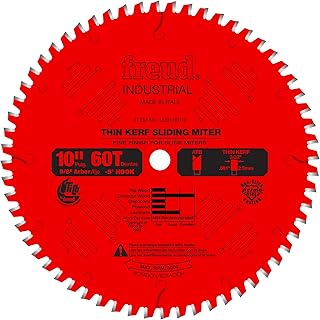
Freud LU91R010 10″ Thin Kerf Sliding Compound Blade
Freud built this one specifically for sliders, with a negative hook that keeps the blade from climbing and a thin kerf that lets modest motors hold their RPM through hardwood. It’s the blade I’d put on a 10-inch slider and simply leave there for general furniture work.
US1080-MTR 80T Miter Blade, USA Made
An 80-tooth full-kerf plate with geometry tuned for crosscuts and miters rather than borrowed from a table saw pattern. The stiffer body pays off on 45-degree bevels through 4/4 oak, where thin plates can wander a few thousandths and open a joint line.
WEN BL1080 10-Inch 80-Tooth Carbide-Tipped
Genuinely surprising performance for the money, and a sensible first upgrade over a factory blade. Carbide isn’t as dense as premium brands so expect fewer sharpenings across its life, but the cut quality in pine, poplar, and prefinished plywood is clean enough to go straight to finish sanding.
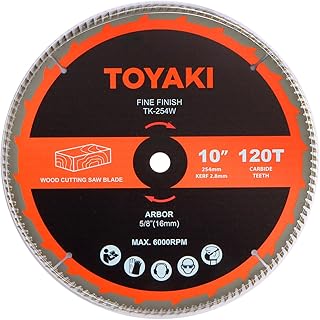
120-Tooth Fine-Finish Woodworking Blade, 5/8″ Arbor
This is the trim-and-plywood specialist: 120 teeth leave a near-polished edge on veneered panels and painted moldings with almost no tearout on the exit face. Feed slowly and don’t ask it to bury itself in thick maple, and it earns its place in the drawer.
TCG Aluminum-Working 120-Tooth Blade
The triple-chip grind is the detail that matters here, shearing aluminum extrusion, brass trim, and rigid PVC without snatching the work or chipping teeth. If you build furniture with metal legs or aluminum edge banding, this saves you from ruining a woodworking blade.
Frequently Asked Questions
Will a table saw blade work in my miter saw?
Physically yes, but it’s a bad idea on a sliding saw. Table saw blades typically use a positive hook angle that pulls the blade into the cut, which on a slider translates to grabbing and lifting the workpiece.
How many teeth do I need for furniture-grade cuts?
Sixty to eighty teeth handles the vast majority of hardwood crosscuts with a finish-ready edge. Step up to 100 or 120 only for veneered plywood, laminate, and thin trim.
Is a thin kerf blade less accurate?
Slightly more prone to deflection under load, but the difference is small on quality tensioned plates. If your saw has a smaller motor or runs on batteries, the reduced cutting load usually produces a better result overall.
When should I replace rather than sharpen?
Quality carbide blades are worth resharpening two or three times, roughly $20 to $30 per service. Budget blades with thin carbide teeth typically aren’t worth it, and any blade with a bent plate or missing tips should be retired.
Final Thoughts
For most people building furniture on a 10-inch saw, the Freud LU91R010 is the blade to buy first, since its negative hook and thin kerf suit sliding saws and it cuts cleanly across the range of stock you’ll actually use. The US1080-MTR 80-tooth is the pick if you want a stiffer full-kerf plate for precise bevels, and the WEN BL1080 delivers the biggest jump in cut quality per dollar for anyone still running a factory blade. Add the TCG blade only if metal or plastic ends up on your bench.