Key takeaways
- CFM at 90 PSI, not max PSI: This single number tells you whether the pump can keep pace with your tool. Around 2.6 SCFM handles a brad or finish nailer comfortably. If you want to run a framing nailer hard or feed two guns at once, look for 4 CFM territory.
- Recovery time over tank size: All six-gallon tanks hold the same air. The difference is how fast the motor refills it. A quick-recovering pump feels like a bigger compressor because you never outrun it.
- Noise you can live beside: Ratings in the 75–80 dBA range are normal; anything advertised lower is worth paying for if you’re working in a finished room, a shared garage, or an apartment building. Ear protection is still smart either way.
- Dual couplers and a real regulator: Two outlets mean a helper can work off the same tank, or you can leave an inflation chuck attached while the nailer stays hooked up. Look for gauges that are readable at a glance and a regulator knob that doesn’t drift.
- What’s actually in the box: Accessory kits vary wildly. A hose, blow gun, and inflation tips are table stakes. A bundled brad nailer changes the math significantly if you don’t already own one.
Six gallons is the sweet spot nobody tells you about until you’ve already bought the wrong compressor. Too small and you’re standing around waiting for the tank to catch up between brad nails; too big and you’ve got a 60-pound cylinder that lives in the garage forever because hauling it upstairs to trim out a bedroom isn’t happening. The pancake format solved that a long time ago, but the spec sheets have gotten muddier: max PSI numbers get printed in huge type while the CFM rating that actually determines whether your nailer keeps firing hides in the fine print.
I’ve run pancake compressors through baseboard installs, a deck rebuild, cabinet face frames, and a lot of tire top-offs on cold mornings. What follows is a practical read on the six-gallon field for 2026 — what the numbers mean when you’re the one holding the trigger, which models earn their keep on a furniture or trim project, and where the cheaper kits genuinely hold up versus where you’ll feel the compromise.
Our top picks


As an Amazon Associate we earn from qualifying purchases at no extra cost to you. Ratings are shown as listed on Amazon.
🛒 Best Price Today on Amazon
Prime members get fast, free shipping on everything above, plus member-only deals. New members get a 30-day free trial — cancel anytime.
How to Choose a 6-Gallon Air Compressor (2026)
- CFM at 90 PSI, not max PSI: This single number tells you whether the pump can keep pace with your tool. Around 2.6 SCFM handles a brad or finish nailer comfortably. If you want to run a framing nailer hard or feed two guns at once, look for 4 CFM territory.
- Recovery time over tank size: All six-gallon tanks hold the same air. The difference is how fast the motor refills it. A quick-recovering pump feels like a bigger compressor because you never outrun it.
- Noise you can live beside: Ratings in the 75–80 dBA range are normal; anything advertised lower is worth paying for if you’re working in a finished room, a shared garage, or an apartment building. Ear protection is still smart either way.
- Dual couplers and a real regulator: Two outlets mean a helper can work off the same tank, or you can leave an inflation chuck attached while the nailer stays hooked up. Look for gauges that are readable at a glance and a regulator knob that doesn’t drift.
- What’s actually in the box: Accessory kits vary wildly. A hose, blow gun, and inflation tips are table stakes. A bundled brad nailer changes the math significantly if you don’t already own one.
The Best 6-Gallon Air Compressors Reviewed
DEWALT DWFP55126 Pancake, 6 Gallon 165 PSI
This is the one I reach for most, largely because the high-efficiency motor starts without complaint in a cold garage and the 165 max PSI gives you a little more usable air per fill than the 150 PSI crowd. At 2.6 SCFM @ 90 PSI it’s tuned for finish work, roofing, and trim rather than sustained framing, and the oil-free pump means zero maintenance beyond draining the tank.
Metabo HPT EC914S, 6 Gallon 200 PSI
The outlier here, and the pick if your projects have outgrown finish nailing — 200 PSI storage plus a 4 CFM flow rate genuinely powers two nailers simultaneously without either gun going soft. It’s the heaviest-duty option on this list and priced accordingly, but for a small shop or anyone regularly working with a partner, the extra headroom is real.
CRAFTSMAN 6 Gallon Pancake Kit with Brad Nailer
Standard 150 PSI, 2.6 SCFM performance in a well-built package, but the reason to choose it is the bundled 18-gauge brad nailer and 10-piece accessory kit. For someone assembling a first air setup for furniture builds, drawer boxes, and trim, this gets you working the day it arrives.
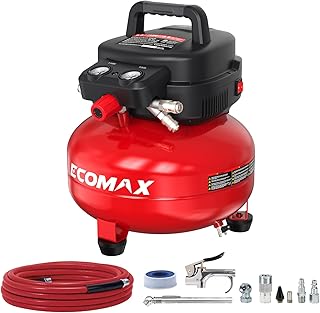
ECOMAX 6 Gallon 150 PSI with 10-Piece Kit
The budget-conscious entry that covers the fundamentals: oil-free pump, 150 PSI, and enough accessories to inflate tires, blow out sawdust, and run a nailer. It won’t match the DEWALT on recovery speed, but for occasional weekend projects the value proposition is hard to dismiss.
ECOMAX 6 Gallon Pancake 150 PSI, 1.5HP (Red)
A step up within the ECOMAX line thanks to dual quick couplers and a 3.6 CFM @ 40 PSI rating that makes inflation tasks noticeably faster. The 1.5HP oil-free pump delivers 2.6 CFM at 90 PSI, putting it on par with the big-name specs for finish work at a lower entry point.
Frequently Asked Questions
Is 6 gallons enough for a framing nailer?
For intermittent framing, yes — but you’ll pause for recovery. If framing is a regular part of your work, choose the Metabo HPT’s 4 CFM output rather than a 2.6 SCFM model, which is optimized for brad, finish, and roofing nailers.
Do I need to add oil to these?
No. Every compressor here uses an oil-free pump, so maintenance comes down to draining the moisture from the tank after each session and keeping the air filter clean. Skipping the drain is the fastest way to rust a tank from the inside.
Can I run a spray gun off a 6-gallon pancake?
Small detail and touch-up guns, yes. Full-size HVLP spraying for furniture finishing demands sustained high CFM that a six-gallon tank can’t deliver — you’ll get pulsing and an uneven film. Consider a larger stationary unit for that work.
How much hose can I use before losing pressure?
A 25-foot, 1/4-inch hose costs you very little. Push past 50 feet or coil it tightly and you’ll notice pressure drop at the tool. Step up to 3/8-inch hose for longer runs or higher-demand nailers.
Final Thoughts
For most people building furniture, installing trim, or tackling general home projects, the DEWALT DWFP55126 is the compressor that earns its price through reliable cold starts and consistent recovery. If you need genuine two-nailer capacity, the Metabo HPT EC914S is worth the upgrade, and the CRAFTSMAN kit remains the smartest first buy for anyone who still needs a brad nailer to go with the tank.