Anyone who has built a bookcase in a garage knows the moment: the brad nailer sinks two fasteners, then wheezes, and you stand there listening to a motor catch up while the glue starts to skin over. Air tools are only as good as the tank feeding them, and matching a compressor to what you actually build is where most first-time buyers guess wrong. Too small and you spend your afternoon waiting. Too big and you have bought a 90-pound appliance to shoot 18-gauge pins into face frames.
This guide sorts the field by real shop work: finish and brad nailers for furniture, upholstery staplers for chair seats, framing guns for a deck or shed, and the occasional tire top-up on the way out the door. Below you’ll find what specs matter, honest notes on five compressors worth owning in 2026, and answers to the questions that come up once the tool is on the bench.
Our top picks



As an Amazon Associate we earn from qualifying purchases at no extra cost to you.
🛒 Best Price Today on Amazon
Prime members get fast, free shipping on everything above, plus member-only deals. New members get a 30-day free trial — cancel anytime.
How to Choose an Air Compressor For Pneumatic Tools (2026)
- SCFM at 90 PSI: This is the only airflow number that matters. Add up the requirements of every tool you plan to run at once, then add roughly 30% headroom. A finish nailer sips air; a random-orbit sander or HVLP gun drinks it, and no pancake tank will keep up with those.
- Tank size versus recovery: A bigger tank buys you longer bursts between motor cycles, but fast recovery matters more for steady trim work. Six gallons is the sweet spot for furniture and cabinetry. One gallon works beautifully for punch-list nailing where you fire and reposition.
- Noise you can live with: Older direct-drive units run near 90 dB, which is miserable in an attached garage. Anything in the 68 to 79 dB range lets you work without ear protection and keeps the peace with the household.
- Oil-free pumps: For weekend and hobby use, sealed oil-free pumps are the right call. No crankcase to drain, no oil misting into your air line and staining raw maple, and they start reliably in a cold shop.
- Match the machine to the job, not the label: “Compressor” covers wildly different equipment. An HVAC unit like the Goodman ZR25K5EPFV800 Copeland Scroll is a sealed refrigerant compressor for an R22 condensing system. It is not a shop air source and cannot drive pneumatic tools.
The Best Air Compressor For Pneumatic Tools (2026)s Reviewed
DEWALT DWFP55126 Pancake, 6 Gallon
The default recommendation for a reason: 2.6 SCFM at 90 PSI keeps a finish nailer and a narrow-crown stapler fed without stumbling, and the 165 PSI tank stretches your working time between cycles. At 30 pounds with a high-flow regulator and two couplers, it handles a second person on the other hose during a cabinet install.
Metabo HPT EC914S, 6 Gallon 200 PSI
The strongest performer here on paper and in practice, with 4 CFM and a 200 PSI tank that genuinely supports multiple framing, siding, or roofing nailers at the same time. If your projects swing between built-ins and outdoor framing, this is the one that won’t bottleneck a two-gun crew.
BOSTITCH BTFP02012-WPK Kit
A quiet 78.5 dB pancake that comes with the hose, couplers, and blow gun you’d otherwise buy piecemeal, which makes it the cleanest first-compressor purchase. The 150 PSI tank is a step down from the others, so treat it as a trim, upholstery, and inflation machine rather than a framing rig.
SENCO PC1010, 1 Gallon
At 20 pounds and 68 dB, this half-horsepower unit is the one you actually carry upstairs to pin crown molding or tack a chair back. Airflow is modest by design, so pair it with a single 18- or 23-gauge gun and enjoy working without a hearing protector.
DEWALT DCC020IB 20V MAX Inflator
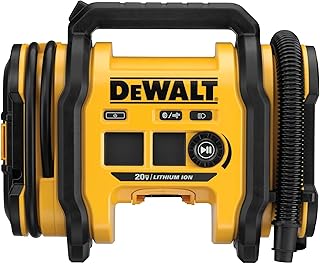
Not a tool-driving compressor, but a genuinely useful companion: cordless, automatic shut-off at your target pressure, and an LED for dark driveways. It handles tires, wheelbarrows, and air mattresses so your shop compressor never leaves the bench.
Frequently Asked Questions
Will a 6-gallon pancake run a sander or spray gun?
Not sustainably. Sanders and HVLP guns typically want 6 to 12 SCFM continuously, well beyond a pancake’s pump. For sanding and finishing, look at a 20-gallon-plus unit or switch to electric tools.
How much hose can I use?
A 50-foot 1/4-inch line is fine for nailers. Beyond that, step up to 3/8-inch to limit pressure drop, and keep the coupler style consistent across your setup.
Do I need to drain the tank?
Yes, after every session. Crack the bottom valve until the hissing stops. Trapped condensate is the fastest way to rust a tank from the inside out.
Can I leave a compressor in an unheated garage?
Oil-free pumps tolerate cold better than oil-lubricated ones, though startup amperage rises in freezing temperatures. Drain it fully and avoid running long extension cords, which starve the motor.
Final Thoughts
For most furniture builders, the DEWALT DWFP55126 hits the right balance of airflow, weight, and price. Step up to the Metabo HPT EC914S if framing or multi-gun work is in your future, and grab the SENCO PC1010 when portability and quiet matter more than raw capacity.