Here’s the frustration nobody warns you about: you buy a shiny air impact wrench for stripping down a dresser or breaking loose seized bolts on a mid-century frame, hook it to the pancake compressor you already own, and get three good hammers before the motor kicks on and the trigger goes limp. The wrench isn’t the problem. Impact tools are air-hungry in a way nailers simply aren’t — a nailer sips a small puff per shot, while an impact wrench drinks continuously for as long as you hold the trigger. That gap between tank size and actual airflow is where most workshop disappointment lives.
This guide sorts it out from a bench-level perspective: what CFM figure actually matters, why a 6-gallon tank is a realistic floor for intermittent impact work, and when a quiet oil-free unit makes more sense than raw output for indoor furniture projects. Below are six compressors worth considering in 2026, from job-site pancakes that can genuinely feed a 3/8″ impact in short bursts to whisper-level units for finish work in a shared space, plus one cordless inflator for the odd tire or cushion. Each is reviewed with the honest limits included.
Our top picks


As an Amazon Associate we earn from qualifying purchases at no extra cost to you.
🛒 Best Price Today on Amazon
Prime members get fast, free shipping on everything above, plus member-only deals. New members get a 30-day free trial — cancel anytime.
How to Choose a/an Air Compressor For Impact Tools (2026)
- CFM at 90 PSI is the only spec that counts: Ignore peak PSI marketing and read the SCFM rating at 90 PSI. A 3/8″ impact wrench typically wants 3–4 CFM for continuous use; anything under 2.6 CFM means working in short bursts with recovery pauses.
- Tank size buys you runtime, not power: A larger tank stores more usable air between motor cycles, which smooths out impact work considerably. Six gallons is a sensible minimum; 8 gallons feels noticeably less interrupted.
- Match the tool to the compressor, not the reverse: A compact 1/4″ or 3/8″ impact driver is realistic on a pancake unit. A 1/2″ wrench chasing rusted hardware needs far more air than any portable can sustain.
- Noise matters more than you think in a home shop: Standard pancakes run 78–82 dBA, loud enough to end a Saturday early. Ultra-quiet oil-free models around 56–60 dBA let you work near living spaces without ear protection or complaints.
- Oil-free pumps for convenience, and check the duty cycle: Oil-free units skip maintenance and start reliably in cold garages. Also confirm recovery time — a pump that refills quickly beats a big tank that takes forever to catch up.
The Best Air Compressor For Impact Tools (2026)s Reviewed
Metabo HPT EC914S 6-Gallon Pancake
With 4 CFM of flow and a 200 PSI tank, this is the most impact-capable pancake in the group — the higher storage pressure means more usable air per fill, which translates to longer trigger pulls before the motor catches up. It’s the one I’d reach for when disassembling hardwood furniture with stubborn fasteners.
DEWALT DWFP55126 6-Gallon Pancake
The workshop default for good reason: 165 PSI, 2.6 SCFM at 90 PSI, an oil-free pump that shrugs off neglect, and a high-flow regulator that recovers fast. It handles a compact impact driver in bursts and absolutely dominates brad and finish nailing for furniture builds.
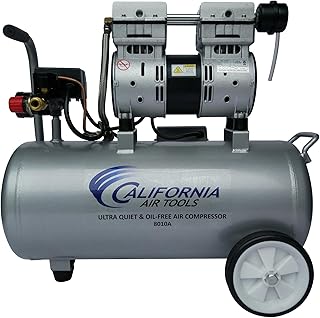
California Air Tools 8010A 8-Gallon Ultra Quiet
At 60 dBA with an 8-gallon aluminum tank on wheels, this is the sweet spot for anyone building furniture in an attached garage or basement. The 1.0 HP oil-free pump is slower to recover than the pancakes, but the larger reserve and low noise make extended sessions genuinely pleasant.
DEWALT DWFP55130 Quiet Trim Compressor
Built around 200 PSI max output with substantially reduced noise, this one targets trim carpenters and cabinet makers. It’s excellent for pin nailers, staplers, and blowing chips off a joint, though it’s too small for sustained impact work.
California Air Tools CAT-1P1060S 1-Gallon
A 56 dBA, one-gallon featherweight you can carry upstairs in one hand — ideal for touch-up nailing, upholstery staples, and dusting off assemblies. Treat it as a finish-work companion rather than an impact tool supply.
Frequently Asked Questions
Can a pancake compressor really run an impact wrench?
In short bursts, yes — a 3/8″ impact on lug-style fasteners will work fine with pauses for recovery. Continuous heavy use needs a stationary compressor with 5+ CFM.
Does higher PSI mean more torque?
Only up to the tool’s rated pressure. Beyond that, extra tank PSI just means more stored air volume, which improves runtime rather than raw hammer force.
Do I need an air dryer or filter?
An inline water separator is worth the small cost. Moisture reaching an impact tool’s motor accelerates internal rust and thins the lubricant.
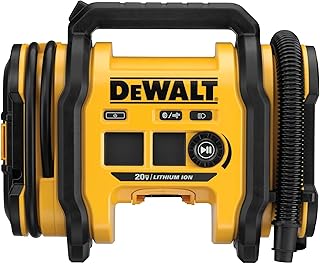
What about the DEWALT 20V tire inflator?
It’s a cordless inflator, not a tool-driving compressor — great for tires, sports gear, and air mattresses, with automatic shutoff and an LED. It won’t power impact tools.
Final Thoughts
For actual impact work, the Metabo HPT EC914S wins on airflow and tank pressure, making it the most capable portable here. If quiet operation in a home workshop matters more, the California Air Tools 8010A delivers a bigger reserve at conversational volume, while the DEWALT DWFP55126 remains the most versatile all-rounder for furniture builders who nail far more often than they hammer bolts.