Anyone who has spent an afternoon under a car on jack stands, or wrestling with rusted lag bolts on a deck frame, knows the moment a breaker bar stops being useful. Your arm gives out before the fastener does. Air-powered impact wrenches solve that by converting compressed air into rapid hammer blows, and unlike cordless models, they never sag halfway through a job because a battery went flat. The catch is that spec sheets have become an arms race. One listing claims 1,500 ft-lbs, the next claims 600, and both cost roughly the same. That number alone tells you almost nothing about whether the tool will still be working in five years.
This guide sorts through six air impact wrenches that show up repeatedly in home shops and small garages, covering what the torque figures actually mean, how much compressor you need behind each one, and where the trade-offs sit between weight, noise, and raw grunt. Whether you are breaking loose suspension bolts, assembling heavy furniture frames with structural hardware, or just want lug nuts off in three seconds instead of three minutes, there is a sensible pick here.
Our top picks



As an Amazon Associate we earn from qualifying purchases at no extra cost to you.
🛒 Best Price Today on Amazon
Prime members get fast, free shipping on everything above, plus member-only deals. New members get a 30-day free trial — cancel anytime.
How to Choose a/an Air Compressor Impact Wrench (2026)
- Nut-busting vs. working torque: Headline numbers are almost always breakaway torque measured in a brief burst. Working torque, the figure you get during sustained tightening, runs far lower. Look for tools that publish both, and treat any single enormous number with suspicion.
- Your compressor’s CFM output: This is the real limiter. Most 1/2″ impacts want 4 to 6 CFM at 90 PSI to run properly. A small pancake compressor will cause the tool to stutter and lose power no matter how impressive its rating. Check your tank’s SCFM before you check anything else.
- Twin hammer mechanism: A twin-hammer design splits the impact load across two hammers, which smooths delivery and reduces wear on the anvil. Single-hammer tools hit harder in short bursts but tend to be rougher on your wrist and shorter-lived under heavy use.
- Weight and body material: Composite housings shave a pound or more off metal bodies, which matters enormously when you are working overhead or holding the tool at arm’s length inside a wheel well. Anything over six pounds gets tiring fast.
- Noise and vibration: Pneumatic impacts are loud. Models in the 85 to 90 dBA range are noticeably more tolerable in a closed garage, and lower vibration means you can work longer without your hands going numb.
The Best Air Compressor Impact Wrench (2026)s Reviewed
Ingersoll Rand 2135QXPA
This is the tool most professional techs reach for, and the reasoning holds up in a home shop too: 1,100 ft-lbs of breakaway torque from a compact, well-balanced body with genuinely refined ergonomics. It costs more than the alternatives, but the internals are serviceable and parts are available, which makes it a buy-once tool rather than a replace-every-two-years one.
AIRCAT 1150
AIRCAT built its reputation on quieting pneumatic tools without gutting their output, and the 1150 delivers 900 ft-lbs at 89 dBA in a composite housing that stays comfortable through long sessions. If you work in an attached garage or share a space, the noise reduction alone justifies the pick.
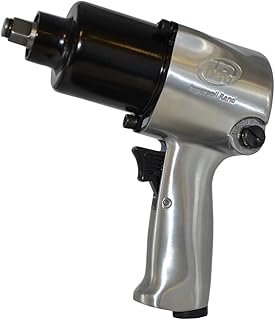
Ingersoll Rand 231C
The 231C has been in production for decades because it simply does not break. Its 600 ft-lbs handles suspension work, lug nuts, and general disassembly without drama, and its modest air consumption means it plays nicely with smaller shop compressors that would choke a higher-output gun.
ACDelco ANI405A Kit
A five-speed regulator on a twin-hammer 500 ft-lb tool gives you finer control than most impacts in this bracket, which is genuinely useful when you are working with softer fasteners or aluminum. Arriving as a kit with sockets and accessories makes it a practical first air impact for a shop that is still building out.
AEROPRO TOOLS 1/2-Inch Twin Hammer
The 1,200 ft-lb claim is optimistic, but strip that away and you still get a lightweight twin-hammer gun that removes seized lug nuts competently for a fraction of the premium brands. Reasonable value as a secondary tool or for occasional weekend use rather than daily duty.
Frequently Asked Questions
What size compressor do I need?
For most 1/2″ impacts, a tank of 20 gallons or more delivering at least 4 to 5 SCFM at 90 PSI keeps the tool running continuously. Smaller compressors work for brief bursts but will need to catch up between fasteners.
Do I need special sockets?
Yes. Impact sockets are made from thicker, more ductile steel designed to absorb hammer blows. Chrome hand sockets can crack or shatter under impact use, which is a real safety hazard at speed.
How often should I oil the tool?
A few drops of air tool oil into the inlet before each use, unless you run an inline lubricator. This single habit does more for tool longevity than anything else.
Is air still better than cordless?
For sustained high-torque work, yes. Air tools are lighter for their output, run indefinitely, and cost less to replace. Cordless wins on portability and convenience for scattered jobs.
Final Thoughts
If you want one tool that will outlast your interest in the hobby, the Ingersoll Rand 2135QXPA is the clear choice. The AIRCAT 1150 is the smarter buy for anyone working in a noise-sensitive space, and the Ingersoll Rand 231C remains the most sensible option for a modest compressor and a reasonable budget.