
Yoga mats die in three well-documented ways. The foam takes a permanent set where your knees and heels land, so the mat develops craters exactly where you need support. The edges curl and then split, usually starting at a corner that got folded once. Or the top surface polishes smooth under your hands and feet, which quietly removes the grip that made it usable in the first place. None of these is sudden, which is why people keep using a dead mat for months.
What resists all three is density. Denser foam recovers its shape, holds its edges and wears more slowly at the surface. Anti-tear construction addresses the second failure mode specifically. Thickness, by contrast, does almost nothing for longevity — a thick soft mat develops dents faster than a thin dense one, because there is more foam to compress and less structure holding it. The options below are ranked by which failure mode they resist and which one will eventually get them.
Our top picks


As an Amazon Associate we earn from qualifying purchases at no extra cost to you.
Quick Comparison
| Product | Best For | Standout Feature | Watch Out For |
|---|---|---|---|
| Fitvids 1/2-Inch Extra Thick Mat | Longest expected service life | High density plus anti-tear construction | Firmer underfoot than plush alternatives |
| CAP Barbell 1/2-Inch High Density Mat | Resisting permanent dents | Dense foam that recovers its shape | Surface still wears at contact points |
| CAP Non-Slip Yoga Mat | Low-frequency practice | Textured surface that grips from day one | Thin foam flattens with heavy use |
| Gaiam Thick NBR Yoga Mat | Moderate regular use | NBR foam with reliable cushioning | NBR compresses over months of kneeling |
| Amazon Basics Extra Thick Exercise Mat | Planned replacement cycles | Priced to swap out without regret | Softer foam dents earliest of the group |
| KEEP Extra Thick NBR Mat, 10mm | Comfort over longevity | Maximum cushioning at 10mm | Most foam to compress, most to lose |
How to Choose
- Density over thickness: Ask how firm the foam is, not how deep. Density is what determines whether the mat recovers after you stand up.
- Edge construction: Anti-tear layers and clean bonded edges are what stop a corner turning into a split. Loose or fraying edges are an early warning.
- Surface type: Printed and coated surfaces wear faster at high-contact points than moulded textures cut into the material itself.
- Never fold it: A crease is a permanent weakness. Every mat here lasts longer rolled, and folding is the single most common cause of early failure.
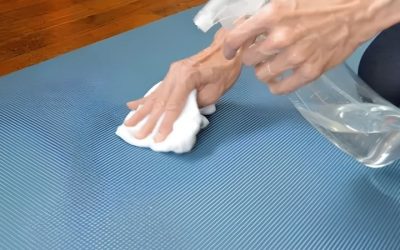
- Clean without solvents: Harsh cleaners break down foam and coatings. Mild soap and water preserve both the surface and the material underneath.
Top Picks Reviewed
Longest Lasting: Fitvids 1/2-Inch Extra Thick Mat
High-density foam and anti-tear construction address the two failure modes that retire most mats. The density means heel and knee craters recover rather than becoming permanent, and the tear resistance means the corners survive hundreds of roll-and-unroll cycles without splitting.
The honest cost is feel. A dense mat is firmer than a plush one at equal thickness, and if you were expecting softness the first session can be disappointing. That firmness is the reason it is still flat a year later.
Best Dent Resistance: CAP Barbell 1/2-Inch High Density Mat
Dents are the failure people notice most, because a mat with craters under the knees is worse than a flat thin mat. Dense half-inch foam resists that specifically, springing back after each session rather than accumulating a permanent record of where you kneel.
Surface wear is the failure it does not prevent. The area under your hands and the balls of your feet will smooth out with use, and once polished it grips less, even though the foam underneath is still sound.
Best for Light Use: CAP Non-Slip Yoga Mat
For a couple of gentle sessions a week, a thin textured mat can last a long time simply because it is not being asked to do much. There is less foam to compress and the moulded texture provides grip that does not depend on a coating.
Under heavy or daily use, thin foam flattens comparatively fast, and once it does there is nothing left to compress. It is a mat matched to a light practice rather than a durable mat in absolute terms.
Best Planned Replacement: Amazon Basics Extra Thick Exercise Mat
There is a legitimate strategy in buying inexpensively and replacing on a schedule. You always practise on foam that has not yet flattened, and the total cost over several years is competitive with one premium mat.
Softer foam does take a set earliest, so expect visible dents within months of frequent use rather than years. Rotating the mat end to end spreads the wear and buys some extra time.
Frequently Asked Questions
How long should a yoga mat last?
With two or three sessions a week, roughly one to three years depending on density and how you store it. Daily practice on a soft mat can flatten it within a year.
What are the signs a mat needs replacing?
Permanent dents under knees or heels, edges that curl and will not lie flat, splits at the corners, and a surface that has gone slick where your hands land.
Does cleaning shorten a mat’s life?
Cleaning correctly extends it. Sweat residue degrades surfaces over time. What shortens life is harsh chemicals, machine washing, and drying in direct sunlight.
Can a dented mat be revived?
Generally no. Compression set is permanent in most foams. Rotating the mat so you kneel on a fresh area buys time, but the dents will not come back out.
Final Thoughts
Longevity is bought with density and construction, not with thickness. The Fitvids high-density anti-tear mat is the strongest bet for a long life, the CAP Barbell half-inch mat resists the dents that ruin most mats, and buying an inexpensive Amazon Basics mat on a replacement cycle is a defensible alternative. Roll it rather than folding it, clean it with mild soap, and keep it out of direct sun — those three habits add more life than any upgrade.
Write Your Review
No reviews yet. Be the first to share your experience!