Shopping for a table saw is one of those purchases where the sticker price tells you almost nothing. Two saws can both claim 15 amps and a 10-inch blade, yet one holds a dead-square fence through a hundred rips while the other drifts a sixteenth of an inch the moment you lean on it. That gap between advertised specs and real bench performance is where most first-time buyers lose money, usually by paying twice: once for the bargain saw, then again for the one they should have bought.
This guide sorts the current crop by what actually matters when you’re breaking down plywood for a bookcase or trimming tenon shoulders on a dining chair. We look at fence quality, motor behavior under load, portability, and whether the included stand is a genuine feature or a folding afterthought. Whether you need a compact jobsite saw for a one-car garage shop or a cabinet saw you’ll hand down to somebody, there’s a sensible pick here.
Our top picks



As an Amazon Associate we earn from qualifying purchases at no extra cost to you.
🛒 Best Price Today on Amazon
Prime members get fast, free shipping on everything above, plus member-only deals. New members get a 30-day free trial — cancel anytime.
How to Choose a Deal On A Table Saw (2026)
- Fence accuracy: This is the single component that decides your joinery. A rack-and-pinion fence that locks parallel every time beats a bigger motor with a sloppy fence, no contest. Check the fence against your miter slot before the first cut and again after a month of use.
- Rip capacity: Measure the widest panel you realistically cut. Roughly 24 to 25 inches of rip handles most cabinet and furniture work by letting you split a 48-inch sheet on center. Anything under 18 inches means committing to a track saw for sheet goods.
- Motor type and power delivery: Universal motors in portable saws spin fast and start hard but bog in thick hardwood. An induction motor runs quieter, cooler, and pulls through 8/4 maple without complaint, though it needs a permanent home and often 230V.
- Dust collection and blade guard design: Look for a shrouded lower blade housing with a 2-1/2 inch port, plus a riving knife that tilts and rises with the blade. Guards that require tools to remove get left in a drawer, which defeats their purpose entirely.
- Stand and footprint: Rolling stands with pneumatic tires earn their keep if you work in a shared garage. Benchtop saws save money but need a solid, level surface at the right height, and clamping one to a wobbly workbench cancels out its precision.
The Best Deal On A Table Saw (2026)s Reviewed
DEWALT DWE7485 8-1/4 in. Compact Jobsite Saw
The 8-1/4 inch blade sounds like a compromise until you notice the 24-1/2 inch rip capacity and the rack-and-pinion fence, which is the smoothest in this size class and stays square through repeated adjustments. It’s the saw I recommend to anyone building furniture in a tight garage who still needs to break down full sheets.
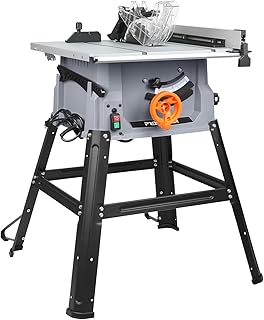
SKIL TS6307-00 15 Amp 10 Inch Jobsite Saw
SKIL’s integrated folding stand deploys in seconds and locks with reassuring solidity, and the worm-drive-style power delivery keeps the blade moving through wet framing lumber. The onboard dust port actually captures a useful share of the chips, which is rarer at this price than it should be.
JET JTAS-10XL50-1DX Deluxe XACTA 10-Inch
This is the buy-it-once machine: a 3 HP induction motor, cast-iron top, and 50 inches of rip capacity that swallows a full sheet without breaking a sweat. It demands 230V service and real floor space, but the cuts come off glass-smooth and the XACTA fence holds thousandths, not sixteenths.
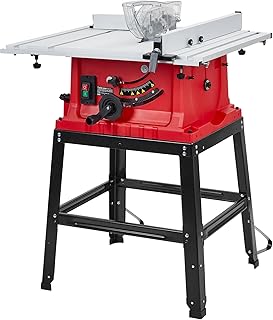
Prostormer 10 Inch Table Saw with Stand
A sensible entry point for weekend deck repairs and trim work, with 5000 RPM at the arbor and a serviceable 45-degree bevel. Plan on upgrading the stock blade to a 40-tooth combination blade right away, and the cut quality improves dramatically for about thirty dollars.
MXBAOHENG Mini Table Saw S3
Seven-speed variable power and a 1/2 inch depth of cut make this the right tool for scale models, inlay banding, and small box parts where a full-size saw would be dangerous overkill. Treat it as a precision hobby instrument rather than a shrunken contractor saw and it performs beautifully.
Frequently Asked Questions
Is an 8-1/4 inch blade too small for furniture work?
Not for most projects. You get roughly 2-1/2 inches of cut depth at 90 degrees, which handles 4/4 and 6/4 stock easily. You’ll only feel the limit when resawing thick slabs or cutting deep tenons in 8/4 material.
Do I need 230V power for a cabinet saw?
For 3 HP machines, yes. Running one on a standard 120V circuit isn’t an option, so budget for an electrician if your shop lacks a 230V outlet. It’s typically a few hundred dollars and worth confirming before you order.
What’s the difference between a splitter and a riving knife?
A splitter is fixed to the table and stays put as the blade moves. A riving knife mounts to the arbor assembly and rises, falls, and tilts with the blade, so it stays right behind the kerf and prevents kickback far more reliably.
Should I replace the included blade?
Almost always. Factory blades are usually 24-tooth rippers meant to prove the saw runs. A quality 40- or 50-tooth combination blade transforms cut quality on any saw in this roundup, including the premium ones.
Final Thoughts
For most home woodworkers, the DEWALT DWE7485 delivers the best balance of fence precision, rip capacity, and shop footprint, and it’s the pick I’d hand a friend starting their first furniture build. The SKIL TS6307-00 is the smarter buy if you need a full 10-inch blade and a stand that travels, while the JET XACTA is the one to save for if you’ve got the space, the 230V circuit, and no interest in ever upgrading again.