Shopping for a table saw usually means wading through spec sheets that all blur together: everyone claims 15 amps, everyone claims 10 inches, everyone claims “jobsite tough.” What actually separates a saw you’ll keep for fifteen years from one you’ll resent by the third project is the stuff nobody puts on the box — how square the fence stays after you slam it into position, whether the miter slot is a real T-slot or a stamped groove, and how much flex you feel in the tabletop when you lean a sheet of plywood on it.
This guide is written from the sawdust side of the bench. I’ve broken down the saws worth watching in 2026, from the rack-and-pinion workhorses that furniture builders reach for to the budget-friendly units that make sense if you’re cutting a few shelves a year. Below you’ll find current deals, a straightforward buying checklist, hands-on notes on the top five, and answers to the questions that come up most often in the shop.
Our top picks



As an Amazon Associate we earn from qualifying purchases at no extra cost to you.
🛒 Best Price Today on Amazon
Prime members get fast, free shipping on everything above, plus member-only deals. New members get a 30-day free trial — cancel anytime.
How to Choose a Table Saw Deals (2026)
- Fence quality above all: A rack-and-pinion fence moves both ends of the guide simultaneously, so it lands parallel to the blade every time. Single-lock fences drift, and a fence that’s out by a hair gives you burn marks, kickback risk, and joints that won’t close. If you’re building furniture, prioritize this over horsepower.
- Rip capacity you’ll actually use: Anything at or above 30 inches lets you split a 4×8 sheet down the middle in one pass. Under 25 inches, you’ll be breaking sheets down with a track saw or circular saw first — which is fine, just plan for it.
- Blade size versus cut depth: A 10-inch blade gives you roughly 3-1/8 inches at 90 degrees, enough for 4×4 stock in one pass. An 8-1/4-inch saw tops out closer to 2-1/2 inches, which handles 2x material comfortably but means two passes on thicker stock.
- Stand design matters more than you think: Rolling stands with pneumatic-style lift let one person set up in seconds. Scissor stands are lighter and cheaper but require lifting the saw’s full weight. If you’re moving between a garage and a driveway, the rolling option pays for itself in your lower back.
- Dust management and accessories: Look for a shroud around the blade feeding a 2-1/2-inch port, plus a riving knife rather than just a splitter. Also check whether the arbor accepts a dado stack — some compact saws don’t, which rules out a whole category of joinery.
The Best Table Saw Deals (2026)s Reviewed
DEWALT DWE7491RS 10-Inch with Rolling Stand
This is the saw I recommend without hesitation to anyone building casework or furniture — the rack-and-pinion fence holds parallel through hundreds of adjustments, and 32-1/2 inches of rip capacity handles full sheet goods solo. The rolling stand deploys in about five seconds, and at 4800 RPM with a proper 40-tooth blade it leaves edges clean enough to glue straight off the saw.
SKIL TS6307-00 15 Amp Portable Jobsite Saw
SKIL undercuts the DEWALT significantly while keeping a rack-and-pinion fence, which is genuinely rare at this price. The folding stand is less refined and you’ll want to check blade-to-slot alignment out of the box, but for a hobbyist shop it delivers accuracy well beyond what the sticker suggests.
DEWALT DWE7485 8-1/4 in. Compact
The compact DEWALT trades cut depth for a 54-pound package you can carry up stairs with one hand. It’s my pick for anyone working in a shared garage or small basement — the fence system is inherited from its bigger sibling, so accuracy holds up even though max depth sits around 2-1/2 inches.
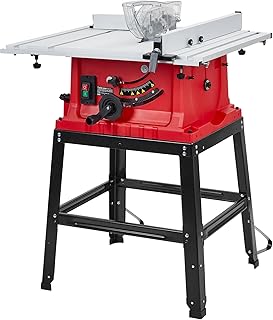
DOVAMAN DTS10A 10″ Table Saw with Stand
The DOVAMAN brings a copper-wound motor and a single-side extension table into entry-level territory, with 3.35 inches of depth at 90 degrees. Expect to spend an hour tuning the fence and checking the blade for square before your first real cut, but once dialed in it’s a capable saw for shelving, trim, and shop fixtures.
10-Inch 5000 RPM Saw with 36 x 25 Inch Tabletop
That oversized 36-by-25-inch table is the standout feature here, giving you meaningful support for wider workpieces without adding outfeed rollers. Bevel and depth adjustments are functional rather than precise, so treat it as a rough-cut and general-purpose saw rather than a fine joinery machine.
Frequently Asked Questions
Do I need a cabinet saw for furniture building?
No. A well-tuned jobsite saw with a rack-and-pinion fence will produce furniture-grade cuts — the limitation is duty cycle and sheet-goods handling, not accuracy. Most home shops are better served by a quality portable saw plus a good crosscut sled than by a cabinet saw that eats half the floor.
What blade should I put on it first?
Swap the stock blade for a 40- to 50-tooth thin-kerf combination blade. Thin-kerf reduces load on a 15-amp motor, and the tooth count splits the difference between clean crosscuts and efficient rips. Keep the stock blade for construction lumber and anything with hidden fasteners.
How much rip capacity do I really need?
If you regularly work with plywood, 30 inches or more lets you center-cut a full sheet. If your projects are mostly solid wood under 12 inches wide, a compact saw is plenty and easier to store.
Can these saws cut plastic and non-ferrous metal?
Acrylic and PVC cut well with a high-tooth-count blade and a slow, steady feed. Aluminum is possible with a dedicated non-ferrous blade, but always verify the manufacturer permits it, use minimal depth, and wear full face protection — chips come off fast and hot.
Final Thoughts
If you’re building furniture and want one saw to keep for the long haul, the DEWALT DWE7491RS is the clear choice — the fence alone justifies the spend. The SKIL TS6307-00 is the smart-money alternative for hobbyists who want rack-and-pinion precision at a lower entry point, while the compact DEWALT DWE7485 makes the most sense in tight shops where every square foot counts.