Our Short List of 3

- Best for: Small-block Chevrolet builders who degree every cam on a stand and want the finest possible readings.
- Model: 4938
- Degree wheel: 16 in Pro wheel
- Fitment: Chevrolet small block, 4.3L 90-degree V6, GM 4-cylinder
- Contents: 16 in wheel, checking fixture, dial indicator with extension, threaded and plate-style piston stops, wire pointer, crank socket, booklet

- Best for: LS builders degreeing Gen III or Gen IV engines on a stand with the heads off.
- Model: 4942
- Degree wheel: 9 in
- Fitment: Chevrolet Gen III and Gen IV LS engines, heads off
- Contents: 9 in wheel, LS crank socket, checking fixture, dial indicator, piston stop, instructions, case
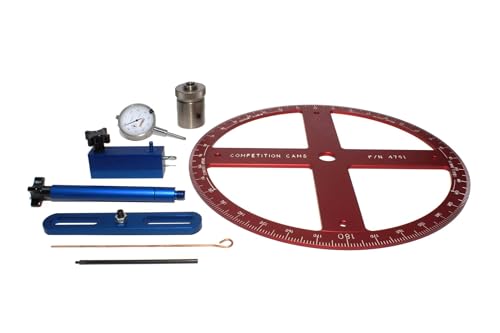
- Best for: Ford, Buick, and Pontiac V8 builders who want the professional-kit layout and a 16-inch wheel.
- Model: 4940
- Degree wheel: 16 in Pro wheel
- Fitment: Ford, Buick, and Pontiac V8 engines, heads off
- Contents: 16 in wheel, fixture, dial indicator with extension, TDC stop, pointer, crank socket
All 5 Picks at a Glance
| Product | Specs | Action |
|---|---|---|
| COMP Cams Professional Camshaft Degree Kit 4938 |
| Check price on Amazon |
| COMP Cams Heads-Off Camshaft Degree Kit for LS Engines 4942 |
| Check price on Amazon |
| COMP Cams Professional Camshaft Degree Kit 4940 |
| Check price on Amazon |
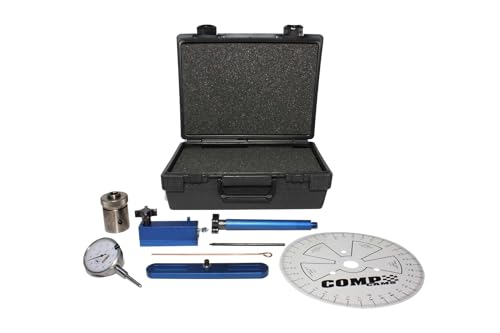 COMP Cams Heads-Off Camshaft Degree Kit 4936 |
| Check price on Amazon |
 JEGS Precision Cam Degree Wheel 555-81622 |
| Check price on Amazon |
Key takeaways
- Compare cam degree wheels and complete degreeing kits with dial indicators and piston stops to verify valve timing against the cam card spec.
The real decision here is not which wheel looks best on the bench, but how your engine will sit while you work. A fresh build on a stand, heads off, calls for a complete kit with a crank socket, a plate piston stop, and a dial indicator setup. An engine already assembled, or one still in the car, needs a different layout, and buying the wrong format wastes money on parts you cannot use.
This guide is for home builders degreeing a cam during assembly, engine swappers checking a used timing set, and anyone correcting a cam that reads off its card. Every product below was picked from its Amazon listing title and published kit contents: wheel diameter, engine family, socket type, and included tools, so the lineup covers Chevrolet small block, LS, and Ford, Buick, and Pontiac engines, plus one universal wheel.
Quick Picks
As an Amazon Associate we earn from qualifying purchases.
| Product | Best for | Key spec from title |
|---|---|---|
| COMP Cams Professional Camshaft Degree Kit 4938 | Small-block Chevrolet build on a stand needing the finest readings | 16 in Pro degree wheel |
| COMP Cams Heads-Off Camshaft Degree Kit for LS Engines 4942 | LS engine on a stand, heads off | 9 in wheel with LS crank socket |
| COMP Cams Professional Camshaft Degree Kit 4940 | Ford, Buick, or Pontiac V8 build on a stand | 16 in Pro degree wheel |
| COMP Cams Heads-Off Camshaft Degree Kit 4936 | Ford, Buick, or Pontiac engine where a 16 in wheel will not fit | Crank socket and full tool set included |
| JEGS Precision Cam Degree Wheel 555-81622 | Builder who already owns a dial indicator and piston stop | 11 in alloy steel wheel, 1-degree increments |
How to Choose
Wheel diameter decides how finely you can read
Every wheel carries the same 360 degrees, so diameter changes only how much rim each degree gets. On a 9-inch wheel one degree spans about 0.157 inch of rim, on an 11-inch wheel about 0.192 inch, and on a 16-inch wheel about 0.279 inch. Wider spacing makes half-degree calls honest instead of guessed, which matters when a cam card tolerance is tight. The trade is clearance: a 16-inch wheel is easy on a stand and hopeless in most engine bays, while a 9-inch wheel fits tight quarters. Bold graduations matter too, since they must stay readable under shop light.
A complete kit versus a wheel on its own
A degree wheel alone cannot produce a single usable number. The job also needs a positive piston stop to find true top dead center, a rigid pointer, and a dial indicator riding on the lifter to read events at the checking lift on the cam card. If you own none of that, a complete kit bundles everything in one box, matched to your engine family. If your toolbox already holds an indicator, a magnetic base, and a stop, a stand-alone wheel fills the one gap that cannot be improvised, and the money saved can go toward an adjustable timing set.
The center hole and crank socket decide fit
A wheel that wobbles on the crank snout ruins every reading, so mounting matters as much as the printed numbers. Stand-alone wheels use a center hole with adapter bushings sized to common crank bolts, which covers most engines once the damper is removed. Engine-specific kits instead include a turning socket machined for that family’s snout and keyway, and Chevrolet, Ford, Chrysler, and LS engines all differ here. The LS socket also engages the oil pump drive. The socket holds the wheel dead true and gives you a handle point for turning the crank smoothly by hand.
Heads off on a stand is a different job from heads on
Every kit in this guide is a heads-off layout meant for an engine on a stand, where a plate stop bolts across the open bore and there is room to swing a big wheel and clamp a fixture to the deck. Heads-on work follows the same math but uses a stop that threads into the spark plug hole, light checking springs on the test cylinder, and usually a smaller wheel that clears the engine bay. Decide which situation describes your build before ordering, because a heads-off kit bought for an assembled engine leaves its best parts unusable.
The 5 Best Options
COMP Cams Professional Camshaft Degree Kit 4938
- Best for: Small-block Chevrolet builders who degree every cam on a stand and want the finest possible readings.
- Model: 4938
- Degree wheel: 16 in Pro wheel
- Fitment: Chevrolet small block, 4.3L 90-degree V6, GM 4-cylinder
- Contents: 16 in wheel, checking fixture, dial indicator with extension, threaded and plate-style piston stops, wire pointer, crank socket, booklet
Small-block Chevrolet builders who degree every cam on a stand and want the finest possible readings.
COMP kits have shown BackOrder status on the maker’s own store, so confirm the Amazon listing is actually selling before you plan a build weekend around it.
This is the full stand kit for the small-block Chevrolet family, built around the 16-inch Pro degree wheel. That diameter is the point: the wide spacing between degree marks lets you call opening and closing points to a fraction of a degree without squinting. The box adds a checking fixture, a dial indicator with extension, threaded and plate-style piston stops, a wire pointer, and the small-block crankshaft socket. It also covers the 4.3-liter 90-degree V6 and GM four-cylinder engines, so one kit serves most classic Chevrolet builds on a stand.
Watch out for: COMP kits have shown BackOrder status on the maker’s own store, so confirm the Amazon listing is actually selling before you plan a build weekend around it.
COMP Cams Heads-Off Camshaft Degree Kit for LS Engines 4942
- Best for: LS builders degreeing Gen III or Gen IV engines on a stand with the heads off.
- Model: 4942
- Degree wheel: 9 in
- Fitment: Chevrolet Gen III and Gen IV LS engines, heads off
- Contents: 9 in wheel, LS crank socket, checking fixture, dial indicator, piston stop, instructions, case
LS builders degreeing Gen III or Gen IV engines on a stand with the heads off.
It is a heads-off kit only, so it does not suit an assembled engine; also confirm live selling status on Amazon, since COMP kits have shown BackOrder status on the maker’s store.
LS engines degree differently at the front of the crank, and this kit is built around that fact. Its crankshaft socket is machined for the Gen III and Gen IV LS snout and oil pump drive, so the wheel mounts concentrically and the crank turns smoothly by hand. Aluminum adapters seat the dial indicator squarely on the lifter. The wheel is the 9-inch unit shared with COMP’s other heads-off kits. If your stand time is mostly LS work, an engine-specific socket beats raw wheel diameter, because a wheel that runs true beats a bigger wheel that runs out.
Watch out for: It is a heads-off kit only, so it does not suit an assembled engine; also confirm live selling status on Amazon, since COMP kits have shown BackOrder status on the maker’s store.
COMP Cams Professional Camshaft Degree Kit 4940
- Best for: Ford, Buick, and Pontiac V8 builders who want the professional-kit layout and a 16-inch wheel.
- Model: 4940
- Degree wheel: 16 in Pro wheel
- Fitment: Ford, Buick, and Pontiac V8 engines, heads off
- Contents: 16 in wheel, fixture, dial indicator with extension, TDC stop, pointer, crank socket
Ford, Buick, and Pontiac V8 builders who want the professional-kit layout and a 16-inch wheel.
The 16-inch wheel needs stand room and will not suit in-car work; check the Amazon listing is live, as COMP kits have appeared as BackOrder on the maker’s store.
This kit brings the same professional layout as the small-block kit above to Ford, Buick, and Pontiac V8 engines: the 16-inch Pro wheel, degreeing fixture, dial indicator and extension, TDC stop, wire pointer, and a crank socket machined for those families. On the stand, the big wheel earns its keep during centerline work, because the opening and closing readings at 0.050 inch tappet lift sit far apart on the rim and the average lands with less rounding error. Choose it when those three engine families fill your stand and reading precision matters most.
Watch out for: The 16-inch wheel needs stand room and will not suit in-car work; check the Amazon listing is live, as COMP kits have appeared as BackOrder on the maker’s store.
COMP Cams Heads-Off Camshaft Degree Kit 4936
- Best for: Ford, Buick, and Pontiac builders who want a complete kit in a smaller footprint than the professional version.
- Model: 4936
- Degree wheel: Diameter not published in kit literature
- Fitment: Ford, Buick, and Pontiac engines, heads off
- Contents: Crank socket, degree wheel, checking fixture, dial indicator, piston stop, instructions
Ford, Buick, and Pontiac builders who want a complete kit in a smaller footprint than the professional version.
The wheel diameter is not published in the kit literature, so do not assume 16-inch spacing; confirm Amazon selling status before ordering, given BackOrder notes on the maker’s store.
This is the standard heads-off kit for Ford, Buick, and Pontiac engines, and the sensible choice when the professional kit’s 16-inch wheel will not fit your stand or your storage shelf. It contains the same working set: crank socket, degree wheel, checking fixture, dial indicator, piston stop, and instructions, in a smaller footprint. The method does not change: find true top dead center with the positive stop, zero the wheel, then read events at the checking lift from the card. What you give up is rim spacing per degree, not completeness.
Watch out for: The wheel diameter is not published in the kit literature, so do not assume 16-inch spacing; confirm Amazon selling status before ordering, given BackOrder notes on the maker’s store.
JEGS Precision Cam Degree Wheel 555-81622
- Best for: Builders who already own the measuring tools and work across several engine families.
- Model: 555-81622
- Degree wheel: 11 in, alloy steel
- Center hole: 3/4 in
- Bushings: 3 inserts for 7/16, 1/2, 5/8, and 3/4 in crank bolts, plus steel washer
Builders who already own the measuring tools and work across several engine families.
It is the wheel only, with no crank socket, pointer, stop, or indicator in the box, so confirm your crank bolt size matches one of the three bushing inserts before ordering.
Not every garage needs a full kit. If you already own a dial indicator, a magnetic base, and a piston stop, this wheel supplies the one part that cannot be improvised: an accurate degree wheel. It is an 11-inch alloy steel wheel made in the USA, sitting between the cramped 9-inch kit wheels and the stand-only 16-inch plates, and it reads in 1-degree increments. The center hole is 3/4 inch, and three bushing inserts adapt it to 7/16, 1/2, 5/8, and 3/4-inch crankshaft bolts, with a steel washer in the box.
Watch out for: It is the wheel only, with no crank socket, pointer, stop, or indicator in the box, so confirm your crank bolt size matches one of the three bushing inserts before ordering.
Which One Fits Your Situation
Your small-block Chevrolet is on a stand, heads off
Pick the COMP Cams 4938 Professional Kit. Its socket is machined for the small-block snout, its plate stop bolts across the open bore, and the 16-inch wheel gives the widest degree spacing in this guide. The same box also covers the 4.3-liter V6 and GM four-cylinder engines, so it stays useful beyond one build.
You are degreeing an LS engine during assembly
Choose the COMP Cams 4942. The deciding part is its crank socket, machined for the Gen III and Gen IV LS snout and oil pump drive, so the wheel runs true while you turn the crank by hand. The 9-inch wheel reads less finely than a 16-inch plate, but a concentric mount matters more than rim spacing on this engine family.
Your Ford, Buick, or Pontiac V8 needs verifying
Both COMP kits for these families carry the right socket, so wheel size settles it. Take the 4940 Professional Kit if your stand has room for the 16-inch wheel and you want the easiest centerline averages. Take the 4936 if space is tight; the tools and method are the same, only the rim spacing per degree shrinks.
You already own an indicator, base, and stop
Buy the JEGS 555-81622 wheel and nothing else. Its bushed 3/4-inch center hole adapts to 7/16, 1/2, 5/8, and 3/4-inch crank bolts, so it moves between engine families without a dedicated socket. At 11 inches it reads more finely than the 9-inch kit wheels, and alloy steel shrugs off shop knocks that would bend a thin plate.
Common Mistakes
- Trusting the damper mark as top dead center instead of finding true top dead center with a positive piston stop and splitting the two readings.
- Reading valve events at the wrong tappet lift instead of the checking lift printed on the cam card, usually 0.050 inch.
- Turning the crank backward to reach a reading, which moves chain slack to the other side and shifts the result.
- Using a loose wire pointer that creeps between readings, quietly invalidating every number taken after it moved.
- Ordering a kit by wheel diameter alone without confirming the crank socket matches your engine family.
Frequently Asked Questions
Do I need to degree a stock replacement cam?
Checking is worthwhile even on a like-for-like rebuild, because timing sets and factory keyways carry tolerances that stack up. Verifying the intake centerline on the stand confirms the whole stack at once. If the readings match the card, the timing is proven; if they are off, you found the error while correcting it was still cheap and easy.
What is the intake centerline method?
Record the wheel reading at 0.050 inch tappet lift on the opening side of the intake lobe and again at 0.050 inch on the closing side, add the two numbers, and divide by two. The result is the crankshaft position of maximum intake lift, which you compare directly with the figure printed on the cam card.
Why not use the damper mark for top dead center?
Everything is measured from that zero, so it has to be exact. Damper rings slip on their hubs, stamped marks carry tolerance, and the piston dwells near the top of the bore, making the highest point vague. A positive stop gives two hard contact readings, and true top dead center sits exactly halfway between them.
My readings are off by four degrees. What now?
A consistent error in one direction means the cam sits advanced or retarded by that amount. Corrections come from offset crank keyways, multi-keyway crank gears, offset cam bushings, or an adjustable timing set. Make the correction, then degree the engine again, because the fix only counts once the wheel and indicator confirm the new readings.
More from Amazon
Programs that pair well with the guide above. Offers and eligibility are set by Amazon and may change.
A free business account with business pricing and bulk-buying tools for work, shop or home office.
Create a business accountFree shipping on eligible items, Prime Video and more. Eligible new members can start with a free trial.
Start a Prime free trialAudiobooks and podcasts to listen to on the go. Eligible new members can start with a free trial.
Try Audible freeAd-free music streaming. Eligible new subscribers can start with a free trial.
Try Music Unlimited freeAs an Amazon Associate we earn from qualifying purchases.