Key takeaways
- Compare the best desk calculators for a home office, from a compact Casio to printing models by Sharp, Victor and Canon with big keys and clear displays.
A phone can do arithmetic, yet a dedicated desk calculator still earns its place in a home office. It never locks its screen mid-sum, never gets buried under notifications, and its wide keys and tall digits help you key in long columns of figures with fewer slips. For anyone who totals invoices, checks expense claims, splits household bills or keeps a small set of books, that focus is the whole point.
The five models below cover the two families worth considering. Two are simple display-only machines for quick sums at a tidy desk. Three are printing models that lay down a paper tape, which is handy when a client, a tax folder or your own records need a trail you can file. Every pick comes from a maker with a long track record in office machines, and each one suits a slightly different way of working.
Disclosure: As an Amazon Associate, we earn from qualifying purchases made through links on this page, at no extra cost to you.
How to Choose a Desk Calculator
Count the digits first. An 8-digit display handles everyday household sums with room to spare, but invoices, payroll figures and yearly totals quickly run past eight digits. A 12-digit display is the safer default for business math, since it shows larger totals in full instead of cutting them off.
Look at the display, not just its size. Tall digits reduce misreads. A fixed raised angle or a tilted panel keeps the readout clear under desk lamps, and a backlit or fluorescent panel stays legible in dim rooms. If you wear reading glasses for screen work, pick the largest digit height your desk space allows.
Think about the keys. Most desktop models use soft membrane keys. They are quiet and fine for short sums. Mechanical switch keys give a firmer, more defined press, which many fast typists prefer during long data entry sessions because each press registers with clear feedback. Wide spacing between keys also matters if you type by touch.
Match the power source to the desk. Solar models with a backup cell run for years with no upkeep, as long as the desk gets decent light. Battery models are simple but need a spare cell now and then. Printing models usually plug into the wall, sometimes with a battery option for short moves around the room.
Decide whether you need a paper tape. A printing calculator records each entry and total on a roll, so you can check a column of figures line by line, attach the tape to a receipt bundle, or hand a copy to someone else. The trade-offs are size, noise and a steady supply of paper rolls and ink rollers.
Check the extra keys. Tax keys add or remove a stored tax amount with one press. Cost, sell and margin keys solve markup sums in seconds. A double check function lets you key a sum twice and flags a mismatch. Clock and calendar printing stamps the date on each tape, which helps when tapes go into a file.
The 5 Best Desk Calculators
1. Casio MS-80B
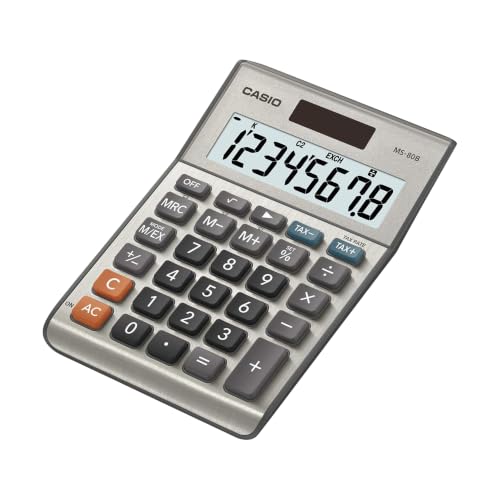
The Casio MS-80B is the compact pick for a desk that only needs honest, quick arithmetic. Its extra large 8-digit readout is easy to scan, and the low body takes up little room beside a keyboard. Dedicated tax keys add or strip a stored tax amount from a total, and a currency conversion function helps when a bill arrives in another currency. Two-way power pairs a solar panel with a backup cell, so the calculator wakes up under normal desk light and keeps working when the light fades. There is no printer and no fuss: you key the sum, read the total, and move on. For household budgets, homework checks and quick invoice totals under eight digits, this is all the calculator most desks need.
Specs
- Display: 8 digits, extra large LCD
- Power source: Solar with battery backup (two-way power)
- Display tilt: Fixed raised angle
- Keys: Standard desktop keys with tax and currency keys
- Printing: No
2. Mr. Pen Mechanical Switch Calculator

Most budget calculators feel soft and vague under the fingers. The Mr. Pen Mechanical Switch Calculator (model CFOD001M430VC) takes the opposite route: each oversized key sits on its own mechanical switch, so every press lands with a firm, clicky confirmation. The 12-digit LCD is large and clear, and the wide key spacing suits touch typing during longer sums. It runs on a single AAA cell, which is easy to keep in a desk drawer, and the flat body comes in several colors if you want desk gear with some personality. Functions stay basic on purpose: add, subtract, multiply, divide, percent and memory. If your sums are long and your typing is fast, the key feel alone makes this one worth a look.
Specs
- Display: 12 digits, large LCD
- Power source: 1 AAA battery (not included)
- Display tilt: Not published
- Keys: Mechanical switch keys, oversized buttons
- Printing: No
3. Sharp EL-1801V Ink Printing Calculator

The Sharp EL-1801V is a long-running office staple built around a bright 12-digit fluorescent display that stays readable across the room. It prints each entry in two colors on a paper tape, with negative figures shown in red, so a long column of debits and credits reads clearly at a glance. Because it runs on AC power, it is always ready for a full day of bookkeeping with no cells to swap. The body is larger than the display-only models here, roughly 7.6 by 10.1 inches, so give it a fixed corner of the desk. If your home office work involves reconciling statements or keeping tapes for a tax file, this is the workhorse pattern that accountants have relied on for years.
Specs
- Display: 12 digits, fluorescent display, extra large readout
- Power source: AC powered
- Display tilt: Fixed upright panel
- Keys: Full-size desktop keys
- Printing: Yes, ink roller, two-color serial printing
4. Victor 1208-2 Compact Printing Calculator

The Victor 1208-2 packs a proper adding machine into a compact body that still fits a small desk. Its big 12-digit LCD pairs with a two-color printer that moves at 2.4 lines per second, fast enough that the tape keeps up with quick entry. Dedicated cost, sell and margin keys solve markup sums without manual formulas, and the machine can print the date and time on the tape for cleaner records. Power is flexible: run it from the included AC adapter at your main desk, or fit four AA cells and carry it to another room. The case uses 20 percent recycled plastic, a small bonus for a tool you will keep for years.
Specs
- Display: 12 digits, large LCD
- Power source: AC adapter (included) or 4 AA batteries
- Display tilt: Fixed display angle
- Keys: Full-size keys with dedicated cost, sell and margin keys
- Printing: Yes, ink roller (IR-40T), two-color, 2.4 lines per second
5. Canon P23-DHV-3 Printing Calculator

The Canon P23-DHV-3 (model 2279C001) adds one feature careful bookkeepers will love: a Double Check function that lets you key the same calculation twice and compares the two entries, flagging a mismatch before it reaches your books. It prints at 2.3 lines per second in two colors, and a built-in clock and calendar can stamp the time and date on each tape. Tax keys and currency conversion cover the sums a small business runs daily. Power comes from four AA cells or the AC adapter, so it works at a fixed desk or on the move between rooms. At about a pound, it is the most portable printing model in this group.
Specs
- Display: 12 digits, LCD
- Power source: 4 AA batteries or AC adapter
- Display tilt: Fixed display angle
- Keys: Full-size keys with tax, currency conversion and Double Check keys
- Printing: Yes, two-color, 2.3 lines per second, with clock and calendar
Comparison Table
| Model | Display | Power | Printing | Best for |
|---|---|---|---|---|
| Casio MS-80B | 8 digits | Solar and battery | No | Compact everyday sums |
| Mr. Pen Mechanical Switch | 12 digits | 1 AAA battery | No | Fast typing, firm key feel |
| Sharp EL-1801V | 12 digits | AC | Yes, ink, two-color | Full-day bookkeeping |
| Victor 1208-2 | 12 digits | AC adapter or 4 AA | Yes, ink, two-color | Markup sums and dated tapes |
| Canon P23-DHV-3 | 12 digits | 4 AA or AC adapter | Yes, two-color | Double-checked records |
Frequently Asked Questions
Is an 8-digit calculator enough for a home office?
For household budgets, bill splitting and homework, yes. The limit appears with large totals: a figure past 99,999,999 cannot be shown in full. If you total invoices, payroll or yearly accounts, a 12-digit model such as the Victor 1208-2 gives you headroom you will use.
Why choose a printing calculator over a display-only model?
The paper tape is a written record of every entry. You can recheck a long column without keying it again, spot the line where a sum went wrong, and file the tape with receipts or hand it to a client. Display-only models are smaller, quieter and cheaper to run, but the record vanishes when you clear the screen.
What paper and ink do printing calculators use?
Most desktop models here use standard 2-1/4 inch adding machine rolls. Ink models use a replaceable ink roller, such as the IR-40T in the Victor 1208-2, rather than a ribbon. A roll and a roller each last a long while in home office use, and both are stocked by any office supply shop.
Which power type suits a desk that sits away from windows?
Solar cells need reasonable light, so a dim corner desk is better served by battery or AC power. The Sharp EL-1801V runs on AC only, while the Victor 1208-2 and Canon P23-DHV-3 accept batteries as well, which also helps during a power cut.
Can a desk calculator handle tax and markup sums?
Yes, if it carries the right keys. Tax keys on the Casio MS-80B and Canon P23-DHV-3 add or remove a stored tax amount in one press. The Victor 1208-2 adds cost, sell and margin keys: enter any two of the three values and the third appears at once.
Conclusion
Pick by the work, not by the spec sheet. The Casio MS-80B covers a tidy desk that needs quick, simple sums. The Mr. Pen model suits fast typists who want keys with real feedback. Once your work needs a paper trail, the three printing models split by habit: the Sharp EL-1801V for all-day AC-powered bookkeeping, the Victor 1208-2 for markup keys and flexible power, and the Canon P23-DHV-3 when a double check on every sum is worth more than raw speed. Any of the five will outlast the phone app it replaces on your desk.
More from Amazon
Programs that pair well with the guide above. Offers and eligibility are set by Amazon and may change.
A free business account with business pricing and bulk-buying tools for work, shop or home office.
Create a business accountFree shipping on eligible items, Prime Video and more. Eligible new members can start with a free trial.
Start a Prime free trialAudiobooks and podcasts to listen to on the go. Eligible new members can start with a free trial.
Try Audible freeAd-free music streaming. Eligible new subscribers can start with a free trial.
Try Music Unlimited freeAs an Amazon Associate we earn from qualifying purchases.