Key takeaways
- Pro: Heavy-duty frame rated for full-size machines without noticeable flex.
- Pro: Integrated drawer and power hub reduce the need for separate accessories.
- Con: Drawer depth is shallow, limiting it to small tools and calipers rather than full filament boxes.
Running a 3D printer on a wobbly folding table is a recipe for failed prints. Every acceleration, every belt tension change, every layer shift traces back to a surface that flexes or slides. The right desk stops that chain at the source, and it also has to handle the clutter problem: filament spools, tools, spare nozzles, and slicer-cable tangles that turn a hobby corner into a junk pile within weeks.
We compared published load ratings, tier dimensions, storage configurations, and aggregated owner feedback across eight stands to identify which desks actually hold steady under print-bed vibration and which ones merely look sturdy on a spec sheet. The differences are real—some units list weight capacities that owners confirm, while others sag noticeably after a few months of daily use. This roundup separates the two.
Our top picks




As an Amazon Associate we earn from qualifying purchases at no extra cost to you.
Quick Picks
| Product | Best for | Price |
|---|---|---|
| Anrigeail | All-in-one workshop setup | $119.99 |
| ENOXEN 36″ 3-Tier Metal | Larger print beds | $109.98 |
| Dual-Zoned Table | AMS and multi-color printing | $104.99 |
| METYERRY 23.6″ Cart | Compact home offices | $125.39 |
| AHOWPD | Filament spool organization | $109.89 |
| ENOXEN Fabric-Drawer 3-Tier | Budget-conscious buyers | $89.99 |
| Heavy Duty Spool Rack Stand | Spool rack integration | $109.99 |
| ENOXEN Brown 3-Tier | Warm studio aesthetics | $109.98 |
How We Picked
We scored each unit on four criteria that matter most for 3D printing desks: structural stability under vibration (rated by published weight capacity and owner-reported wobble), filament and accessory storage depth, build quality at the listed price, and ease of assembly. A stand that meets one criterion but fails another—like a spacious top shelf with no drawer for tools—got flagged rather than dismissed outright.
The 8 Best Desk For 3D Printer in 2026
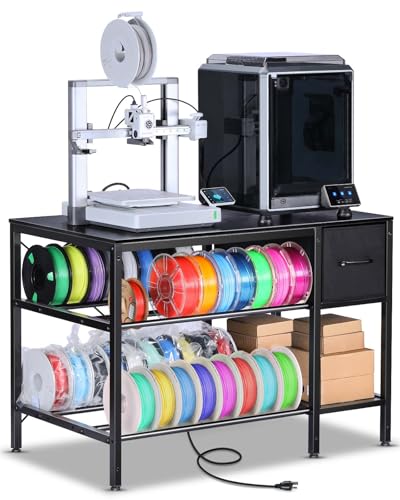
Anrigeail 3D Printer Stand with Filament Storage
This metal table targets makers who want a single purchase covering the printer, filament spools, and power access. The built-in power hub eliminates the surge-strip mess that litters most printer corners.
- Pro: Heavy-duty frame rated for full-size machines without noticeable flex.
- Pro: Integrated drawer and power hub reduce the need for separate accessories.
- Con: Drawer depth is shallow, limiting it to small tools and calipers rather than full filament boxes.
Skip this if you need deep storage for boxed filament or larger accessories beyond the top and middle tiers.
ENOXEN 36-Inch 3-Tier Metal Desk
The 36-inch width gives this stand an edge for anyone running a printer with a large build volume—Bambu Lab X1-Carbon, Elegoo Neptune 4 Plus, or similar footprints fit without overhang. Metal construction keeps the price reasonable despite the size.
- Pro: Widest top surface in this roundup at 36 inches, no compromise on large-bed printers.
- Pro: Metal drawer resists warping under the heat a printer radiates.
- Con: Three-tier metal design makes it heavier to move during reorganization.
Skip this if your room is tight on floor space and you need a sub-30-inch footprint.
Dual-Zoned 3D Printer Table with AMS Storage Panel
Built around the Bambu Lab ecosystem, this table dedicates a vertical storage panel to AMS units and spare spools. The dual-zone layout separates the printing surface from a staging area for finished parts.
- Pro: AMS-specific panel keeps multi-color setups tidy and reachable.
- Pro: Lower price than most competitors despite the specialized storage.
- Con: The panel design assumes AMS-style feeds; single-spool printers waste that shelf real estate.
Skip this if you run a Klipper-based or single-spool machine and would never use the panel.
METYERRY 23.6″ Large Printer Stand with Power Outlet
At 23.6 inches square, this cart suits small printers and tight desks. The built-in power outlet adds convenience without the bulk of a full workshop station. Three tiers of rolling cart design make it mobile.
- Pro: Compact footprint fits beside a laptop desk or in a narrow corner.
- Pro: On-board power outlet removes the extension-cord trip hazard.
- Con: The surface is barely larger than the printer itself, leaving little room for tool staging.
Skip this if you regularly print parts that need post-processing or need space for a slicer laptop alongside the printer.
AHOWPD 3D Printer Table with Filament Storage Rack
This unit leads on filament organization, with a dedicated rack that holds multiple spools in a vertical column. The drawer organizer complements the rack by keeping nozzle sets, scrapers, and adapters in labeled slots.
- Pro: Vertical spool rack lets you swap filament mid-print without bending down.
- Pro: Drawer organizer inserts prevent the small-parts graveyard most stands develop.
- Con: Rack occupies vertical height, so low-ceiling rooms or under-shelf placements lose clearance.
Skip this if your printer sits under a cabinet with limited headroom.
ENOXEN 3-Tier Stand with Fabric Drawers
At under ninety dollars, this is the clear value option. Fabric drawers shave cost versus metal versions while still corralling tools and spare filament. For a beginner printing one or two models per week, the capacity trade-off is minor.
- Pro: Lowest price in the group without sacrificing three-tier structure.
- Pro: Fabric drawers are quiet when pulled, useful in shared office spaces.
- Con: Fabric won’t support heavy metal tools or resist moisture from post-processing wash stations.
Skip this if you run resin wash-and-cure workflows near the stand.
Heavy Duty 3D Printer Table with Spool Rack
This workstation integrates a side-mounted spool rack into the frame, keeping filament feeding off-axis and clear of the build plate. The three-tier stable design supports heavier machines without the wobble budget stands show.
- Pro: Side spool rack eliminates the top-mounted arm that blocks vertical access on many stands.
- Pro: Frame stability suits heavier printers like the Creality K1 Max or Prusa XL.
- Con: Side rack adds width, so it needs more floor clearance than front-facing designs.
Skip this if your available footprint is narrower than 30 inches.
ENOXEN Heavy Duty 3-Tier Desk, Brown
The brown finish gives this stand a warmer, less industrial look that blends into a living room or a finished home office better than black metal. Functionally it mirrors the 36-inch sibling, with a metal drawer and three tiers.
- Pro: Brown finish reads as furniture rather than equipment in a mixed-use room.
- Pro: Metal drawer and tier construction match the black version’s durability.
- Con: Lighter color shows dust and plastic shavings more visibly between cleanings.
Skip this if you want the lowest-maintenance surface in a dusty or garage-like space.
Buying Guide
Stability and Load Rating
3D printers generate cyclical vibration from stepper motors and belt tensioners. A stand needs a published load rating well above your printer’s weight—aim for a table rated at three times your machine’s mass to absorb resonance. Metal frames resist this far better than particleboard or thin-walled aluminum. Owner reports of “wobble” almost always trace to under-rated surfaces or loose fasteners on cheaper joints.
Filament Storage Layout
Spools stored on top of the printer feed downward and add rotational inertia to the gantry. A dedicated rack—vertical column, side arm, or drawer-fed system—keeps the filament path short and the center of gravity low. For AMS users, a vertical panel is more space-efficient than horizontal spool holders. Match the storage style to your feeder system before prioritizing aesthetics.
Power and Cable Management
A built-in outlet or power hub reduces the extension-cord sprawl that creates tripping hazards behind desks. If your chosen stand lacks integrated power, budget for a clamp-on strip or a routed cable tray. Confirm the stand’s shelf depth accommodates both your printer’s power brick and your slicer laptop or mini-PC.
Our Verdict
Top pick: The ENOXEN 36-inch 3-Tier Metal Desk offers the best balance of surface area, structural durability, and storage at its price point, handling any large-bed printer without compromise. Budget pick: The ENOXEN Fabric-Drawer 3-Tier at under ninety dollars delivers honest three-tier organization for a beginner who prints PLA models a few times per week. Conditional pick: If you run a Bambu Lab multi-color setup, the Dual-Zoned Table with AMS Panel wins outright despite its narrower audience.
FAQ
Can I use a regular computer desk for a 3D printer?
You can, but thin particleboard tops amplify vibration and cause layer artifacts. A dedicated printer stand with a metal frame and rated load capacity prevents the resonance that computer desks introduce.
What weight capacity do I actually need?
Choose a stand rated for at least triple your printer’s weight. This headroom accounts for dynamic loads from rapid gantry movement and keeps the frame outside its flex range during prints.
Do fabric drawers hold up near a hot printer?
Fabric drawers tolerate moderate radiant heat but degrade faster near machines that exhaust above 60 degrees C continuously. For high-temp PETG or ABS printing, metal drawers are the safer long-term choice.
How tall should a 3D printer stand be?
Most makers prefer a working height of 30 to 36 inches so the print bed sits at elbow level when standing. Taller three-tier designs also keep filament spools clear of the floor, reducing dust contamination on exposed filament.