Key takeaways
- Pro: Open bottom design prevents heat pooling that enclosed mounts sometimes cause.
- Pro: Mobile base lets you pull the tower out for cable work without unmounting.
- Con: Still occupies floor space near the desk, which defeats the purpose for tight layouts.
A PC tower sitting on the floor collects dust, blocks airflow, and gets kicked by chairs. Moving it under the desk frees up legroom, keeps intakes clear of carpet fibers, and puts your system within arm’s reach for cable management or upgrades. The problem is that “under desk” covers a wide range of setups: standing desks that change height, fixed desks with shallow aprons, desks with cross-braces, and desks with no structural member to bolt into at all.
What separates a good under-desk PC holder from a bad one comes down to three things: whether the mounting method actually suits your desk construction, whether the load rating covers your build with room to spare, and whether the cradle dimensions fit your case width. A bracket rated for fifty pounds on a twenty-pound mid-tower is overkill in a good way. A bracket rated for fifty pounds on a forty-pound case with side panels and liquid cooling is asking for trouble. Owner feedback consistently shows that the cheapest failures happen when someone ignores width clearance or assumes a clamp works on every desk edge.
Our top picks



As an Amazon Associate we earn from qualifying purchases at no extra cost to you.
Quick Picks
| Product | Best for | Price |
|---|---|---|
| Adjustable Computer Tower Stand | Floor placement with ventilation | $16.99 |
| Heavy Duty Under Desk PC Holder | Maximum load capacity under a fixed desk | $49.90 |
| JANE EYRE Computer Tower Stand | Height-adjustable floor stand for sit-stand | $45.58 |
| JOY worker Under Desk PC Mount | Standing desks with clamp-on leg mounting | $39.99 |
| TOPSKY Under Desk PC Mount | No-drill install under a standard desk | $41.99 |
| YOSE Computer Tower Stand | Lightest budget option on wheels | $13.95 |
| Under Desk PC Mount BK-80X50mm | Floor-standing no-drill option at low cost | $19.99 |
| VIVO MOUNT-PC04B | Premium locking mechanism for heavy builds | $59.99 |
How We Picked
We filtered these eight products on published load capacity, mounting method, and case-width compatibility because those three specs determine whether an installation holds or fails. Beyond raw capacity, we looked at whether each product offers a path for standing-desk users versus fixed-desk users, since that distinction eliminates half the market for most buyers. Owner feedback on vibration noise and long-term sag rounded out our assessment of whether a bracket’s rated capacity translates to real-world stability over years of daily use.
The 8 Best PC Holder Under Desk in 2026
Adjustable Computer Tower Stand, Ventilated Mobile CPU Holder
This is a floor stand, not an under-desk mount, but it appears frequently in searches for “pc holder under desk” because it solves the same core problem: getting the tower off dirty carpet. The ventilation design keeps bottom-mounted PSU intakes clear, and the adjustable width fits most mid-towers without fuss.
- Pro: Open bottom design prevents heat pooling that enclosed mounts sometimes cause.
- Pro: Mobile base lets you pull the tower out for cable work without unmounting.
- Con: Still occupies floor space near the desk, which defeats the purpose for tight layouts.
Skip this if your desk has room beneath it for a true mount or if you dislike any floor furniture near your feet.
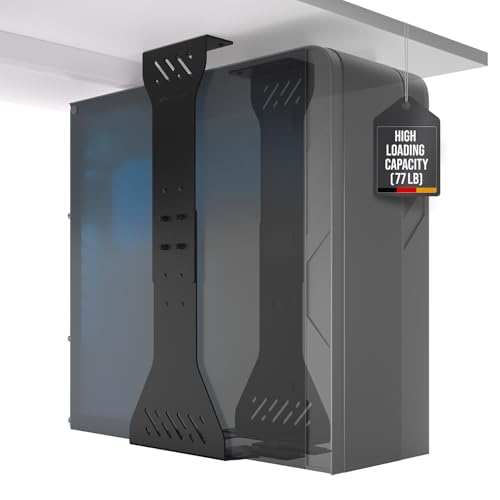
Heavy Duty Under Desk PC Holder – 77 lbs Load Capacity
At 77 pounds rated capacity, this bracket targets enthusiasts with dual-GPU builds or large E-ATX cases that already strain lighter mounts. The adjustable cradle accommodates a wide range of tower widths, and the all-steel construction gives it a rigid feel that cheaper aluminum alternatives lack.
- Pro: Highest load rating in this roundup by a significant margin.
- Pro: Adjustable width means it fits both slim and wide cases without extra adapters.
- Con: The heavy steel design requires a solid desk apron; it is overkill for a 15-pound office tower.
Skip this if your desk is thin-particleboard or you simply want a quiet, low-profile mount for a compact build.
JANE EYRE Computer Tower Stand – 23.03″ to 28.3″ Height Adjustable
This floor stand bridges the gap between sitting and standing desk heights, adjusting from roughly 23 to 28 inches. For a user who raises and lowers their desk throughout the day, the tower stays at a consistent relative position rather than hanging at a fixed bracket height.
- Pro: Height range covers most standing-desk travel without repositioning.
- Pro: Frees the desk underside entirely, which helps with cable routing.
- Con: Takes up floor footprint and still requires clearance between desk legs.
Skip this if your desk has cross-braces, a center pedestal, or a cable tray that blocks floor access beneath it.
JOY worker Under Desk PC Mount for Standing Desk, Clamp-On Leg
Most under-desk mounts assume you can drill into the tabletop or clamp to an apron. This one clamps to the desk leg itself, which makes it the go-to option for standing desks whose apron is too shallow or whose surface is honeycomb-core and cannot hold a screw. The clamp mechanism grips without leaving marks on powder-coated legs.
- Pro: Works on desk styles where no other mount can attach.
- Pro: No drilling, so renters and office workers with furniture rules can install it.
- Con: Leg clearance varies; some standing-desk frames have gussets or wiring channels that block the clamp.
Skip this if your desk legs are square-tubed and narrow, or if you already have a thick apron that would accept a simpler bolt-on mount.
TOPSKY Under Desk PC Mount No Drill, 50 lb Capacity
A no-drill mount rated to 50 pounds that fits standard desk aprons via C-clamp hardware. It handles most consumer mid-towers without a second thought and installs in under ten minutes without tools beyond a wrench. The clamp pads spread pressure across the apron surface to reduce the risk of denting soft wood.
- Pro: Tool-free removal if you change desks or reposition.
- Pro: Fifty-pound capacity gives comfortable headroom for typical builds under 30 pounds.
- Con: Requires a desk apron at least an inch thick; it will not grip a bare tabletop edge.
Skip this if your desk has no apron, a glass top, or an apron thinner than what the clamp pads can compress against without slipping.
YOSE Computer Tower Stand with Rolling Caster Wheels
The lowest-priced option in this group at under fourteen dollars. It is a floor stand on casters, designed for carpeted rooms where a stationary base would sink into pile. The wheels let you roll the tower out for maintenance and back for normal use without lifting anything.
- Pro: Cheapest way to clear the floor and protect your case from carpet dust.
- Pro: Casters roll on carpet, which many hard-floor wheel designs cannot.
- Con: No under-desk mounting at all; the tower stays beside the desk.
Skip this if your goal is genuinely freeing up floor area beneath the desk or if you need a secure mount that prevents tipping.
Under Desk PC Mount, No Drill BK-80X50mm
Fits towers between 5.9 and 10.4 inches wide and holds 44 to 50 pounds. The non-slip gaskets are an upgrade over bare-metal clamps that slowly creep under vibration. For under-desk mounts in the sub-twenty-dollar range, this one offers the most specific published compatibility numbers, which reduces the guesswork of whether your case fits.
- Pro: Explicit width range lets you confirm compatibility before buying.
- Pro: Non-slip gaskets reduce micro-movement from desk bumps.
- Con: 44-50 pound range is close to the upper end of mid-tower builds; no margin for very heavy custom rigs.
Skip this if your case plus components exceeds 40 pounds or if you want a mount you can reposition without loosening the clamp every time.
VIVO Heavy Duty Adjustable Under-Desk PC Mount MOUNT-PC04B
VIVO builds monitor arms for a living, and that engineering carries over here: the locking mechanism on this mount uses a keyed bracket rather than a simple clamp screw, which means the tower cannot vibrate loose overnight. Rated to 66 pounds with adjustable width, it occupies the premium slot in this comparison at sixty dollars.
- Pro: Secure locking system provides the highest confidence for heavy builds.
- Pro: VIVO’s established parts ecosystem means replacements and support are accessible.
- Con: Highest price in this roundup; a fixed-desk user with a lightweight build gets the same function from a $20 option.
Skip this if budget matters more than long-term rigidity or if your desk cannot support the bolt pattern and apron thickness it requires.
Buying Guide
Mounting Method: Clamp, Bolt, or Leg
Your desk determines what you can use. A clamp-on apron mount is the simplest solution for standard office desks with a wooden front rail at least 3/4 inch thick. A bolt-through mount is the most secure but requires access to the underside and leaves permanent holes. A leg clamp exists for standing desks where the apron is too thin, absent, or replaced by a motor shroud. Before choosing a product, measure your apron depth, check for cross-braces, and confirm you have at least two inches of clearance between the desk bottom and the floor or cable tray.
Load Capacity and Case Dimensions
Published capacity ratings use static weight with a safety factor, but real-world stress comes from vibration and occasional tugs on cables. A general rule: choose a bracket whose rating exceeds your total system weight by at least 20 percent. Also verify width. Most mid-towers fall between 7 and 9 inches wide, but some gaming cases push past 10 inches, and slim cases come in under 6. The BK-80X50mm product is unusual in publishing an explicit range (5.9 to 10.4 inches); most others list only a maximum or leave you to check the cradle dimension in the spec sheet.
Standing Desks: Why Height Travel Changes the Equation
A fixed under-desk mount moves with the desk, keeping the tower at a constant height relative to the tabletop. This is fine for a bolt-on or clamp-on mount attached to the desk surface. The complication arises when the mount attaches to the floor or to a desk leg that telescopes: the tower and desk then move at different rates, and cables bind. If you use a standing desk, either choose a mount on the tabletop structure itself or accept a floor-standing solution like the JANE EYRE that adjusts independently.
Our Verdict
The VIVO MOUNT-PC04B is the top pick for anyone who wants the most secure, long-lasting under-desk solution without worrying about vibration creep or capacity limits. Its locking bracket and 66-pound rating make it the safest bet for mid-to-heavy builds, and the price premium buys a level of mechanical refinement that cheaper clamps simply do not match.
For budget buyers, the Under Desk PC Mount BK-80X50mm at $19.99 delivers the best published compatibility data and a no-drill install at the lowest price among true under-desk options. It covers the widest range of setups for the least money.
One condition where another product wins: if you have a standing desk with no usable apron, the JOY worker Clamp-On Leg mount at $39.99 becomes the only viable choice in this group, because it attaches to the leg rather than the desktop.
FAQ
Can I use an under-desk PC mount on a glass-topped desk?
No. Clamp-on and bolt-on mounts require a solid apron or tabletop thick enough to distribute load. Glass tops cannot be drilled, and clamping a steel bracket to glass risks localized stress fractures. Your safest option is a floor stand or a leg-mount if the desk frame allows one.
Will an under-desk mount block my airflow?
A well-designed mount cradles the case without touching the side-panel intakes, so airflow is unaffected and often improved because the tower sits off carpet. Poorly designed mounts that grip the full side face can block vents on cases with side-panel mesh. Check that your mount contacts only the bottom and one side rail rather than wrapping around the full case.
Do I need to drill for an under-desk PC holder?
Not always. Several products in this comparison use C-clamp hardware that grips the desk apron without holes, making them renter-friendly and removable. Drilling provides the most rigid hold and is preferable for heavy builds, but a quality clamp rated within capacity is adequate for typical consumer systems under 30 pounds.
How do I know if my case is too wide for an under-desk mount?
Measure your tower width at its widest point, including any protruding cables or case feet. Compare that number against the mount’s published cradle width. If the manufacturer does not list a width range, look for owner photos on listings or assume a standard 7 to 9 inch mid-tower clearance and treat anything wider as a potential fit problem.