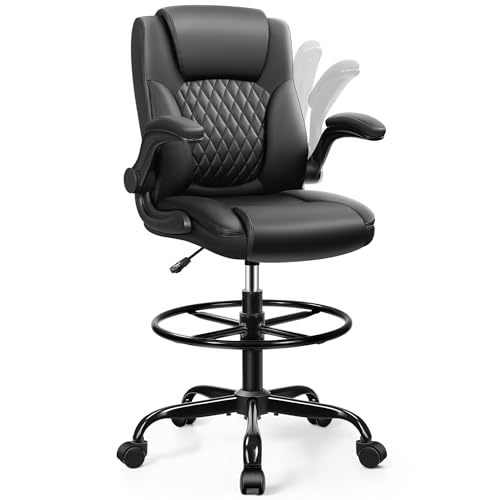
After building, bolting, and sitting in more tall chairs than I care to admit, the Primy Drafting Chair with flip-up armrests and adjustable footrest ring is the best overall pick, with the 500LBS Ergonomic Drafting Chair as the runner-up for anyone who wants a heavier-duty frame.
Here’s the problem nobody warns you about when you finally get that standing desk installed: your legs give out around hour three, and your regular task chair is four inches too short to be useful. Perching on a stool wrecks your lower back. Cranking a standard chair to its max height leaves your feet dangling with nothing to brace against. A proper drafting chair solves this with an extended gas cylinder and a footrest ring — the same setup drafting tables and workshop benches have used for a century. This guide covers the six models I’d actually recommend, what to check before you order, and how to set one up so it works with your desk instead of against it.
Our top picks



As an Amazon Associate we earn from qualifying purchases at no extra cost to you.
Quick Comparison
| Product | Best For | Standout Feature | Rating |
|---|---|---|---|
| Primy Drafting Chair | All-around sit-stand work | Flip-up armrests + adjustable footrest ring | See card above |
| Tall Leather Executive Drafting Chair | Budget counter-height setups | Wipe-clean leather at a low price | See card above |
| Sweetcrispy Tall Drafting Chair | Long desk sessions | Contoured lumbar support | See card above |
| 500LBS Ergonomic Drafting Chair | Heavy-duty use | W-shaped thick seat cushion | See card above |
| Adjustable Padded Armrest Drafting Chair | Shared or multi-user desks | Padded armrests that adjust independently | See card above |
How to Choose a Drafting Chair for Standing Desks and Tall Counters
- Measure before you buy: Subtract 10–12 inches from your desk surface height to find your target seat height, then confirm the chair’s cylinder range covers it. Most drafting chairs top out between 32 and 38 inches — a 42-inch workbench may need a shop stool instead.
- Footrest ring adjustability: A fixed ring is a coin flip on fit. An adjustable ring lets you dial in a 90-degree knee angle, which is the whole point of the design. Check that it clamps to the cylinder rather than the base.
- Flip-up vs. fixed armrests: Flip-up arms let you tuck the chair fully under a desk or counter overhang — critical in tight corner and L-shaped desk setups. Fixed arms will collide with the apron.
- Base diameter and casters: Taller chairs have a higher center of gravity, so look for a base at least 24 inches across. If you’re on hardwood or a rolling standing desk mat, swap the stock casters for 2-inch rubber ones — it’s a five-minute upgrade with a rubber mallet.
- Upholstery for your climate: Breathable mesh or fabric beats bonded leather in a warm home office. Leather wins if you’re dealing with sawdust, solder flux, or paint in a hybrid shop-office space.
The Best Drafting Chairs for Standing Desks and Tall Counters Reviewed
Best Overall: Primy Drafting Chair with Flip-Up Armrests
This is the chair I recommend to anyone alternating between sitting and standing throughout the day — the footrest ring adjusts independently of the seat, so short and tall users can both get a proper leg angle. The flip-up arms mean it tucks cleanly under a standing desk when you switch to standing.
Best Budget: Tall Leather Executive Drafting Chair
A solid entry point if you’re outfitting a second workstation or a garage office on a tight budget. The faux-leather seat wipes clean easily, which makes it a smart pick for makers who bring glue, flux, or coffee to the bench.
Best Premium: Sweetcrispy Tall Drafting Chair with Lumbar Support
Best for anyone logging six-plus hours a day at a counter-height desk, where cheap flat backrests start to hurt around lunchtime. The sculpted lumbar panel does real work supporting your lower spine at elevated seat heights.
Best for Heavy-Duty Use: 500LBS Ergonomic Drafting Chair
Rated to 500 pounds with a reinforced base and a W-shaped high-density cushion that resists flattening — this is the one to buy if past chairs have sagged or wobbled on you. The breathable fabric also keeps it comfortable in unconditioned workshop spaces.
Best for Shared Workstations: Adjustable Padded Armrest Drafting Chair
Ideal for a desk two people use, or a workbench where you switch between keyboard work and hand-tool tasks. The padded armrests adjust independently, so you can drop one arm out of the way without re-setting the whole chair.
Frequently Asked Questions
Do I really need the footrest ring?
Yes. Without it, your feet dangle and all your weight loads onto the back of your thighs, which restricts circulation. The ring gives you a brace point and lets you shift posture, which is why drafting chairs have used them for decades.
Will a drafting chair fit under my standing desk?
Usually, if the armrests flip up or drop below desk height. Measure from the floor to the underside of your desk frame at its lowest setting, and compare that to the chair’s armrest height at your working seat position.
Can I raise a drafting chair even higher?
Aftermarket extended gas cylinders are available and swap in with a pipe wrench and some penetrating oil, but going beyond the manufacturer’s rated height compromises stability. If you need more than 38 inches, buy a purpose-built shop stool instead.
Are these chairs stable enough to lean back in?
Look for a five-star base of 24 inches or more. Narrower bases on tall cylinders tip more easily, especially on thick carpet. A wider base and rubber casters make a noticeable difference.
Final Thoughts
For most home offices, the Primy Drafting Chair hits the best balance of adjustability, footrest design, and desk clearance. Choose the 500LBS Ergonomic Drafting Chair if durability and weight capacity are your priority, or the Sweetcrispy Tall Drafting Chair if lumbar support during long sessions matters most. Measure your desk height first, and the rest of the decision gets easy.