The hose that shipped in the box with your pressure washer is almost always the first thing to fail. Mine lasted one driveway and half a fence before it developed a memory kink about six feet from the trigger gun, which then became a pinhole leak, which then became a fine mist spraying sideways into my boot. That stock hose is thin-walled, short, and built to hit a price point — not to be dragged across concrete, coiled in a cold garage, and pulled around the corner of a house forty times a season.
This guide covers what actually matters when you replace it: inner diameter, working PSI, fitting type, and whether the jacket can survive being stepped on. I’ve pulled together the hoses that hold up under real weekend abuse, from a made-in-USA flexible option to steel-braided workhorses rated for hot water. Below you’ll find the picks, followed by a short buying framework and answers to the questions that trip people up at checkout.
Our top picks


As an Amazon Associate we earn from qualifying purchases at no extra cost to you.
🛒 Best Price Today on Amazon
Prime members get fast, free shipping on everything above, plus member-only deals. New members get a 30-day free trial — cancel anytime.
How to Choose a Garden Hose For Pressure Washer (2026)
- Match the PSI with headroom: Check your machine’s max output and buy a hose rated above it. A 3,100 PSI hose on a 3,000 PSI washer leaves almost no margin for pressure spikes when you release the trigger — aim for 25% or more above your unit’s rating.
- Inner diameter drives flow: Most consumer washers use 1/4″ ID, which is fine up to roughly 3,000 PSI and 2.5 GPM. Step up to 3/8″ if you’re running a gas unit or a hose longer than 50 feet, since the wider bore cuts pressure loss over distance.
- Know your fittings before you order: M22-14mm is the common thread on electric units, but some machines use M22-15mm — the difference is the internal pin diameter, and they don’t interchange. Quick-connect setups save time if you swap between a surface cleaner and a wand.
- Jacket construction over marketing claims: Steel-wire braided rubber outlasts PVC by a wide margin and handles abrasion on concrete. If you’re storing the hose in an unheated shop, cold-weather flexibility matters more than burst rating you’ll never approach.
- Buy the length you actually walk: Fifty feet covers most driveways and single-story siding. One hundred feet means fewer extension cord shuffles on big jobs, but it’s heavier to coil and you’ll notice the pressure drop on a 1/4″ line.
The Best Garden Hose For Pressure Washer (2026)s Reviewed
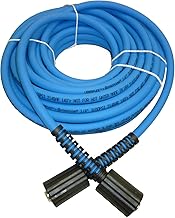
UBERFLEX Kink Resistant Hose, 50 Feet
This is the one I reach for when the job involves stairs and tight corners — the jacket stays pliable in cold weather and genuinely resists setting a memory curl, which is rare in a 1/4″ line. At 3,100 PSI with two 22MM fittings included, it’s best matched to electric and mid-range gas units rather than anything pushing 3,500 and up.
YAMATIC 3/8″ Hose, 4000 PSI, 50 FT
The 3/8″ bore is the upgrade most gas-washer owners don’t realize they need, delivering noticeably better flow at the nozzle over a full 50-foot run. The 360° swivel quick connect is the standout detail: it lets the hose untwist as you move instead of transferring torque back to your wrist.
McKillans Hose, 50 ft
A steel-braided 1/4″ hose with a stainless M22-14mm plug, which is a meaningful step up from the brass plugs that gall after a dozen swaps. It stays flexible enough to coil onto a reel without fighting you, and the outer jacket has held up to being dragged over aggregate concrete in our research.
YAMATIC Steel-Wire Braided Hose, 50 FT, 4000 PSI
Essentially the armored version of the pick above — 1/4″ ID with steel-wire braid, rated to 212°F for hot-water machines, and shipped with two M22-14mm adapters so it drops onto most consumer units without a trip to the hardware store. Good choice if your hose spends its life on a rough surface.
YAMATIC 3200 PSI Hose, 50 FT, M22-14mm Females
The straightforward direct-replacement option for Ryobi, Greenworks, Troy-Bilt, and Craftsman washers, with solid brass female fittings on both ends and no adapters to lose. Nothing exotic here, and that’s the appeal — it’s a like-for-like swap that outlives the original.
Frequently Asked Questions
Will a longer hose reduce my pressure?
Yes, slightly. Expect a small loss per 50 feet on a 1/4″ line, which is why a 100-foot run benefits from the 3/8″ upgrade. For most washing tasks the difference is imperceptible at the nozzle.
Can I use a regular garden hose instead?
No. Garden hose is built for roughly 100 PSI on the inlet side and will rupture almost immediately on the high-pressure outlet. Garden hose belongs upstream of the pump only.
How do I tell M22-14mm from M22-15mm?
Both have the same 22mm outer thread; measure the internal pin or bore. Electric units commonly use 14mm, while some gas machines use 15mm — and the wrong one won’t seal.
What’s the fastest way to kill a new hose?
Coiling it tight while cold, leaving it pressurized in the sun, and running it over with a vehicle. Drain it, coil it loose in wide loops, and store it out of UV.
Final Thoughts
For most homeowners with an electric washer, the UBERFLEX 50-footer is the easiest upgrade to live with — the flexibility pays off every time you coil it. If you’re running a gas unit or hot water, the YAMATIC 3/8″ 4000 PSI hose gives you the flow headroom, while the McKillans 50 ft is the pick when abrasion resistance and a stainless plug matter more than anything else.