The hose that ships with a pressure washer is usually the first thing to fail. Mine gave up halfway through stripping years of algae off a deck — a hairline split near the crimp, a fine spray in my face, and a hard stop to the afternoon. Stock hoses tend to be short, stiff in cold weather, and prone to memory coils that catch on every planter and porch post. Once you’ve dragged one across a driveway a few times, the kinks become permanent and flow drops right when you need pressure most.
A replacement hose is one of the cheapest upgrades that meaningfully changes how the tool feels in your hands. This guide walks through the specs that actually matter — inner diameter, PSI headroom, fitting type, jacket material — and then covers the hoses I’d hand to a friend who just wrecked theirs. Whether you’re washing patio furniture on a Saturday or running a wand all week, there’s a right answer here.
Our top picks


As an Amazon Associate we earn from qualifying purchases at no extra cost to you.
🛒 Best Price Today on Amazon
Prime members get fast, free shipping on everything above, plus member-only deals. New members get a 30-day free trial — cancel anytime.
How to Choose a/an Pressure Washer Hoses (2026)
- Match the inner diameter to your machine: Electric and light gas units run fine on 1/4″, which stays light and coils easily. Step up to 3/8″ for gas washers above roughly 3,000 PSI or any run past 50 feet, since the wider bore keeps flow from choking at the nozzle.
- Buy PSI headroom, not the bare minimum: Pick a hose rated well above your washer’s output. A 3,100 PSI hose on a 3,000 PSI machine leaves nothing for pressure spikes when you release the trigger, and those spikes are what kill crimps.
- Check the fitting thread before you click: M22 comes in 14mm and 15mm inner diameters, and they are not interchangeable. Ryobi, Greenworks, and Craftsman units commonly want M22-14mm; quick-connect kits solve mismatches but add a leak point.
- Weigh jacket material against your climate: Steel-braided rubber shrugs off hot water and abrasion but is heavy. Polyurethane and hybrid blends stay limp below freezing and won’t scuff painted siding or teak furniture.
- Add a swivel if you work around obstacles: A 360° swivel at the machine end stops the hose from winding itself into a corkscrew as you circle a car or a patio set. It’s a small feature that eliminates most mid-job untangling.
The Best Pressure Washer Hoses (2026)s Reviewed
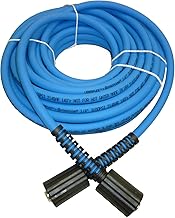
UBERFLEX Kink Resistant 1/4″ 50 ft
This is the hose I reach for when I’m working around furniture and finished surfaces — the jacket is genuinely supple, lays flat off the reel, and doesn’t leave marks on painted wood. Made in the USA with two 22MM fittings included, it’s rated to 3,100 PSI, which makes it a natural match for most electric and mid-range gas units.
YAMATIC 3/8″ 4000 PSI 50 ft
Steel-braided rubber and a 4,000 PSI rating put this in contractor territory, and the 15°F to 212°F range means hot-water rigs and winter work are both fair game. The 360° swivel quick connect earns its keep on any job where you’re constantly changing direction.
100 ft Steel Braid 4200 PSI with 3/8″ QC
Reach is the whole pitch here: a hundred feet lets you park the machine and forget about it while you cover a full driveway or two-story wall. The adapter set bridges 3/8″ and 1/4″ connections, though at this length you’ll want the wider bore to preserve flow.
Flexzilla 1/4″ x 50 ft Replacement Hose
Flexzilla’s hybrid polymer stays flexible in cold weather better than anything else in this bracket, and the ZillaGreen jacket makes it easy to spot before you back over it. M22 fittings, 3,100 PSI, and a genuinely light coil make it the easiest hose here to manage one-handed.
YAMATIC 1/4″ 3200 PSI M22-14mm
The solid brass M22-14mm female fittings are the detail worth paying for — they thread cleanly and resist the stripping that plagues plastic-collared connectors. It’s a direct swap for Ryobi, Greenworks, Troy-Bilt, and Craftsman machines, which covers most of the driveways on my street.
Frequently Asked Questions
Will a longer hose reduce my pressure?
Slightly, and the effect compounds with length. At 100 feet, a 3/8″ hose loses far less pressure than 1/4″, which is why the long options here use the wider bore.
How do I tell M22-14mm from M22-15mm?
Look inside the fitting and measure the opening, not the threads. The 15mm version has a visibly wider bore; if a connection weeps no matter how tight you crank it, you almost certainly have a mismatch.
Can I run hot water through any of these?
Only if the spec says so. The steel-braided YAMATIC handles up to 212°F, while most polyurethane hoses top out well below that and will soften permanently.
What’s the best way to store a hose?
Drain it, then coil it loosely in wide loops rather than tight figure-eights. Storing a hose under tension is what creates the memory kinks that eventually crack.
Final Thoughts
For most homeowners, the Flexzilla 50-foot replacement hits the best balance of flexibility, weight, and cold-weather manners, with the UBERFLEX close behind if you want a USA-made option that’s gentle on finished surfaces. If you’re running a gas machine hard or need real reach, the YAMATIC 3/8″ 4000 PSI is the one I’d trust for the long haul.