Anyone who has hauled a pressure washer out of the garage on a Saturday morning knows the machine is only half the equation. Blast plain water at a mildew-streaked fence or a driveway wearing three seasons of oil drips and you’ll spend an hour chasing shadows, gouging wood grain, and etching concrete because you cranked the pressure to compensate. The chemistry does the loosening; the water just carries it away. Pick the wrong bottle, though, and you get a soap that won’t cling, a foam that collapses before it dwells, or worse, a formula that clouds your patio furniture’s aluminum or strips wax off the truck parked twenty feet away.
This guide sorts the detergent aisle into something usable. We look at concentrates that dilute far enough to justify the shelf space, dedicated vehicle soaps built for foam cannons, and one accessory that turns a mediocre soap into a thick, dwelling blanket. Everything here has been judged on dilution economics, surface safety around wood, painted siding, and outdoor furniture, and whether it actually rinses clean instead of leaving a haze you discover the next morning.
Our top picks


As an Amazon Associate we earn from qualifying purchases at no extra cost to you.
🛒 Best Price Today on Amazon
Prime members get fast, free shipping on everything above, plus member-only deals. New members get a 30-day free trial — cancel anytime.
How to Choose a/an Pressure Washer Soap (2026)
- Concentration ratio: Read the finished-gallons claim, not the bottle size. A 32 oz jug that yields 40 gallons of working solution beats a 172 oz pail meant to be poured nearly straight, both on cost per square foot and on storage space in a crowded garage.
- Surface compatibility: Cedar fences, powder-coated patio sets, and teak all react differently. Look for explicit language about wood, painted surfaces, and aluminum. If a label only lists concrete and asphalt, keep it away from your furniture.
- Foaming behavior: Downstream injectors on most consumer machines produce a thin wash, which is fine for flatwork. Cars need a cannon-specific soap with high surfactant load so the foam sits and softens grit before your mitt or the rinse touches paint.
- Bleach and additive content: Some mildew formulas rely on sodium hypochlorite, which will kill plantings and fade fabric cushions. If you’re working near a garden bed or an outdoor rug, choose a non-bleach cleaner and pre-wet the surroundings.
- Injector friendliness: Thick, gel-like soaps can starve a downstream injector and gum the siphon tube. Thinner concentrates draw more reliably, especially through long hose runs on electric units.
The Best Pressure Washer Soap (2026)s Reviewed
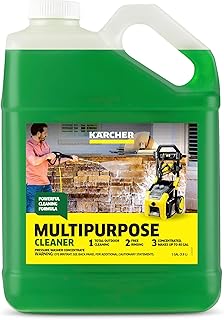
Kärcher Multi Purpose Detergent
The most versatile bottle on this list, and the one I reach for when the job spans a deck, the siding above it, and the walkway below. It’s genuinely concentrated, stretching to roughly 40 gallons of cleaner, and it’s mild enough that I’ve used it on painted Adirondack chairs without any dulling or streaking.
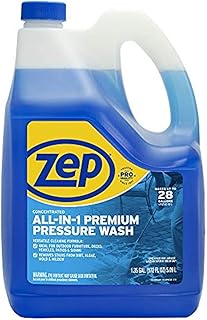
Zep All-in-1 Concentrate, 172 oz
Buy this one if you have real acreage of hardscape to cover, because the pail size makes sense only at volume. It bites into road film and grease better than the Kärcher, though I’d dilute conservatively and test on any composite decking first.
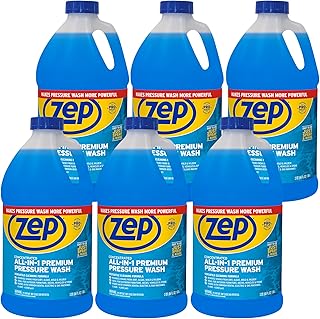
Zep All-In-One Pressure Wash, 64 oz Case
The same proven formula in six manageable jugs, which matters more than it sounds when you’re pouring one-handed off a ladder. Buying the case brings the per-ounce cost down sharply, making this the smart pick for anyone doing seasonal work on multiple properties.
Wash Chems Pro30 Auto Foam Soap
A one-step touchless soap that earns its keep on filthy trucks, mower decks, and anything that lives outdoors. At 2.5 gallons it’s a commitment, but the dilution is aggressive enough that a single container outlasts several summers of weekend washing.
Wash Chems Pro50 Foam Cannon Soap
Denser and slicker than the Pro30, formulated specifically for cannon use where cling time is everything. This is the one I’d hand someone who cares about paint, since it lifts contaminants with minimal mechanical contact.
Frequently Asked Questions
Can I use dish soap in my pressure washer?
Don’t. Dish soap foams unpredictably in a pressurized system, offers no corrosion inhibitors, and can degrade seals over time. It also strips protective coatings from vehicle paint and sealed wood.
Do I need a foam cannon, or is the built-in soap tank enough?
For fences, driveways, and siding, the built-in tank or downstream injector is fine. For vehicles, a cannon like the Tool Daily unit produces thick, dwelling foam that the onboard tank simply cannot match.
How long should soap sit before rinsing?
Five to ten minutes on most surfaces, and never let it dry. Work in shaded sections on hot days and mist the area lightly if the sun starts pulling moisture out early.
Will these soaps damage plants or lawn?
Non-bleach concentrates are generally low risk if you pre-soak nearby beds and rinse them afterward. Bleach-based mildew formulas will scorch foliage, so tarp anything you care about.
Final Thoughts
For most homeowners tackling patios, fences, and outdoor furniture, the Kärcher Multi Purpose Detergent is the easiest recommendation, offering real dilution value and enough gentleness for finished surfaces. Anyone cleaning large hardscape areas should step up to the Zep All-In-One case for the per-ounce savings, and if vehicles are in the rotation, pair the Wash Chems Pro50 with a Tool Daily foam cannon for genuinely touchless results.