
Key takeaways
- Warranty Description: 2 Year
- Tension Supported: 264 lb
- Strap Type: Cable/Pulley straps
The tape measure decides this purchase, not the marketing copy. A Smith machine needs three separate measurements before you spend anything: the floor footprint (usually 4 to 7 feet wide and 4 to 6 feet deep), the ceiling clearance (the frame itself is often 82 to 88 inches, and you still need room to press a bar overhead at the top of the rails), and the walk-around space on at least two sides so you can load plates without scraping drywall. A machine that technically fits into a spare bedroom but leaves you turning sideways to slide a 45 on the far sleeve will quietly stop getting used by week three.
The second thing worth knowing early: “Smith machine” covers three fairly different products. There are dedicated angled-rail Smith units, hybrid cage-and-Smith combos with a pulley stack bolted to the back, and full functional trainers where the Smith bar is one feature among a dozen. Each one wins in a different room. Below, the picks are organized by the space you actually have — a low-ceilinged basement, a shared garage bay, a bonus room over a garage — rather than by which unit has the longest spec sheet.
Our top picks
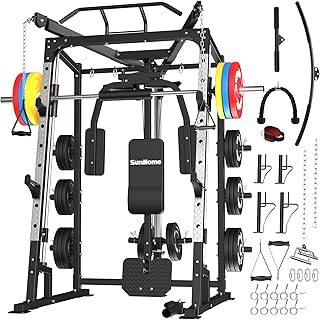
 Mikolo Smith Machine with Weight Stack
- Warranty Description: 2 Year
- Tension Supported: 264 lb
- Strap Type: Cable/Pulley straps
 MAJOR FITNESS Drone2 Advanced Training Smith Machines–
- All-in-One Home Gym System - The Drone2 Premium…
- Built to Last with Lifetime After-Sales Support -…
- Premium Cable System - This cable machine home…


As an Amazon Associate we earn from qualifying purchases at no extra cost to you.
As an Amazon Associate we earn from qualifying purchases.

Quick Comparison
| Pick | Type | Approx. footprint | Ceiling needed | Loading | Best room |
|---|---|---|---|---|---|
| Force USA G3 All-In-One Trainer | Cage + Smith + dual pulleys | ~5 x 4.5 ft | ~8 ft | Plates + weight stack | Garage bay, one machine only |
| Marcy MD-9010G Smith Cage | Cage + Smith + lat/pec stations | ~6.5 x 5 ft | ~7.5 ft | Plates | Basement or wide spare room |
| Body-Solid Series 7 Smith (GS348QP4) | Smith + lat/row + pec station | ~6 x 6 ft | ~8 ft | Plates | Dedicated home gym room |
| Titan Fitness Plate-Loaded Smith Machine | Dedicated Smith, no attachments | ~4.5 x 4 ft | ~7.5 ft | Plates | Tight corner beside an existing rack |
| Valor Fitness BE-11 Smith Machine | Dedicated Smith with bench pegs | ~5 x 4.5 ft | ~7.5 ft | Plates | Bonus room with modest ceilings |
Dimensions above are approximate and vary by production run — confirm the current spec sheet on the product listing against your own measurements before ordering.
How to Choose
- Measure ceiling height at the machine’s future location, not the tallest part of the room. Basements with ductwork and garages with sloped ceilings routinely lose 6 to 10 inches exactly where a rack wants to stand. Add roughly 12 inches above the frame height for comfortable overhead pressing on the rails.
- Decide whether the bar path should be angled or vertical. Most home units run the bar on rails pitched around 7 to 12 degrees, which tracks more naturally for bench and squat patterns. Fully vertical rails feel more restrictive but occupy slightly less depth — a real consideration in a narrow room.
- Count your plate storage separately. Six to eight Olympic plates need somewhere to live. Frames with integrated weight horns save you a second piece of furniture and about 2 square feet of floor.
- Check the safety catch system before anything else. Working alone means you rely entirely on the hook-and-notch stops. Look for numerous closely spaced notches and a rotating bar that locks with a short, confident wrist turn rather than a long reach.
- Be honest about assembly. These arrive as 200 to 500 pounds of boxed steel. Plan for two people, three to five hours, a socket set, and a doorway wide enough for the longest single tube — measure that too.
Top Picks Reviewed
Force USA G3 All-In-One Trainer — best when one machine has to do everything
The G3 compresses a power rack, a Smith bar, a dual-pulley cable system, chin-up bar, and low row into a footprint close to five feet square. That density is the entire argument for it: in a single-car garage bay where the car still parks, it replaces three separate stations. The tradeoff is transition time — switching from Smith presses to cable flyes means moving pins, a bench, and sometimes an attachment. It suits lifters who train alone and don’t mind a slower session in exchange for reclaiming half a garage.
Marcy MD-9010G Smith Cage — best value for a wide basement
The MD-9010G is broad rather than tall, which is a genuine advantage under a 7.5-foot basement ceiling. You get an angled Smith bar inside a cage with a lat pulldown, low row, and pec station, all plate-loaded so there are no proprietary weight stacks to buy. Fit and finish are what you’d expect at this price — bushings rather than sealed bearings, so expect a bit of rail noise — but the geometry is sound and the safety notches are plentiful. Best for someone building a first home gym who wants breadth over refinement.
Body-Solid Series 7 Smith (GS348QP4) — best build quality for a dedicated room
This is the one that feels commercial. Heavy-gauge steel, linear bearings on the rails, and a bar path smooth enough that you notice the difference on the first set. It wants a real room: roughly six feet square plus bench and walk-around clearance, and eight feet of ceiling. If you’ve committed a spare bedroom or a finished basement corner permanently to lifting, the extra outlay buys a machine that won’t develop rattles in five years and won’t need replacing when your working weights climb.
Titan Fitness Plate-Loaded Smith Machine — best for adding to an existing setup
No lat tower, no pec deck, no cables — just rails, a bar, and catches, which is precisely why it slots into a four-and-a-half-foot corner beside a rack you already own. If your gym is already handling pull-ups and rows, paying for duplicate stations is wasted floor space. This is the surgical addition: guided pressing and squatting for lifters who train heavy without a spotter, at a footprint most spare rooms can absorb.
Valor Fitness BE-11 Smith Machine — best under a low bonus-room ceiling
The BE-11 keeps a compact profile with a modest frame height, making it one of the more realistic options for finished attic space or a room over a garage where the ceiling sits near seven and a half feet. Bench pegs and integrated plate horns keep clutter down, and the angled rails handle incline pressing without the bar drifting into your face. It’s not a heavy-duty commercial frame, but for moderate loads in a space where taller machines simply won’t stand up, it’s the practical answer.
Frequently Asked Questions
How much ceiling height do I actually need?
Take the machine’s frame height and add about a foot. Most home Smith machines stand 82 to 88 inches, so
Best Gym Mat for Home: Rubber vs Foam Picks for Any Floor
Best gym mat for home choices come down to material density and...
Best Rowers for Home Gym: Air, Magnetic and Water Compared
Best rowers for home gym shortlists usually collapse once someone measures the...
Best Weight Home Gym: 6 All-in-One Machines for Small Rooms
Best weight home gym decisions come down to two numbers before brand...
Best Home Gym Equipment for Beginners: The Starter Setup
Best home gym equipment for beginners is not a machine – it...
Best Treadmills for Home Gym: 5 Picks by Deck and Motor
Best treadmills for home gym decisions come down to two specifications and...
Best Home Gym Compact Setups: 6 Space-Saving Picks Ranked
Best home gym compact claims usually quote a stored footprint and stay...
Best Adjustable Bench for Home Gym: 5 Picks Ranked by Use
Best adjustable bench for home gym decisions turn on three numbers most...
Best Cable Machine for Home Gym: 5 Picks and Pulley Ratios
Best cable machine for home gym shortlists collapse quickly once you convert...
Best Cable Machines for Home Gym: 5 Types and Their Limits
Best cable machines for home gym use are not one product category...
Best Home Gym Setup: Floors, Ceilings, Noise and Layout
Best home gym setup guides talk about equipment and skip the room,...
Write Your Review
No reviews yet. Be the first to share your experience!