
Key takeaways
- Warranty Description: 2 Year Manufacturer
- Tension Supported: 1000 pounds
- Handle Type: Fixed Handle
Power cage dimensions are published, and almost everyone reads the wrong number. The height listed is the frame height — usually around 82 to 88 inches. What you actually need is that plus clearance for the pull-up bar at the top and your head above it, which pushes the practical requirement past 8 feet. Then there is the barbell: a standard 7-foot bar needs a foot of clearance either side to get on and off the J-hooks without scraping the uprights.
In a single-car garage with an 8-foot ceiling and a door track running across it, that combination rules out more cages than it admits. The six options below span squat racks with pulley systems, full cages rated to 2000 pounds, and Smith-style hybrids — assessed specifically on footprint, height demands, and whether the cable attachments add depth you may not have accounted for.
Our top picks

 ULTRA FUEGO Power Cage
- Warranty Description: 2 Year Manufacturer
- Tension Supported: 1000 pounds
- Handle Type: Fixed Handle
 DP01 Power Cage
- Warranty Description: 2 year
- Tension Supported: 2000 pounds
- Grip Size: Standard


As an Amazon Associate we earn from qualifying purchases at no extra cost to you.
Quick Comparison
| Product | Best For | Standout Feature | Watch Out For |
|---|---|---|---|
| SPORTSROYALS Power Rack | Compact cable training | Pulley system with pulldown | Cable tower adds depth |
| ULTRA FUEGO Power Cage | Modular setups | J-hooks, dips and landmine | Optional parts cost extra |
| DP01 Power Cage | Heavy barbell work | 2000 lb with dual pulleys | Deepest footprint here |
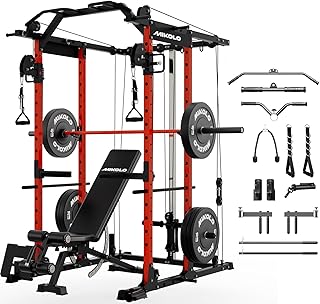
| Mikolo Power Cage | Balanced home gyms | 1500 lb with crossover | Assembly is a long job |
| pooboo Smith Power Cage | Solo lifters | Smith bar plus cable system | Widest overall frame |
| JEEKEE Power Rack | Value per feature | 2000 lb with LAT pulldown | Needs full ceiling height |
How to Choose
- Measure to the lowest obstruction: Garage door tracks, light fittings, and ducting all sit below the ceiling. That lower number is your real height budget, and it is often 6 to 10 inches less than you assumed.
- Add 30 inches to the frame width: A 7-foot barbell overhangs the uprights considerably. Without clearance either side you cannot rack and unrack cleanly, which is both annoying and unsafe.
- Cable towers extend backward: A pulley system adds a weight tower behind the cage, often 18 to 24 inches deep, plus room for the plates. Budget for it in your depth measurement.
- Check the safety bar range: The whole point of a cage is training alone safely. Confirm the safety bars adjust low enough for your bench press and squat depth before buying.
- Plan the plate storage: Weight horns on the uprights add width but keep the floor clear. Without them, plates end up leaning against the frame where you need to walk.
Top Picks Reviewed
Best for Tight Spaces: SPORTSROYALS Power Rack
The multi-functional design fits a pulley system and LAT pulldown into a relatively contained frame, which makes it the most workable option in a single-car garage that still has to hold other things.
The cable tower adds depth at the back that the headline dimensions do not emphasise. Measure the full front-to-back requirement including plate clearance before committing.
Best Value Features: JEEKEE Power Rack
A 2000 lb rating with a cable system, LAT pulldown, and J-hooks packs a great deal into one purchase, giving squats, presses, pulldowns, and rows from a single frame.
It wants full ceiling height for the pull-up bar to be usable. In a low garage you will end up with a rack whose top station you cannot use properly.
Best Modular Option: ULTRA FUEGO Power Cage
J-hooks, dip handles, and a landmine attachment come as part of the package, with optional extras available later. Starting smaller and expanding is the sensible approach when floor space is uncertain.
The optional attachments are genuine extra costs. Price the configuration you actually want rather than the base frame alone.
Best for Heavy Lifting: DP01 Power Cage
A 2000 lb rating with cable crossover and dual independent pulleys makes this the most capable trainer here, comfortably handling any load a home lifter will produce while adding full cable functionality.
Dual pulleys mean towers on both sides and a substantial depth requirement. This is a two-car garage or dedicated basement purchase.
Best All-Rounder: Mikolo Power Cage
At 1500 lb with a cable crossover and LAT pulldown, this hits the middle ground of capability and size that suits most serious home gyms without demanding a warehouse.
Assembly is a long job — plan a full day with two people, and expect the cable routing to take the largest share of that time.
Best for Training Alone: pooboo Smith Power Cage
Combining a Smith bar with a 2000 lb cage and crossover system means you can press and squat heavy without a spotter, since the guided bar can be racked at any point in the movement.
It is the widest frame here, and the guided bar path does not suit everyone’s shoulders and hips for free-weight-style pressing.
Frequently Asked Questions
How much ceiling height does a power cage need?
Frame height plus clearance to use the pull-up bar — practically over 8 feet for most adults. Measure to the lowest obstruction, not the ceiling itself.
How much floor space should I allow?
Roughly 8 feet wide by 6 to 8 feet deep including barbell overhang and cable tower depth, plus walking space. The frame footprint alone understates this considerably.
Do I need to bolt a cage to the floor?
Most home cages are stable unbolted at typical home loads, particularly heavier-rated models with plate storage adding mass. Bolting is worth considering for very heavy work or if you do kipping pull-ups.
Is a cage better than a squat stand?
For training alone, yes — the safety bars let you fail a squat or bench safely. Stands take less room but require either a spotter or considerable caution with load selection.
Final Thoughts
In a small garage, the SPORTSROYALS Power Rack fits the most capability into the least space, while the JEEKEE Power Rack offers the strongest feature set per pound spent if your ceiling allows it. Anyone with a genuinely large space and serious loads should look at the DP01 Power Cage and its dual pulley system.
Write Your Review
No reviews yet. Be the first to share your experience!