
The floor is the one piece of home gym equipment you’ll never think about again if you get it right, and the one you’ll curse every session if you don’t. A 45 lb plate dropped from hip height carries roughly the same impact energy whether it lands on a garage slab, a basement subfloor, or the second-floor bedroom you optimistically converted. Concrete cracks, joists ring, and the bar itself takes damage — I’ve seen a knurled sleeve get flat-spotted on bare cement in under a month. Meanwhile the cheap 1/2-inch foam puzzle mats sold as “gym flooring” compress permanently under a squat rack’s footplates and start telegraphing every seam.
The good news: the honest answer is usually the cheapest one. Agricultural horse stall mats — 4 ft by 6 ft, 3/4 inch thick, vulcanized recycled rubber — run a fraction of what branded gym tile costs per square foot and outperform most of it. The trade-off is weight (about 95 to 110 lb per mat), a stubborn smell for the first few weeks, and the fact that you’ll want a friend and a utility knife. Below I’ve broken down the realistic options by budget, by how much of your Saturday they’ll consume, and by whether you’re working over concrete, wood, or a floor you’re not allowed to damage.
Our top picks



As an Amazon Associate we earn from qualifying purchases at no extra cost to you.
Quick Comparison
| Option | Typical Thickness | Rough Cost per Sq Ft | Best For | Install Effort |
|---|---|---|---|---|
| Rubber stall mats | 3/4 in | $1.50 – $2.50 | Deadlifts, racks, garage slabs | Heavy but simple — dry lay |
| Interlocking rubber tiles | 3/8 – 1 in | $2.50 – $5.00 | Odd-shaped rooms, solo installs | Easy — puzzle edges |
| Rolled rubber | 6 – 12 mm | $1.75 – $3.50 | Large open areas, cardio zones | Moderate — awkward to handle |
| EVA foam puzzle mats | 1/2 – 1 in | $0.60 – $1.50 | Yoga, bodyweight, kids’ overflow | Very easy |
| Artificial turf strip | 1/2 in with pad | $2.00 – $4.00 | Sled pushes, sprints, carries | Easy — roll and trim |
| Vinyl plank over underlay | 5 – 8 mm | $2.00 – $4.00 | Multi-use rooms, machines only | Moderate — click-lock rows |
How to Choose
- Start with your heaviest drop, not your average lift. If a loaded bar ever leaves your hands above knee height, you want 3/4 inch of dense rubber under the drop zone. Everything else in the room can be thinner. Zoning the floor — thick where you pull, thin where you stretch — saves real money.
- Check what’s beneath you. Bare concrete needs impact absorption. A wood subfloor over joists needs impact and vibration control, since the structure transmits low-frequency thud straight to the room below. On a slab-on-grade basement, add a 6 mil poly moisture barrier before anything else goes down, or you’ll find mildew under the mats.
- Weigh install logistics honestly. Stall mats are the best value per square foot and the worst to carry alone. Interlocking tiles cost more but arrive in 20 to 30 lb boxes you can haul up a staircase yourself, and they cut with a straightedge and a hook blade.
- Budget for off-gassing. Recycled rubber smells like a tire shop for two to six weeks. Unbox outdoors, hose the mats down, let them cure in the sun, and ventilate the space. If the gym shares air with living quarters and that’s a dealbreaker, look at vulcanized rolled rubber or turf instead.
- Leave an expansion gap. Rubber and vinyl both move with temperature. In an uninsulated garage, cut your layout about 1/4 inch shy of the walls per side so summer heat doesn’t buckle the field into a hump under your rack.
Top Picks Reviewed
3/4-Inch Rubber Stall Mats — Best Overall Value
Four mats cover 96 square feet, which is enough for a rack, a platform footprint, and room to walk. Density is the point here: these are pressed at roughly 60 Shore A, stiff enough that a rack’s uprights don’t sink and a bumper plate rebounds predictably instead of dying in the surface. Cut with a fresh hook blade against a metal straightedge, scoring in three or four passes rather than trying to slice through in one. Dry lay is fine; the sheer mass keeps them put.
Interlocking Rubber Tiles — Best for Solo, Stair-Access Installs
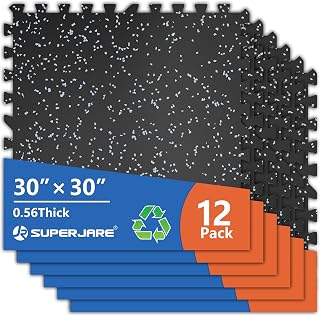
Roughly 2 ft by 2 ft, they let you tile around a water heater, a support post, or a staircase bulkhead without heroic cuts. The interlocks hold well under lateral load from lunges and sled work. Buy 8 percent over your measured area for cuts and mistakes, and choose square-edge tiles over beveled if you’ll ever roll a loaded dumbbell across them.
Rolled Rubber, 8 mm — Best for Cardio and Machine Zones
A single continuous surface means no seams for a treadmill’s vibration to work open. Eight millimeters is plenty under machines and light dumbbell work, but it is not a deadlift surface. Let the roll relax flat for 48 hours before trimming, and double-face tape the perimeter rather than gluing the whole field if you might move.
1-Inch EVA Foam Tiles — Best Budget Starter
Cheap, light, forgiving on knees and spines, and genuinely good for mobility work, planks, and kettlebell flows. They will dent under rack feet and tear at the interlocks if you drag heavy equipment, so treat them as a comfort layer for a designated area rather than a whole-gym solution.
Turf Strip with Attached Pad — Best for Sleds and Sprint Work
A 4 ft wide, 15 ft long lane along one side of a garage transforms what you can train: sled drags, bear crawls, and prowler pushes all want low-friction, and turf is the only surface that gives it without slipping underfoot. Nylon fiber outlasts polyethylene under sled runners.
Rigid-Core Vinyl Plank over Acoustic Underlay — Best for Shared Rooms
If the space is also a home office or guest room, click-lock vinyl over a 3 mm cork or rubber underlay looks like flooring, cleans easily, and handles machines and bodyweight work. Pair it with a 4 ft by 6 ft rubber island where you actually lift. This is the one option here that’s genuinely nice to be barefoot on.
Frequently Asked Questions
Will 3/4-inch rubber protect a concrete slab from dropped weights?
From bumper plates, yes, for years. From repeatedly dropped iron plates or bare barbells, no — nothing thin does. For heavy pulls, build a small platform: two layers of 3/4 inch plywood with stall mat on top, sitting on your existing floor. It spreads the load across the whole footprint instead of concentrating it under the plate edge.
Do I need adhesive?
Rarely in a home setting. Stall mats hold themselves down by weight, and interlocking tiles bind to each other. Glue only the perimeter of rolled rubber, and only if you’re committed to the space, since removing troweled adhesive from concrete is miserable work.
How long does the rubber smell last?
Two to six weeks with airflow, longer in a closed, humid basement. Scrubbing with a dilute simple-green solution and letting mats air outdoors for a weekend cuts it dramatically. Vulcanized products smell noticeably less than crumb-and-binder ones.
Can I put this over carpet?
Interlocking tiles and stall mats work over low-pile carpet, but the padding underneath makes everything feel spongy and unstable for lifts — bad news under a rack. Pull the carpet in the training zone if you can, or lay a sheet of 3/4 inch plywood between carpet and rubber to create a rigid plane.
Final Thoughts
Spend on the drop zone and economize everywhere else. A garage gym built on four stall mats under the rack, thin rolled rubber under the bike, and a turf lane down one wall costs less than a single square of premium branded tile and will outlive the equipment standing on it. Measure your room, sketch your zones on paper, order about 8 percent extra, and give the rubber a weekend outside before it comes indoors. That’s the whole job — and once it’s down, you’ll genuinely never think about it again.

Write Your Review
No reviews yet. Be the first to share your experience!