Key takeaways
- Real hide vs. faux: Top-grain leather on the seating surfaces breathes better and develops a patina, but it costs multiples more. Quality faux leather (polyurethane over a woven backer) holds up fine in low-traffic rooms — it’s bonded leather, which flakes at the seams after a few years, that you want to avoid.
- Wall clearance: A standard recliner needs 12 to 18 inches behind it to open fully. Wall-hugger designs pull the seat forward instead, dropping that to 3 or 4 inches. Measure your wall-to-coffee-table gap before you shop, not after.
- Frame joinery: Kiln-dried hardwood with corner blocks and metal reinforcement at the mechanism mounts is the standard. Flip the sofa and look at where the recline hardware bolts in — if it lands in particleboard, that’s your future failure point.
- Manual vs. power: Manual levers cost less and never need an outlet. Power gives you infinite positions, independent headrest control, and matters a lot if anyone using the sofa has limited grip strength or mobility.
- Assembly reality: Most three-seaters ship in two or three modules that slide together on steel brackets, but a fully assembled section can run 90 pounds. Plan for two people and a clear path through doorways — measure the narrowest turn in your hallway.
What's inside
Buying a reclining sofa online is a gamble most people lose once. The photos look great, the listing promises “premium leather,” and then a 300-pound box arrives with a frame that flexes when you sit down and a recline mechanism that groans on the third pull. Having taken apart more than a few of these to fix a broken pull-cable or re-tension a sagging seat deck, I can tell you the differences that matter are almost never the ones highlighted in the product title. They’re in the hidden stuff: how the seat frame is joined, whether the leather on the seating surface is real hide or a bonded coating, and how much clearance the mechanism actually needs behind it.
This guide sorts through the leather and faux-leather reclining sofas worth considering in 2026, from budget manual three-seaters to full power configurations with adjustable headrests and USB charging. I’ve focused on construction quality, real-world measurements, and how each one behaves after a year of daily use rather than out-of-the-box impressions. You’ll also find a buying checklist covering the specs worth checking before you click, plus answers to the questions that come up most often once the sofa is actually in the room.
As an Amazon Associate we earn from qualifying purchases.


🛒 Best Price Today on Amazon
Prime members get fast, free shipping on everything above, plus member-only deals. New members get a 30-day free trial — cancel anytime.
How to Choose a Leather Reclining Sofa (2026)
- Real hide vs. faux: Top-grain leather on the seating surfaces breathes better and develops a patina, but it costs multiples more. Quality faux leather (polyurethane over a woven backer) holds up fine in low-traffic rooms — it’s bonded leather, which flakes at the seams after a few years, that you want to avoid.
- Wall clearance: A standard recliner needs 12 to 18 inches behind it to open fully. Wall-hugger designs pull the seat forward instead, dropping that to 3 or 4 inches. Measure your wall-to-coffee-table gap before you shop, not after.
- Frame joinery: Kiln-dried hardwood with corner blocks and metal reinforcement at the mechanism mounts is the standard. Flip the sofa and look at where the recline hardware bolts in — if it lands in particleboard, that’s your future failure point.
- Manual vs. power: Manual levers cost less and never need an outlet. Power gives you infinite positions, independent headrest control, and matters a lot if anyone using the sofa has limited grip strength or mobility.
- Assembly reality: Most three-seaters ship in two or three modules that slide together on steel brackets, but a fully assembled section can run 90 pounds. Plan for two people and a clear path through doorways — measure the narrowest turn in your hallway.
The Best Leather Reclining Sofas (2026) Reviewed
Watson & Whitely Genuine Leather Wall Hugger Power Reclining Sofa
This is the most complete package here: genuine leather on the contact surfaces, power recline with independently adjustable headrests, and a wall-hugger mechanism that only asks for a few inches of clearance. The USB-A and Type-C ports are wired into the arm panel rather than dangling from a pigtail, which is the detail that tells you the design was thought through.
THSUPER Power Top Grain Leather Reclining Sofa and Loveseat Set
A genuine top-grain set with power recline, a drop-down center table, and a tall ergonomic backrest that supports anyone over six feet without a separate pillow. Buying sofa and loveseat together also guarantees the hides match — a real problem when you order pieces months apart from the same line.
Genuine Leather Manual Reclining Sofa, Overstuffed Armrest
The smart middle path: real leather where your body touches it, a straightforward manual mechanism with nothing electronic to fail, and generously padded arms that don’t compress into a hard edge. The manual levers are stiff for the first month or so, then loosen into a smooth pull.
Faux Leather Manual Reclining Sofa with 2 Concealed Cup Holders
The hidden cup holders flip out of the center seat and disappear again, so you keep full three-person seating instead of surrendering a spot to a permanent console. In black faux leather it wipes clean with a damp cloth, which makes it a sensible pick for a family media room.
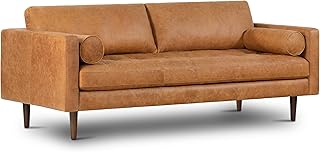
Faux Leather Mid-Century Modern 3 Seat Recliner Sofa
Tapered legs and a tighter profile keep this from reading as a bulky recliner, so it works in a living room where a traditional model would dominate. It’s the leanest silhouette on this list while still delivering full manual recline on all three seats.
Frequently Asked Questions
How much space do I need behind a reclining sofa?
Budget 12 to 18 inches for a conventional mechanism. Wall-hugger models like the Watson & Whitely need roughly 3 to 4 inches because the seat travels forward as the back tilts. Always verify against the manufacturer’s stated clearance rather than eyeballing it.
Is faux leather worth it, or should I pay for genuine hide?
Good polyurethane faux leather performs well for five-plus years in normal use and cleans up easily around kids and pets. Genuine top grain justifies the price if the sofa sees daily heavy use or you want it to look better with age instead of worse.
Can I assemble a three-seat recliner alone?
Technically yes, since the modules slide onto steel brackets, but the sections weigh enough that maneuvering them solo risks scraping the leather or bending a bracket. Get a second pair of hands for the lift and do the bracket alignment yourself.
What usually breaks first, and can it be fixed?
On manual sofas it’s the pull-cable or the release handle; on power models it’s the motor’s control switch. Both are inexpensive replaceable parts available from the manufacturer, and swapping either takes basic hand tools and about twenty minutes.
Final Thoughts
If your budget allows, the Watson & Whitely wall hugger is the best all-around choice — genuine leather, power headrests, integrated charging, and a footprint that works against a real wall. For a full matched room, the THSUPER top-grain set delivers genuine leather in both pieces with a shared hide batch. And if you want real leather without power electronics, the Genuine Leather Manual Reclining Sofa with overstuffed arms is the durable, low-maintenance pick that will still be working in a decade.