Key takeaways
- Measure your junction box first: Most flush mounts use a crossbar bracket with 3.5-inch screw spacing, but older boxes vary. Pop the old fixture off and check before you order — a mismatched bracket means a trip to the hardware store mid-project.
- Match diameter to room size: A 7.5-inch panel handles a closet or small bath. Hallways and average bedrooms want 12 to 13 inches. Going undersized is the most common mistake and no amount of brightness fixes it.
- Prioritize selectable CCT over guessing: Fixtures with 3000K–6500K switching let you tune the room after install rather than living with your best guess. 3000K for bedrooms, 4000K for kitchens, 5000K+ for garages and task areas.
- Verify dimmer compatibility: Integrated LEDs need a dimmer rated for LED loads. Pairing one with an old incandescent rotary dimmer causes flicker and buzz. If you’d rather not swap the switch, look for remote-controlled dimming instead.
- Check for ETL or UL listing: This is non-negotiable for anything hardwired into your home. Unlisted fixtures can fail insurance claims and often skip proper thermal management, which shortens LED life considerably.
What's inside
Swapping out a ceiling light looks like a twenty-minute job until you’re standing on a ladder with the old fixture dangling from its wires, discovering that the mounting bracket doesn’t line up with your junction box, or that the “warm white” you ordered casts your kitchen in the color of weak tea. Anyone who has done this more than once knows the frustration isn’t the wiring — it’s picking the wrong fixture in the first place. Too dim for a hallway. Too harsh for a bedroom. A diffuser that shows every dead bug through the acrylic.
This guide takes a workbench approach: what actually matters when you’re the one holding the wire nuts. I’ve grouped the standouts by where they earn their keep, flagged the details that only show up during install, and skipped the marketing copy about “ambient elegance.” You’ll find selectable color temperature units, dimmable flush mounts, a couple of decorative options, and notes on ceiling clearance, bracket compatibility, and whether a remote is genuinely useful or just another thing to lose in the couch cushions.
As an Amazon Associate we earn from qualifying purchases.




🛒 Best Price Today on Amazon
Prime members get fast, free shipping on everything above, plus member-only deals. New members get a 30-day free trial — cancel anytime.
How to Choose a Light For Ceiling (2026)
- Measure your junction box first: Most flush mounts use a crossbar bracket with 3.5-inch screw spacing, but older boxes vary. Pop the old fixture off and check before you order — a mismatched bracket means a trip to the hardware store mid-project.
- Match diameter to room size: A 7.5-inch panel handles a closet or small bath. Hallways and average bedrooms want 12 to 13 inches. Going undersized is the most common mistake and no amount of brightness fixes it.
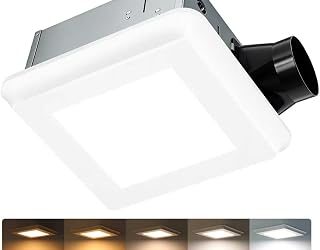
- Prioritize selectable CCT over guessing: Fixtures with 3000K–6500K switching let you tune the room after install rather than living with your best guess. 3000K for bedrooms, 4000K for kitchens, 5000K+ for garages and task areas.
- Verify dimmer compatibility: Integrated LEDs need a dimmer rated for LED loads. Pairing one with an old incandescent rotary dimmer causes flicker and buzz. If you’d rather not swap the switch, look for remote-controlled dimming instead.
- Check for ETL or UL listing: This is non-negotiable for anything hardwired into your home. Unlisted fixtures can fail insurance claims and often skip proper thermal management, which shortens LED life considerably.
The Best Light For Ceiling (2026)s Reviewed
Dimmable LED Flush Mount with Remote Control, 12-Inch
The remote earns its place here — you get full 3000K–6500K adjustment and dimming without touching your wall switch or rewiring anything. At 12 inches and ultra-thin, it disappears into low-clearance bedrooms while still throwing enough light for a full room.
DLLT 13-Inch 5CCT Flush Mount
Five color temperature steps instead of the usual three gives you finer control, and the 24W output is genuinely bright for a fixture this slim. The brushed nickel trim reads more finished than the plain white plastic rings you find at this size, which matters in a hallway you walk past twenty times a day.
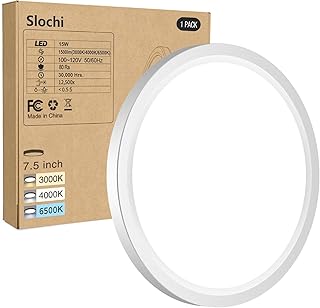
7.5-Inch Ultra Thin Round Flush Mount
This is the workhorse for small spaces — bathrooms, closets, pantries, tight landings. The 100W-equivalent output is plenty for the footprint, and the three-temperature switch means you can run it cool in a utility area without ordering a different SKU.
libtit 13-Inch Dimmable LED Ceiling Light
ETL listed with a solid mounting plate and clean brushed nickel edge, this one installs without fuss and handles standard LED dimmers well. A sensible pick when you want the 13-inch coverage and dimming but don’t need a remote in the mix.
Black 2-Light Farmhouse Flush Mount with Seeded Glass
The only bulb-based fixture on this list, and that’s the appeal — you choose the bulbs, swap them freely, and the seeded glass with matte black hardware brings actual character to an entryway or foyer. Just budget for two quality LED bulbs on top of the fixture cost.
Frequently Asked Questions
Can I install a flush mount ceiling light myself?
If you’re comfortable killing the breaker, testing with a non-contact voltage tester, and joining three wires with wire nuts, yes. Most of these mount to an existing junction box in under thirty minutes. If there’s no box up there, or you find cloth-insulated wiring, bring in an electrician.
Do integrated LED fixtures need to be replaced when they burn out?
Eventually, yes — the LEDs aren’t user-serviceable. Most are rated for 30,000 to 50,000 hours, which is a decade or more of normal use. If replaceability matters to you, go with a bulb-based fixture like the farmhouse two-light.
What color temperature should I use in a kitchen?
4000K is the sweet spot: crisp enough to see what you’re chopping, not so blue that food looks unappetizing. This is exactly why selectable CCT is worth the small premium — you can test both and settle on what looks right in your space.
Why does my new LED fixture flicker?
Almost always the dimmer. Older incandescent dimmers cut power in a way integrated LEDs can’t handle. Swap in an LED-rated dimmer and the flicker disappears. If it persists on a standard switch, check that your neutral connections are tight.
Final Thoughts
For most rooms, the DLLT 13-Inch 5CCT flush mount is the pick I’d install in my own house — enough output, enough color control, and trim that doesn’t look like a rental. The 12-Inch Dimmable with Remote is the smarter choice if your wall switch isn’t dimmer-ready and you’d rather not open up a switch box, while the Black 2-Light Farmhouse option is where to spend your money if the entryway needs personality more than lumens.