Key takeaways
- Connector hardware: Steel bracket-and-pin systems hold alignment far better than plastic clips or fabric hook-and-loop straps. Ask yourself how many times you plan to reshape the sofa, because velcro-style joins loosen after a handful of moves and let gaps open between seats.
- Measure the path, not just the wall: Modular boxes are forgiving, but a 40-inch-deep seat base still needs a doorway, a stair turn, and an elevator to cooperate. Map your tightest pinch point in three dimensions before you order an oversized deep-seat model.
- Cover removability in practice: Look for full-length zippers on every cushion and base panel rather than a slipcover that only pulls off the back. Corduroy and boucle both hide crumbs well, but only genuinely removable covers let you spot-treat instead of scrubbing in place.
- Sleeper and storage mechanics: Pull-out beds add weight and reduce the amount of usable space under the seat, so decide which feature matters more. If you want both, verify the storage compartment sits in a section separate from the bed mechanism.
- Frame and leg load path: Solid wood or steel rails with plywood decking beat particleboard every time. Check that legs bolt into reinforced blocks rather than screwing straight into a thin panel, since that single detail predicts whether the sofa sags in year three.
What's inside
Anyone who has hauled a one-piece sectional up a stairwell knows the frustration: the sofa that looked perfect in the showroom will not clear the landing, and once it does, it only fits one wall in one direction. Modular seating solves that geometry problem by shipping in boxes you can carry solo, then letting you bolt or clip the pieces into whatever shape the room actually wants. The tradeoff is that build quality now lives in the hardware, the frame joinery, and the connector design rather than in one factory-welded chassis, and those details vary wildly between listings that look nearly identical in photos.
This guide comes from the perspective of someone who reads assembly diagrams before checkout and keeps a rubber mallet next to the Allen key. Below are six modular sectionals worth considering in 2026, evaluated on how they go together, how they hold up to reconfiguration, what the storage and sleeper mechanisms actually deliver, and whether the covers survive a wash cycle. Following the picks, you will find a buying checklist and answers to the questions that come up most often once the boxes are open.
As an Amazon Associate we earn from qualifying purchases.


🛒 Best Price Today on Amazon
Prime members get fast, free shipping on everything above, plus member-only deals. New members get a 30-day free trial — cancel anytime.
How to Choose a Modular Sectional Sofa (2026)
- Connector hardware: Steel bracket-and-pin systems hold alignment far better than plastic clips or fabric hook-and-loop straps. Ask yourself how many times you plan to reshape the sofa, because velcro-style joins loosen after a handful of moves and let gaps open between seats.
- Measure the path, not just the wall: Modular boxes are forgiving, but a 40-inch-deep seat base still needs a doorway, a stair turn, and an elevator to cooperate. Map your tightest pinch point in three dimensions before you order an oversized deep-seat model.
- Cover removability in practice: Look for full-length zippers on every cushion and base panel rather than a slipcover that only pulls off the back. Corduroy and boucle both hide crumbs well, but only genuinely removable covers let you spot-treat instead of scrubbing in place.
- Sleeper and storage mechanics: Pull-out beds add weight and reduce the amount of usable space under the seat, so decide which feature matters more. If you want both, verify the storage compartment sits in a section separate from the bed mechanism.
- Frame and leg load path: Solid wood or steel rails with plywood decking beat particleboard every time. Check that legs bolt into reinforced blocks rather than screwing straight into a thin panel, since that single detail predicts whether the sofa sags in year three.
The Best Modular Sectional Sofa (2026)s Reviewed
108″ L-Shaped Modular Sectional with Pull-Out Sleeper, Dark Grey
This one earns its keep as a genuine three-in-one: seven seats, a pull-out bed, and hidden compartments under the seat bases, all in soft corduroy with covers that zip off cleanly. Assembly is straightforward bracket work with no tools beyond what ships in the box, though budget an extra pair of hands for the corner module.
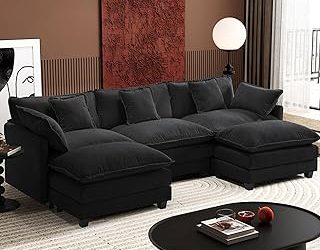
107″ Cloud Couch U-Shaped Modular Sectional, Black
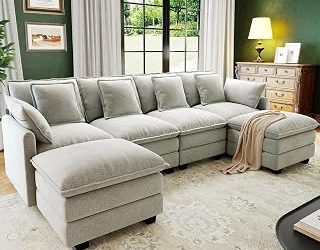
The deep four-seat configuration plus two ottomans gives you real flexibility to run it as a U, an L, or two facing loveseats depending on the season. Six washable pillows do the structural work here, which means fluffing is part of ownership, but the payoff is a sink-in seat depth that firmer sectionals cannot match.
EASE MOOSE Oversized L-Shape Modular Sofa, White
A wide, deep-seated build in a clean white finish that reads more custom than flat-pack once assembled. White upholstery demands a cover-care routine, so treat the fabric before first use and keep the removable panels on a rotation.
HONBAY Modular Sleeper Sofa with Storage, Green
HONBAY has the most refined connector system in this group, and it shows when you break the U-shape down and rebuild it as an L. The corduroy holds its nap well, the pull-out bed deploys without fighting, and the storage bay is sized for actual bedding rather than throw pillows.
108″ U-Shaped Modular Sectional with Pull-Out Bed, Dark Gray
Seven seats, a sleeper, and under-seat storage make this the most feature-dense pick on the list for rooms that double as guest quarters. Expect a longer build session than the L-shaped models, since the U configuration means more panels and more bracket alignment.
Frequently Asked Questions
How long does assembly actually take?
Plan on 45 to 90 minutes for an L-shape and up to two hours for a U-shape, working alone. Most of that time is unpacking and cover-fitting rather than hardware, so clear a staging area before you start cutting boxes.
Can I reconfigure the sofa later without damaging it?
Yes, provided the model uses metal brackets or pin-and-socket joins. Loosen rather than fully remove hardware where possible, and keep the original bag of spare fasteners, because reconfiguring is when small parts disappear.
Are removable covers machine washable?
Most corduroy and woven covers here are, on cold and gentle, but always air dry. Heat shrinks the panels just enough that refitting becomes a wrestling match.
Do modular sleepers work for regular nightly use?
They are best for guests and occasional nights rather than a primary bed. If someone will sleep on it several nights a week, add a three-inch topper to compensate for the folding mechanism.
Final Thoughts
For most rooms, the HONBAY modular sleeper is the smartest all-around buy thanks to its connector hardware and usable storage, while the 108″ L-shaped dark grey sectional delivers the best feature-per-dollar mix of sleeper, storage, and washable corduroy. If deep, sink-in comfort outranks convertibility on your list, the 107″ Cloud U-shaped sectional with its two ottomans is the one to reach for.