Key takeaways
- Load capacity vs. real use: Ratings run from 500 lbs to 4,500 lbs, but the number matters less than how the load is distributed. A bench holding a running miter saw takes more abuse than one holding a static 300-lb engine block, so buy above your expected weight and account for hammering, prying, and leaning.
- Clamping system: Bench dogs and integrated clamps turn a table into a workholding surface. Look for a slotted or perforated top that accepts dogs in multiple positions, plus clamps with enough throat depth (12 inches is generous) to grip thick stock without slipping.
- Setup and teardown time: If it takes ten minutes and two people to open, you’ll leave it folded. Test for one-motion deployment, and check the folded footprint and weight — under 30 lbs is genuinely carryable, over 50 lbs means you’re rolling it.
- Work height and adjustability: Roughly 31 to 35 inches suits most standing tasks; 25 to 30 inches is better for sawhorse duty and sheet goods. Adjustable-leg models let you switch between assembly height and cutting height without a second purchase.
- Surface material and repairability: HDPE resin resists moisture and solvents but scars under a utility knife. MDF or bamboo tops feel better under hand tools and can be replaced. Steel frames outlast plastic ones, so prioritize a metal leg structure regardless of what the top is made from.
Anyone who has tried to rip a sheet of plywood across two stacked buckets knows the problem: the work always outgrows the space you have for it. Garages fill up with cars and bikes, apartment balconies barely fit a chair, and a permanent 6-foot bench with a cast-iron vise is a fantasy for most of us. So the cutting happens on the floor, the sanding happens on the kitchen table, and the assembly happens wherever there’s room to kneel. Nothing gets clamped properly, and the results show it.
A portable workbench solves that by giving you a flat, clampable surface that disappears when the project ends. But the category is broad — some models are essentially foldable sawhorses, others are full mobile stations with outlets and casters, and a few are modular platforms built to swallow entire sheets of plywood. This guide breaks down what actually matters when you’re shopping in 2026, then walks through five benches I’d recommend depending on whether you’re framing a deck, building cabinets, or just needing somewhere solid to fix a bike.
Our top picks

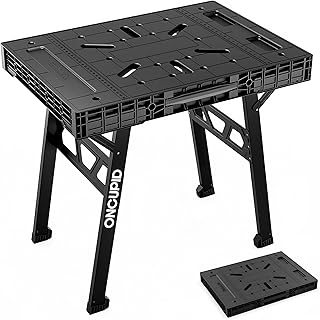


As an Amazon Associate we earn from qualifying purchases at no extra cost to you. Ratings are shown as listed on Amazon.
🛒 Best Price Today on Amazon
Prime members get fast, free shipping on everything above, plus member-only deals. New members get a 30-day free trial — cancel anytime.
How to Choose a Portable Workbench (2026)
- Load capacity vs. real use: Ratings run from 500 lbs to 4,500 lbs, but the number matters less than how the load is distributed. A bench holding a running miter saw takes more abuse than one holding a static 300-lb engine block, so buy above your expected weight and account for hammering, prying, and leaning.
- Clamping system: Bench dogs and integrated clamps turn a table into a workholding surface. Look for a slotted or perforated top that accepts dogs in multiple positions, plus clamps with enough throat depth (12 inches is generous) to grip thick stock without slipping.
- Setup and teardown time: If it takes ten minutes and two people to open, you’ll leave it folded. Test for one-motion deployment, and check the folded footprint and weight — under 30 lbs is genuinely carryable, over 50 lbs means you’re rolling it.
- Work height and adjustability: Roughly 31 to 35 inches suits most standing tasks; 25 to 30 inches is better for sawhorse duty and sheet goods. Adjustable-leg models let you switch between assembly height and cutting height without a second purchase.
- Surface material and repairability: HDPE resin resists moisture and solvents but scars under a utility knife. MDF or bamboo tops feel better under hand tools and can be replaced. Steel frames outlast plastic ones, so prioritize a metal leg structure regardless of what the top is made from.
The Best Portable Workbenches (2026), Reviewed
TLGREEN 7-in-1 Multifunctional Portable Workbench
This is the Swiss Army knife of the group, converting between workbench, sawhorse, scaffold, creeper, dolly, and hand truck, with a built-in power outlet that saves you dragging an extension cord across the floor. It’s the strongest pick for a cramped single-bay garage where one tool has to cover a lot of ground.
BORA Centipede 4×6 ft Folding Work Table
The Centipede unfolds like a scissor lattice into a 4×6-foot platform rated to 4,500 lbs, and it’s the only design here that comfortably supports a full sheet of plywood for track-saw cuts. It weighs little, packs into a carrying bag, and accepts 2×4 brackets so you can build a sacrificial top for cutting.
Keter Heavy-Duty Folding Workbench
Keter’s resin-and-steel bench has earned its reputation on reliability: 1,000-lb capacity, 12-inch adjustable clamps, and a top that shrugs off rain and spilled finish. It’s the low-drama choice for homeowners who want dependable clamping without fussing over maintenance.
Pony 2-in-1 Portable Folding Work Table
Pony targets woodworkers specifically, pairing height adjustability from 25 to 35 inches with four clamps and four bench dogs — enough workholding to handle joinery and glue-ups, not just rough cuts. The dual bench-and-sawhorse function means it earns its floor space twice over.
Heavy-Duty Portable Workbench, 1,650 lbs Capacity
With a fully welded steel leg structure, no assembly required, and a 1,650-lb rating in a compact 34-by-25-inch footprint, this one is built for automotive and metalwork abuse rather than fine woodworking. If you need a bench you can hammer on without flex, start here.
Frequently Asked Questions
Can a portable workbench replace a permanent bench?
For most home projects, yes. What you give up is mass — a heavy stationary bench absorbs hand-plane and chisel forces better. Adding weight to the lower shelf or clamping the bench to a wall helps close that gap.
How much capacity do I actually need?
Home woodworking and repairs rarely exceed 500 lbs of static load, so a 1,000-lb rating gives comfortable margin. Go higher if you plan to support engine components, appliances, or long lumber loads.
Are folding workbenches stable enough for power tools?
Good ones are, provided you deploy them on level ground and lock every leg. Mount saws and routers to a plywood subtop rather than clamping directly to a resin surface, which reduces vibration and prevents cracking.
Can I leave one outdoors?
Resin-topped models with powder-coated steel legs handle occasional exposure, but no folding bench should live outside year-round. Moisture reaches the hinges and pivot pins first, and once those bind, deployment becomes a two-person job.
Final Thoughts
For most makers, the Keter Heavy-Duty Folding Workbench hits the best balance of clamping capability, durability, and price, while the BORA Centipede is the clear winner if you regularly break down sheet goods and need a large, low platform that packs into a bag. If your garage has to serve as woodshop, garage, and staging area all at once, the TLGREEN 7-in-1 earns its keep by replacing several tools you’d otherwise be tripping over.