Key takeaways
- Ceiling-mounted forced air unit heater turns garages, barns,…
- 50,000 BTUs heat up to 1,667 sq ft,…
- Compatible with standard 24-volt or new Wi-Fi enabled…
Best Propane Garage Heaters: How to Size BTU to Your Space
The best propane garage heater is the one whose BTU output matches your garage’s actual cubic footage and insulation level — not the biggest unit you can afford. As a rule of thumb, start with 30–40 BTU per square foot for a well-insulated garage, 40–50 BTU per square foot for average insulation, and 50–60 BTU per square foot for an uninsulated or drafty space, then adjust upward for high ceilings, cold climates, and unheated slab floors. A 24,000 BTU unit comfortably handles a typical insulated two-car garage; a single-car uninsulated garage in a cold climate may need 30,000–45,000 BTU; and a large, poorly sealed shop can demand 60,000–80,000 BTU or more.
That single number — BTU — determines everything downstream: which models make sense, how big a propane tank you need, how far the heater must sit from walls and vehicles, and whether you can use a radiant unit that heats objects or a forced-air unit that heats the air. Get the sizing right and almost any reputable heater performs well. Get it wrong and you either freeze or waste money on fuel and oversize equipment.
Our top picks
 Mr. Heater 50
- Ceiling-mounted forced air unit heater turns garages, barns,…
- 50,000 BTUs heat up to 1,667 sq ft,…
- Compatible with standard 24-volt or new Wi-Fi enabled…
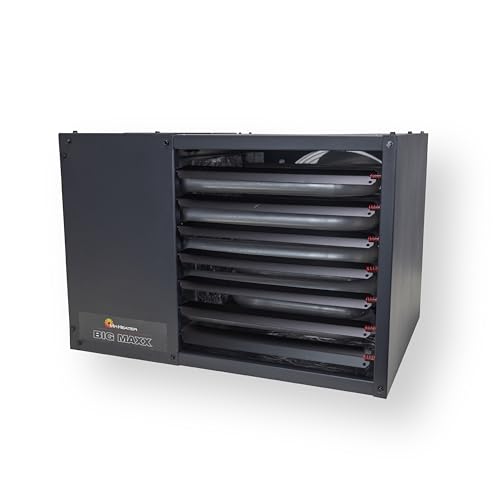 Mr. Heater 80
- Ceiling mounted forced air propane unit heater turns…
- 80,000 BTUs heat up to 2,667 square feet
- Color may vary between grey and tan
| Product | Key specs | |
|---|---|---|
| Mr. Heater 50 | Ceiling-mounted forced air unit heater turns garages, barns,… 50,000 BTUs heat up to 1,667 sq ft,… Compatible with standard 24-volt or new Wi-Fi enabled… | Check price |
| Mr. Heater 80 | Ceiling mounted forced air propane unit heater turns… 80,000 BTUs heat up to 2,667 square feet Color may vary between grey and tan | Check price |
 Avenger Portable Outdoor Propane Cabinet Heater Avenger Portable Outdoor Propane Cabinet Heater | Check price | |
 Mr. Heater Original 540-Degree 45 Mr. Heater Original 540-Degree 45 | Multi-directional radiant propane heater mounts directly to a… High-medium-low regulator: 45,000-36,000-30,000 BTUs Tip-over safety shut-off switch | Check price |
As an Amazon Associate we earn from qualifying purchases at no extra cost to you.
The BTU Formula, Step by Step
Manufacturers and HVAC references converge on a straightforward method: calculate the garage’s volume, then apply a BTU factor per cubic foot, then multiply by an insulation and climate multiplier. Here is the working sequence.
Step 1: Measure the volume, not the floor area
Multiply length × width × ceiling height. A 20 × 20 ft garage with an 8 ft ceiling is 3,200 cubic feet. A 24 × 24 ft garage with a 10 ft ceiling is 5,760 cubic feet. A 30 × 40 ft shop with a 12 ft ceiling is 14,400 cubic feet. High ceilings matter more than most buyers expect, because warm air stratifies. A garage with a 12 ft ceiling can need 25–40% more heat than the same footprint with an 8 ft ceiling.
Step 2: Apply a BTU-per-cubic-foot factor
Common working figures:
- Well insulated, sealed, moderate climate: about 2.5–3 BTU per cubic foot
- Average insulation, some drafts: about 3.5–4.5 BTU per cubic foot
- Uninsulated, unsealed, or frequently opened doors: about 5–6 BTU per cubic foot
For that 3,200 cubic foot two-car garage with average insulation, you land around 11,200–14,400 BTU. That is well inside the range of a small radiant unit. For the 5,760 cubic foot garage, you land around 20,000–26,000 BTU. For the 14,400 cubic foot shop, uninsulated, you land at 72,000–86,000 BTU — which puts you squarely in large forced-air or multi-unit territory.
Step 3: Adjust for climate and door traffic
Add roughly 10–20% if you routinely see single-digit or sub-zero winter temperatures. Add 10–15% if you open a large overhead door several times a day in a working shop. Subtract nothing for a mild climate — instead, size at the low end so the unit cycles rather than short-cycles.
Quick Size Chart
| Garage size (L × W × H) | Cubic feet | Insulation level | Recommended BTU output | Typical heater type |
|---|---|---|---|---|
| 12 × 20 × 8 ft (single car) | 1,920 | Well insulated | 6,000–10,000 | Mounted radiant panel or small forced-air |
| 12 × 20 × 8 ft (single car) | 1,920 | Uninsulated | 10,000–18,000 | Radiant tank-top or compact forced-air |
| 20 × 20 × 8 ft (two car) | 3,200 | Well insulated | 10,000–14,000 | Small forced-air or radiant |
| 20 × 20 × 8 ft (two car) | 3,200 | Average | 14,000–20,000 | Forced-air, 15,000–20,000 BTU class |
| 24 × 24 × 9 ft (two car, deep) | 5,184 | Average | 22,000–28,000 | Forced-air, 30,000 BTU class on low setting |
| 24 × 24 × 10 ft | 5,760 | Uninsulated | 28,000–38,000 | Forced-air, 30,000–40,000 BTU |
| 30 × 30 × 12 ft (shop) | 10,800 | Average | 40,000–50,000 | Forced-air, 40,000–60,000 BTU |
| 30 × 40 × 12 ft (large shop) | 14,400 | Uninsulated | 60,000–90,000 | Large forced-air or two staged units |
| 40 × 60 × 14 ft (workshop/barn) | 33,600 | Well insulated | 80,000–110,000 | Two large forced-air units or ducted system |
These are starting points for a 20–30°F temperature rise over outdoor air, which is what most garage users actually want — enough to work comfortably in a sweatshirt, not to create a living-room environment. If you want a 50–60°F rise in a cold climate, double the low-end figure.
Radiant vs. Forced-Air: What Actually Changes for You
Both types burn propane. The difference is where the heat goes and what that means for comfort, clearance, and placement.
Radiant (infrared) propane heaters
Radiant units emit infrared energy that warms people, tools, vehicles, and floors rather than the air. That produces near-instant warmth when you stand in front of them, which is why they are popular in garages used for short, intermittent work sessions. They are typically quiet, need no electricity for the burner (some need power for a fan or ignition), and can be mounted overhead or used as portable tank-top units.
The trade-off is uneven coverage. Radiant heat is directional: the floor under the unit gets warm, the corners do not. Clearance matters a great deal, because the reflector face radiates toward whatever is in front of it. Common clearance guidance for overhead radiant units is 24–36 inches from combustible walls and ceilings, and enough distance from the floor that you are not baking the slab directly beneath. Vehicles parked close to a radiant unit can absorb heat that never reaches your workbench.
Forced-air propane heaters
Forced-air units use a burner and a fan to push heated air through the room. They heat the air, so the whole volume warms, though it takes longer to feel it. They distribute more evenly and work better in larger or oddly shaped spaces, which is why most 30,000 BTU and up garage heaters are forced-air. The trade-offs are noise (the fan runs constantly while heating), electricity use (they need a power source, typically 120V), and air movement that can stir up dust in a woodshop.
Forced-air units also have different clearance needs. They generally require 6–12 inches of clearance around the enclosure for airflow intake and exhaust, plus specific distances from the vent termination outside. Mounting height is usually specified by the manufacturer — commonly 8–10 ft to the bottom of the unit in a garage with vehicles below.
Comparison Table: Radiant vs. Forced-Air
| Factor | Radiant propane heater | Forced-air propane heater |
|---|---|---|
| What it heats | Objects, people, floor surfaces | Air in the room |
| Time to feel warmth | Nearly immediate when in line of sight | 10–30 minutes to warm the volume |
| Coverage | Directional, uneven | Whole-room, more even |
| Typical output range | 8,000–45,000 BTU | 15,000–125,000+ BTU |
| Electricity needed | Often none for the burner | Yes, typically 120V for fan and ignition |
| Noise | Silent unless it has a fan | Fan noise while running |
| Mounting clearance | 24–36 in. from combustibles typical | 6–12 in. around enclosure, per manual |
| Venting | Vented or vent-free variants | Vented (most common) or vent-free |
| Best for | Spot heating, quick sessions, small garages | Larger spaces, long work sessions, even temperature |
| Typical price range | Usually $100–$500 | Usually $150–$900 |
Vented vs. Vent-Free: The Safety Decision
Any propane heater that burns fuel indoors produces carbon monoxide and water vapor. How you handle that exhaust determines what kind of installation you can do.
Vent-free (unvented) heaters
Vent-free units burn propane and release combustion byproducts into the room. They are allowed in some jurisdictions and prohibited in others, and they always require ventilation — typically a source of outside air and some means of exhausting air, plus a working CO alarm. They also add significant moisture to the air, which can condense on cold tools and cause rust. In a garage, moisture is a real durability concern for anything steel.
Vent-free units are usually the cheapest and simplest to install, since you do not need a wall or roof penetration. They are best suited to well-ventilated, intermittently used spaces, and to lower-BTU radiating panels used for spot warmth rather than whole-room heating.
Vented heaters
Vented units exhaust combustion gases outdoors through a wall or roof vent. They cost more and require a penetration through the building envelope, plus correct clearances from windows, doors, and air intakes around the exterior. In exchange, they avoid indoor moisture buildup and CO accumulation, which makes them the better choice for a garage you heat regularly or one with stored metal equipment.
Most high-output forced-air garage heaters — the 40,000–125,000 BTU class — are vented and often designed for horizontal or vertical venting with specific pipe lengths and elbows. Check the manual before assuming a horizontal vent run will work; long runs and too many elbows can cause draft problems.
Tank Sizing: How Long Will a Cylinder Last?
Propane consumption scales directly with BTU. A gallon of propane contains roughly 91,500 BTU, and a pound is about 21,600 BTU. To estimate runtime, divide the heater’s rated input by the energy content of your tank.
Practical rules:
- A 20 lb (about 4.7 gallon) grill-style tank holds roughly 430,000 BTU of usable energy — but cold weather cuts usable output, and a heavily drawn tank can frost and stall.
- A 30,000 BTU heater pulling from a 20 lb tank runs for roughly 10–12 hours at full output in mild weather, less as the tank chills.
- A 40 lb tank holds about 9.4 gallons, roughly 860,000 BTU, doubling runtime.
- A 100 lb tank holds about 23.6 gallons, roughly 2.1 million BTU, which is the practical minimum for a 60,000–80,000 BTU heater used in long sessions.
- Beyond 100 lb, most buyers switch to a permanent 120- or 500-gallon tank with a fixed line.
Two cold-weather realities matter more than the math. First, propane vaporization drops as temperature falls, so a small tank that works fine at 45°F may not keep up at 10°F. Second, a high-draw heater on a small tank can cause frost on the tank exterior, further reducing pressure. For anything above 40,000 BTU operated in genuine winter, a 100 lb tank is a sensible floor, and two tanks with a switchover valve is a common shop setup.
Clearance, Mounting, and Placement Realities
Clearance is where garage heater installations most often go wrong, because garages are full of combustibles — gasoline cans, shop rags, cardboard, lumber, and vehicle interiors.
- To combustible walls and ceilings: follow the manual exactly. Overhead radiant units frequently specify 24–36 inches; forced-air units often specify less around the unit body but more around the vent.
- To the floor: mounted unit bottoms are commonly listed at 7–10 ft for garages with vehicles underneath.
- To vehicles: keep parked cars clear of the heater’s discharge path or radiant face. Gasoline vapors are heavier than air and can collect near the floor.
- To the propane tank: tanks belong outside, with the hose routed through a wall or under a door gap with a protective sleeve. Never store a propane cylinder indoors or in an attached garage.
- Vent termination: typically at least 12 inches from any opening window or door and well clear of soffits, per manufacturer and local code.
Sizing the space also means thinking about where you actually work. If your bench is on the far wall from the only sensible heater location, a forced-air unit with adjustable louvers will serve you better than a radiant panel pointed at the middle of the floor.
What Actually Matters When You Buy
Strip away the marketing and a propane garage heater is judged on a short list of attributes:
- Rated BTU input and output: the input figure tells you fuel consumption; efficiency tells you output. Most modern propane heaters run 80% or better, but check whether the quoted number is input or output.
- Turn-down ratio: a two-stage or modulating unit at 30,000/20,000 BTU is far more comfortable in a 5,000 cubic foot garage than a single-stage 30,000 BTU unit that short-cycles.
- Thermostat control: a built-in or remote thermostat turns a heater into a set-and-forget appliance. This is the single biggest quality-of-life feature difference between entry-level and mid-range units.
- Ignition type: standing pilot, spark ignition, and hot-surface ignition each have different power and reliability profiles. Direct-spark is common in mid-range units and avoids a continuously burning pilot.
- Safety systems: look for an oxygen depletion sensor on vent-free units, a flame rollout switch and high-limit switch on forced-air units, and tip-over protection on portables.
- Power requirement: most forced-air units need 120V. In a detached garage without power, you are limited to vent-free radiant or battery/millivolt ignition options.
- Build and warranty: heat exchangers are the wear item. A 5- to 10-year heat exchanger warranty signals a better-built unit than a 1-year blanket warranty.
Insulation: The Cheapest BTU You Will Ever Buy
Before spending on a bigger heater, consider that insulation changes the required BTU more than any other single variable. Going from uninsulated to R-13 walls and R-30 ceiling in a two-car garage can cut the needed output by 30–40% — roughly the difference between a 40,000 BTU and a 24,000 BTU heater, plus years of lower fuel use and less heater cycling.
Priorities, in order of return:
- Seal and insulate the ceiling plane first. Heat rises, and an uninsulated lid wastes the most.
- Air-seal around the overhead door and any penetrations. A 1/4-inch gap around a 16 ft door is a large hole in BTU terms.
- Insulate walls to at least R-13 where practical.
- Consider an insulated overhead door or a door insulation kit.
- Add a ceiling fan or air circulator to push stratified warm air back down — often worth several thousand effective BTU.
Decision Matrix: Match Your Situation to a Heater Type
| Your situation | Recommended type | Working BTU range | Key reasons |
|---|---|---|---|
| Rented space, no wall penetrations allowed | Portable vent-free radiant | 8,000–18,000 | No install, no permanent vent, easy to remove |
| Small insulated single garage, occasional use | Radiant or small forced-air | 10,000–18,000 | Quick warm-up, low cost, easy mounting |
| Two-car garage, working hours at a time | Forced-air, vented, thermostat | 24,000–30,000 | Even heat, set-and-forget, no moisture issues |
| Uninsulated two-car garage, cold climate | Forced-air, vented, two-stage | 30,000–45,000 | Covers losses, staged output avoids short cycling |
| Detached shop, no electrical service | Radiant, millivolt or tank-top | 10,000–30,000 | No fan power required |
| Large workshop 1,000+ sq ft | Forced-air, vented, high output | 60,000–100,000 | Volume demands high output; venting controls moisture |
| Woodshop with dust concerns | Overhead radiant or vented forced-air with filtration | 20,000–40,000 | Radiant stirs less dust; forced-air needs filter maintenance |
| Garage used for storage plus occasional projects | Forced-air with thermostat on low | 15,000–24,000 | Maintains above-freezing temps, protects stored goods |
Real-World Installation Notes
A few practical details separate a heater that works from one that annoys you for years.
Mounting height and reach. If you mount a forced-air unit at 9 ft, you will need a ladder every time you service the filter or reset the unit. Many owners choose 8 ft specifically so a step stool reaches it. Radiant overhead units on chains are usually hung so the bottom face sits 8–10 ft above the floor, angled slightly toward the main work area.
Gas line vs. hose. Portable tank-top heaters use a hose and regulator, commonly 5–10 ft long. Permanently mounted units typically use a rigid or semi-rigid gas line from an exterior regulator and tank. Hose length is limited by pressure drop; longer runs need a larger-diameter hose or a two-stage regulator.
Power. A 120V circuit is standard for forced-air garage heaters, but check the amperage. Most residential units draw 2–6 amps, well within a 15A circuit, but a shared garage circuit powering a freezer and lights may not tolerate the addition.
Thermostat placement. Mount the thermostat away from the heater’s discharge path and away from the overhead door. A thermostat near a cold door will run the heater constantly; one in the warm discharge stream will shut it off too early.
Startup smell. New heaters commonly burn off manufacturing oils for the first 10–20 minutes. Ventilate during first use.
Cost to Run: A Rough Sense of Scale
Propane prices vary widely by region and season, so treat these as illustrative. At a typical residential propane price, a 30,000 BTU unit running continuously for one hour consumes roughly a third of a gallon. Over a winter of, say, 200 hours of use, that is around 65–70 gallons. A 60,000 BTU unit doubles that. Insulation, thermostat setbacks, and cycling behavior move these numbers more than brand choice does.
For comparison, electric resistance heat delivers about 3,412 BTU per kilowatt-hour. Propane is generally cheaper per delivered BTU in most North American markets, which is the main reason propane dominates the garage-heating category.
Common Sizing Mistakes
- Oversizing “for safety.” A 60,000 BTU heater in a 3,200 cubic foot garage will short-cycle, wear the ignition system, and feel drafty rather than comfortable.
- Ignoring ceiling height. A 10 ft ceiling adds 25% volume over 8 ft for the same footprint.
- Forgetting the door. An uninsulated 16 ft overhead door can represent a third of the wall area.
- Assuming all BTUs are equal. Radiant heats differently. A 24,000 BTU radiant unit can feel warmer than a 24,000 BTU forced-air unit when you are standing in its line of sight, but colder elsewhere.
- Undersizing the tank. The most common real-world failure is a correctly sized heater starved by a tank too small for cold-weather vaporization.
The Short Version
Measure your garage in cubic feet, pick a BTU-per-cubic-foot factor between 2.5 and 6 based on insulation and drafts, adjust for climate and door traffic, and you have your target output. Choose radiant for spot warmth and intermittent use, forced-air for whole-room comfort and larger spaces. Go vented if you heat regularly or store metal tools; go vent-free only where ventilation and local rules allow it. Size the tank to the heater’s appetite — 100 lb and up for anything over 40,000 BTU in real winter. And before you buy the bigger unit, spend some of that budget on insulation, because every dollar there buys more effective BTU than any upgrade at the heater itself.