Key takeaways
- 7,500-watt high setting addresses more heat demand than 5,000-watt models.
- Remote-controlled thermostat offers a published 50 to 85 degree F range.
- Included bracket supports either wall or ceiling placement with louvers.
Garages lose heat through opening doors, cold slabs, and uninsulated walls. A garage heater needs an electrical and mounting plan before you choose controls. These six electric, fan-forced shop heaters include five fixed 240-volt models and one specialized 240-volt plug-in alternative. Some storage garages are unsuitable: the Consumer Product Safety Commission emphasizes clearance from combustibles, and several manufacturer manuals prohibit use near gasoline vapors, paint solvents, or combustible dust.
Quick Verdict: The Dr. Infrared Heater DR-975 is our Best Overall pick for a suitable, professionally wired garage: its documented 7,500-watt high setting, lower heat setting, remote thermostat, and adjustable wall or ceiling mounting give buyers practical control. The Comfort Zone CZ230ER offers lower-cost digital controls if its circuit requirements fit. These are editorial choices based on published specifications as of October 2026, not in-house testing.
As an Amazon Associate we earn from qualifying purchases.
By DIY Ideas 4 Home Editorial Team
The 6 Best Garage Heaters Reviewed
We selected identifiable models using manufacturer specifications and installation manuals, then cross-checked listings for their exact configurations. The deciding factors were rated wattage at 240 volts, connection method, usable controls, published physical size, and installation demands. Shopping prices in this selection span roughly $145 to $1,530 as of October 2026, before a new circuit or electrician’s labor. A heater that claims to cover 750 square feet cannot promise that result in a drafty uninsulated shop; the same wattage produces the same heat regardless of branding.
| Product | Best For | Key Spec | Listed Price (as of October 2026) | Watch Out For |
|---|---|---|---|---|
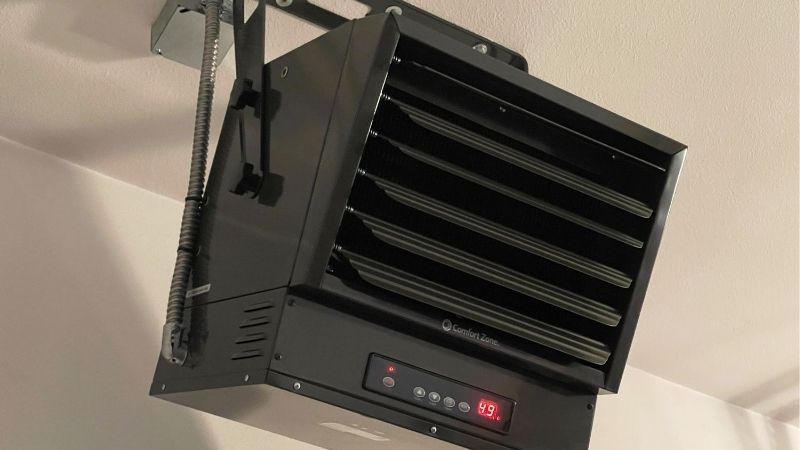
| Dr. Infrared Heater DR-975 | Best Overall: flexible fixed heat | 7,500 W high; 240 V; wall or ceiling mount | $240.00 at Home Depot | Hardwired circuit and exact manual clearances required |
| Comfort Zone CZ230ER | Best Value: digital overhead heat | 7,500 / 6,250 W; 240 V; remote | $144.97 at Home Depot | Manufacturer manual calls for a 40 A circuit |
| Dyna-Glo EG7500DGP | Mechanical thermostat and two settings | 7,500 / 5,000 W; 240 V; ceiling mount | $249.99 at Home Depot | Knob control requires reaching heater unless rewired |
| DuraHeat EUH5000 | Existing 240 V plug-in workshop | 4,800 W; NEMA 6-30P; portable or mounted | $159.95 at Home Depot | Cannot plug into a normal 120 V receptacle |
| Fahrenheat FUH5-4 | Warm-air fan-delay operation | 5,000 W; 240 V; 270 CFM | $686.00 at Northern Tool | Manual thermostat, no remote, hardwired installation |
| King Electric KB2407-1-B2-ECO | High-airflow workshop heating | 7,500 W; 240 V; 690 CFM | $1,529.99 at Northern Tool | Premium upfront cost and permanent wiring |
Dr. Infrared DR-975: Best Overall
Best For: Owners planning a permanent shop circuit who want remote temperature changes and a directional fan without floor clutter.
A ceiling-mounted heater is only convenient if its controls remain usable once it is overhead. The DR-975 pairs a remote-controlled thermostat with adjustable front louvers, so it better accommodates changing work areas than the dial-only Fahrenheat unit. Its wall-mount option also helps when joists, storage racks, or a garage-door track complicate ceiling placement. It is not a convenient weekend purchase if the building lacks a correctly sized dedicated circuit.
Dr. Heater’s DR-975 product page identifies a 7,500-watt high output on 240-volt power, a thermostat range of 50 to 85 degrees F, and an optional external wall thermostat connection. Its DR-975 owner’s manual documents a lower 4,700-watt heat option, rather than a variable-speed economy claim. Home Depot listed the DR-975 for $240.00 in October 2026, in the mid-range of this set; the official product page also states a one-year limited component warranty and identifies UL/cUL listing for this model. Verify the listing identity and current certification details when ordering.
At approximately 15 inches long, 19 inches wide, and 13 inches high, with a stated 26-pound product weight, this is a substantial overhead installation rather than a compact desk appliance. Its enclosed lubricated motor reduces routine oiling, but the intake and louvers still require periodic dust inspection with power isolated. The DR-975 manual specifies a properly installed breaker and its own mounting distances; hire a licensed electrician for the supply and do not place solvents or fuel containers in the heated workspace.
Pros:
- 7,500-watt high setting addresses more heat demand than 5,000-watt models.
- Remote-controlled thermostat offers a published 50 to 85 degree F range.
- Included bracket supports either wall or ceiling placement with louvers.
Cons:
- Requires permanent 240-volt wiring, unlike the plugged DuraHeat alternative.
- One-year component coverage is shorter than some buyers expect.
Who Should Buy It: Choose it for a planned, code-compliant renovation with changing work zones; choose the DuraHeat EUH5000 if a proper 240-volt receptacle already exists and ceiling wiring is undesirable.
Comfort Zone CZ230ER: Best Value
Best For: Buyers seeking remote and digital temperature control for a hardwired garage heater without an industrial-unit price.
Paying less does not automatically mean giving up high heat output. The CZ230ER combines the same 7,500-watt maximum rating as the DR-975 with a second heat setting, a digital thermostat, and a handheld remote. That is why it is the value pick rather than simply the lowest-cost heater in the chart. Its more demanding installation requirements are central to the decision: price the electrical work before deciding whether the apparent savings will survive the project.
Comfort Zone’s CZ230ER manual specifies 7,500 watts on high, 6,250 watts on low, and 31.3 amperes at 240 volts, plus an approximate 18-foot horizontal air throw. The same document calls for a recommended 40-amp breaker and appropriately specified copper conductors, with the actual installation subject to code and electrician verification. Home Depot’s October 2026 listing was $144.97, a notably lower entry price than the DR-975, and the manufacturer’s CZ230ER manual provides a one-year defects warranty. The two heat selections are not evidence of a fundamentally more efficient resistance heater.
The manufacturer’s installation drawing depicts an approximately 14-inch-wide housing and specifies a roughly 25- to 30-pound unit weight for the series. Clearance around the mounted body, the open doorway, and storage shelving matters more than bare casing size. A rear-access service area and a fan that can accumulate workshop dust also deserve attention. In the CZ230ER manual, operation is limited to indoor dry locations without gasoline, paint, flammable liquids, or combustible dust; that restriction can disqualify an otherwise attractive installation.
Pros:
- 6,250-watt low mode adds a distinct output choice below the 7,500-watt peak.
- Digital temperature adjustment and included remote suit an overhead bracket mount.
- October retailer listing under $150 leaves more purchase budget for wiring.
Cons:
- Recommended 40-amp circuit may require electrical-panel capacity upgrades.
- Not suitable for garages where combustible dust or solvent vapors linger.
Who Should Buy It: Buy it if your electrician confirms the 40-amp supply and clearances; consider the Dr. Infrared DR-975 when wall mounting and its different control layout are more useful.
Dyna-Glo EG7500DGP: Knob-Control Option
Best For: Workshop users preferring a physical thermostat dial and distinct heat-output switch over remote menus.
Some garages have predictable hours: turn on heat, work, turn it down, leave. The EG7500DGP suits that routine because the on-unit dial and output selector are straightforward and visible. It also includes a separate caution indicator that signals an abnormal overheat condition, a useful inspection cue in an area where sawdust or debris may collect. The limitation is access: if the unit is mounted high, setting changes are less convenient than on the remote-operated Comfort Zone.
Dyna-Glo’s EG7500DGP owner’s manual shows selectable 5,000- and 7,500-watt heat levels at 240 volts, a thermostat that cycles the heating element, and a red caution light tied to thermal cutout. Its manual also explains the optional external-thermostat connection, which must be designed and wired correctly rather than improvised. Home Depot listed the specific EG7500DGP at $249.99 in October 2026. This is not the brand’s EG7500DH digital variant, and advertising that model’s remote or touch panel here would mislead shoppers.
Lowe’s model-specific specifications report a width of 14 inches, height of about 12.63 inches, depth of 10.63 inches, and weight of 25.3 pounds. That footprint fits many overhead bays, but the joist position must also leave room for ductless fan discharge and the electric connection. The manual instructs owners to stop operation when the red warning indicator is on, find the cause of overheating, and clean only after disconnecting supply power. If you expect frequent adjustment from the shop floor, include a properly rated wall-control plan in the installation quote.
Pros:
- 5,000-watt first setting permits lower output before the 7,500-watt position.
- Separate caution lamp gives a clear response to thermal-limit activation.
- Adjustable mounting direction makes airflow placement distinct from fixed grills.
Cons:
- Mechanical controls are awkward to reach after high-ceiling mounting.
- External thermostat capability entails additional approved wiring and components.
Who Should Buy It: Choose this for simple physical controls and a qualified permanent installation; the Comfort Zone CZ230ER is better suited to changing settings remotely from the floor.
DuraHeat EUH5000: Best for Existing 240 V Outlets
Best For: A small workshop already equipped with the correct 240-volt receptacle where movable heat matters more than permanent mounting.
The most meaningful distinction here is the power connection. While five picks call for permanent wiring, this DuraHeat offers a factory-style plug-in approach with a mounting bracket and the option to reposition the heater when the work layout changes. It can make more sense than paying to hardwire a single fixed head in a garage that already has a matching outlet. But the outlet itself is not optional: an ordinary household plug, an adapter, or a makeshift extension is not a substitute for the required supply.
Home Depot’s model-specific EUH5000 listing gives a 4,800-watt rating at 240 volts, approximately 16,400 BTU per hour, and a requirement for a NEMA 6-30P connection. The October 2026 listed price was $159.95, putting this compact utility unit near the bottom of the group’s purchase range. DuraHeat’s EUH5000 owner’s manual describes thermostat operation and overheat protection. The wattage is lower than the 5,000-watt FUH5-4 and appreciably below the three 7,500-watt high-output models; do not assume its small metal case compensates for the difference.
The EUH5000’s published dimensions are approximately 13 inches high, 9 inches wide, and 11 inches deep, at about 9.75 pounds. That makes the physical unit easier to move than the King workshop heater, though it must sit on a stable approved surface or be mounted as the manual instructs. Check the length of the existing power cord, plug orientation, and position of the receptacle before buying. Keep the heater clear of wood shavings and never use it while flammable products are being sprayed, poured, or evaporated nearby.
Pros:
- 4,800-watt output works with a correctly matched 240-volt outlet.
- Approximately 9.75-pound body is simpler to relocate than ceiling units.
- Included mounting hardware supports a second placement option in the shop.
Cons:
- Requires a dedicated-style NEMA 6-30 receptacle, not a standard wall outlet.
- Lower maximum output limits comfort in leaky high-ceiling garages.
Who Should Buy It: Use this model when the right receptacle exists and projects shift around; the Dr. Infrared DR-975 is more appropriate when permanent 7,500-watt heat is the priority.
Fahrenheat FUH5-4: Best for Fan Delay
Best For: Owners who dislike an initial blast of unheated air and prioritize conventional mechanical operation over remote features.
The FUH5-4’s value lies in how it manages the blower, not a claim that it makes more heat per watt. Instead of immediately circulating cold garage air at startup, its fan waits until the heating element warms. After the thermostat stops calling for heat, the fan continues briefly to remove residual heat. That sequence can be particularly welcome in a work bay where the discharge points near a stationary bench. It costs considerably more than several higher-output alternatives, so the operating behavior needs to matter to justify it.
Northern Tool’s Fahrenheat FUH5-4 product listing gives 5,000 watts at 240 volts, 17,065 BTU per hour, and 270 CFM of blower airflow. It identifies an included manually adjustable thermostat and a 12-month parts-and-labor warranty, with no remote control. The published October 2026 retail price was $686.00. Fahrenheat’s FUH54 owner’s manual confirms the 5,000-watt factory rating for the corresponding 240-volt FUH54 configuration and describes alternate outputs requiring qualified field adjustment. Those changes are not something a buyer should attempt to improvise to fit an undersized circuit.
Manufacturer dimensional documentation for the FUH54 family depicts a housing roughly 14 inches across and 12.5 inches tall; the Northern Tool listing gives a 28.4-pound shipping weight, not an installed unit measurement. The manual also specifies minimum mounting height and throw-direction constraints, so merely finding a joist is insufficient. Dusty woodworking shops should pay attention to its service-access panel, fan intake, and high-limit cutout. A permanent wiring plan should include a means of isolation and safe access for maintenance.
Pros:
- Automatic fan delay avoids blowing unheated air directly after startup.
- 270-CFM published blower rate describes the air movement behind its output.
- One-year parts-and-labor coverage is identified on the retail product listing.
Cons:
- $686 listed price exceeds several 7,500-watt competing heaters.
- No handheld remote for owners working under a high-mounted unit.
Who Should Buy It: Pay for the fan-delay characteristic if bench comfort is the concern; choose the Dyna-Glo EG7500DGP if a lower purchase price and more maximum wattage matter more.
King Electric KB2407-1-B2-ECO: Best for Airflow
Best For: Long work bays needing strong published fan delivery and a permanently mounted unit rather than a compact hobby-garage appliance.
A large garage with cold corners may benefit more from air movement than from another small heater aimed at the nearest chair. This King model is the specialist choice because the manufacturer publishes a comparatively high airflow figure and a defined horizontal throw distance. Those figures indicate an emphasis on distributing heat across a working area, although wall insulation and door leakage still decide how comfortable the far end becomes. It is not an economical purchase for briefly warming one corner of a single-car garage.
King’s KB2407-1-B2-ECO spec sheet identifies the KB2407-1-B2-ECO as a 7.5-kW, 240-volt single-phase heater drawing approximately 31.3 amperes at its rated supply. The same table lists 690 CFM of airflow and about a 20-foot horizontal air throw under the manufacturer’s conditions. Northern Tool displayed this exact model at $1,529.99 in October 2026, firmly at the premium end of the six models. King also identifies electronic controls in the ECO2S family, but the installation plan must follow the documentation for this precise 7.5-kW SKU.
The distributor specification for KB2407-1-B2-ECO reports approximate dimensions of 18.5 inches long, 20.875 inches wide, and 20.125 inches high, so check joists, shelves, and overhead-door tracks carefully before choosing its position. King publishes mounting-height guidance for the 7.5-kW model, which must be checked against your ceiling and discharge pathway. At this price, confirm service access, parts availability, and the selected thermostat configuration with the supplier. A licensed electrical installer must determine the circuit design and whether the building’s service has adequate spare capacity.
Pros:
- Manufacturer states 690 CFM for the exact 7.5-kW ECO variant.
- Approximately 20-foot rated air throw targets longer, unobstructed shop bays.
- Single-phase 240-volt specification avoids confusion with three-phase industrial equipment.
Cons:
- $1,529.99 asking price dwarfs the other purchase prices shown.
- Large overhead body and permanent wiring increase siting and installation commitment.
Who Should Buy It: Consider this for a long occupied workshop with a suitable heating plan; compare the Fahrenheat FUH5-4 if a shorter bench-focused airflow path is adequate.
How to Choose a Garage Heater
Start with a sketch, not an online square-footage claim: mark the overhead door’s full travel, shelving, lumber racks, vehicle positions, the occupied workbench, and any fuel or finishing materials. Then ask an electrician what power is already available. For garages containing gasoline vapors, paint solvents, or combustible dust, the manufacturer’s placement restrictions can make ordinary electric utility heaters inappropriate; address those hazards before selecting a unit.
Match Rated Watts to the Space
The products here range from 4,800 to 7,500 watts. In a reasonably sealed work area, a 7,500-watt heater supplies more heat to offset infiltration than the 4,800-watt DuraHeat. That does not mean it will necessarily warm an uninsulated two-car garage quickly. A cold concrete floor, unsealed overhead door and open ceiling can dominate heat losses, even with the fan running continuously. Consider insulating the door and sealing air gaps before treating a bigger heater as the only solution.
Manufacturer estimates for coverage use different assumptions and are not standardized guarantees. If you mostly work at a single bench for short periods, airflow aimed at that bench may matter more than trying to hold the entire room at living-room temperature. If you run the garage as a daily shop, calculate heat loss with a contractor who can account for climate, slab, walls, air changes, and ceiling height. A correctly sized heating system also avoids unnecessary cycling and uncomfortable drafts.
Confirm Voltage, Outlet and Circuit Capacity
Every heater in this group requires 240-volt service; none belongs in a regular 120-volt, 15-amp receptacle. The DuraHeat EUH5000 needs the specified NEMA 6-30 connection, whereas the DR-975, CZ230ER, EG7500DGP, FUH5-4, and King model are discussed as permanent hardwired installations. A plug shape does not prove circuit adequacy. A licensed electrician should examine the load, conductor and breaker specifications, local code, and other large garage loads such as an EV charger, welder, or compressor.
In particular, the Comfort Zone CZ230ER manual’s recommended 40-amp breaker is not interchangeable with the Fahrenheat’s lower-amperage supply merely because both heaters are metal boxes on ceiling brackets. Do not add a home-built cord to a hardwired appliance to imitate the DuraHeat. If an existing receptacle is shared with another heavy machine, confirm when each device can safely operate and whether a dedicated circuit is needed.
Plan Clearances Around Garage Hazards
The CPSC’s 2026 portable-heater guidance calls for roughly three feet between portable heaters and combustible items, but a permanently mounted utility heater has its own detailed front, side, ceiling, and floor clearance requirements. Follow the larger applicable restriction rather than automatically transferring a general household rule to every overhead model. Workbenches grow piles of cardboard, paper, sawdust, and cloth as projects progress. Air intake and discharge must remain clear throughout the season, not just on installation day.
Fuel vapor precautions deserve a separate decision. Several manufacturers instruct users not to run these heaters where gasoline, paint thinner, aerosol spray, or combustible dust is present. If the garage is used for vehicle fueling, spray finishing, or dusty machining, consult the manufacturer’s hazard guidance and a qualified professional instead of assuming that raising a heater to the ceiling eliminates ignition risk. Never operate an unvented propane heater or generator in a closed garage to avoid electrical work; the CPSC warns of carbon monoxide risks from fuel-burning appliances.
Compare Controls, Service Access and Total Cost
Remote operation is genuinely helpful when the heater hangs above an SUV or storage rack. The DR-975 and CZ230ER offer that convenience; Dyna-Glo emphasizes its analog controls and Fahrenheat its delayed fan. On the King unit, airflow data and the planned control configuration justify more attention than a generic temperature-display feature. Decide whether you need lower heat output for occupied hours, automatic thermostat cycling to maintain a work temperature, or simple manual heat on demand.
Purchase price is only the first cost. Budget for a dedicated circuit, supports, a code-compliant disconnect where required, and possible panel work; those costs vary too much by property to quote as a universal dollar range. Cleaning intake dust and checking mounting fasteners are ongoing responsibilities. Ask the installer to leave the relevant owner’s manual and a clearly identified breaker location, then confirm that any needed replacement fan or thermostat components can still be purchased.
Frequently Asked Questions
These questions come up after buyers narrow the list to a couple of models. They concern real purchasing constraints rather than repeating the table of published specifications.
Can a Garage Heater Run During Car Repairs?
Not during work that may release flammable vapors or create an ignition hazard. A closed container of automotive fluid is different from open gasoline, brake-cleaner spray, or solvent evaporation. Read the particular heater’s prohibited-location language before using tools or chemicals nearby. If the job will involve draining fuel, spray painting, or dusty sanding, shut down the unit and follow a suitable ventilation and safety plan instead of counting on ceiling height for protection.
Will an Electric Shop Heater Add Humidity?
No. A resistance heater does not generate water vapor as a combustion byproduct. As room temperature rises, the relative humidity reading may fall even when the amount of moisture in the air is nearly unchanged. In a winter garage where rust is a concern, look for actual water entry, condensation on cold tools, and wet vehicles rather than buying a heater on the assumption that warmth alone solves every moisture problem. A hygrometer can help distinguish humid air from cold surfaces.
Does Opening the Garage Door Waste the Heat?
Yes, some warmed air escapes each time a large overhead door opens. The amount depends on outdoor temperature, wind, door opening duration, and the garage’s air volume. A higher-wattage unit does not prevent this loss; it just has more capacity to reheat air afterward. If parcels and people enter frequently, a separate insulated passage door and an air-sealed overhead door may improve everyday comfort more than a feature-rich thermostat.
Can These Heaters Use a Smart Plug?
No ordinary residential smart plug should be assumed suitable for these 240-volt high-current products. Five models require permanent wiring, and the DuraHeat needs a dedicated 240-volt connector that is not a typical smart-plug format. If timed operation or remote scheduling is important, ask a licensed electrician whether the manufacturer’s approved control terminals and a compatible, appropriately rated controller can be used. Do not add a consumer plug-in adapter merely to connect the heater to an app.
Final Thoughts
The Dr. Infrared Heater DR-975 remains the Best Overall choice for an eligible garage because its 7,500-watt output, mounting flexibility, and remote thermostat solve three practical problems together. Before purchasing it, take a photograph of the breaker panel label and measure the full travel path of the garage door: those two facts may change which model can be installed. If a correct 240-volt receptacle already exists, the DuraHeat EUH5000 could be the more sensible purchase; if a qualified installer approves the higher-current installation and cost matters most, compare the Comfort Zone CZ230ER’s live price. Check the chosen owner’s manual and the current seller listing before scheduling the work.