Key takeaways
- Map the footprint fully open: Chalk the outline on your floor with the footrest extended and the headrest tilted back. Add the manufacturer’s stated wall clearance, then add two inches for baseboard and trim you probably forgot about.
- Manual versus power: Manual levers have almost nothing to fail and cost less. Power mechanisms buy you infinite positioning and adjustable headrests, but they need a nearby outlet and a transformer box you’ll want to keep accessible.
- Look for kiln-dried hardwood and steel: Corner-blocked hardwood rails with a steel reclining mechanism outlast particleboard every time. If the listing says “engineered wood” throughout, expect racking under load.
- Understand the leather grades: Genuine top-grain wears in and develops patina. Bonded and PU look identical on day one and start flaking at stress points within a couple of years, especially over seat welts.
- Plan the delivery path first: Measure your narrowest turn, then choose modular pieces over one-box three-seaters if you’re navigating tight stairs. Detachable backs are a genuine advantage here.
What's inside
Anyone who has ever wrestled a reclining sofa through a doorway knows the real problem with this category: the specs sheet almost never tells you what you actually need to know. Depth measurements get quoted with the footrest closed. “Wall hugger” gets stamped on frames that still need six inches of breathing room. Power cords sprout from the side you didn’t plan for. And the difference between a frame that squeaks in month four and one that’s still silent in year six comes down to joinery you can’t see in a product photo.
This guide takes a builder’s view of reclining couches for 2026 — frame construction, mechanism type, cable routing, serviceability, and the assembly reality of getting a three-piece sectional up a stairwell. I’ve flagged which models reward a careful measure-twice approach, which ones hide their hardware where you can actually reach it, and which are worth the extra money for genuine hide instead of bonded or PU surfaces.
As an Amazon Associate we earn from qualifying purchases.


🛒 Best Price Today on Amazon
Prime members get fast, free shipping on everything above, plus member-only deals. New members get a 30-day free trial — cancel anytime.
How to Choose a Recliner Couch (2026)
- Map the footprint fully open: Chalk the outline on your floor with the footrest extended and the headrest tilted back. Add the manufacturer’s stated wall clearance, then add two inches for baseboard and trim you probably forgot about.
- Manual versus power: Manual levers have almost nothing to fail and cost less. Power mechanisms buy you infinite positioning and adjustable headrests, but they need a nearby outlet and a transformer box you’ll want to keep accessible.
- Look for kiln-dried hardwood and steel: Corner-blocked hardwood rails with a steel reclining mechanism outlast particleboard every time. If the listing says “engineered wood” throughout, expect racking under load.
- Understand the leather grades: Genuine top-grain wears in and develops patina. Bonded and PU look identical on day one and start flaking at stress points within a couple of years, especially over seat welts.
- Plan the delivery path first: Measure your narrowest turn, then choose modular pieces over one-box three-seaters if you’re navigating tight stairs. Detachable backs are a genuine advantage here.
The Best Recliner Couches (2026) Reviewed
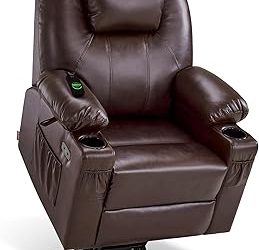
Genuine Leather Power Recliner Sofa, 3-Seater
Real hide over a substantial frame, with the power controls, hidden cup holders, and USB port integrated cleanly rather than bolted on as afterthoughts. The brown finish hides scuffs well, making it a sensible pick for households where the couch does real work.
Watson & Whitely Wall Hugger Power Reclining Sofa
The standout here is the genuinely tight wall clearance combined with adjustable power headrests — a rare pairing that lets you park it close to a wall without giving up neck support. USB-A and Type-C ports and RV-friendly dimensions make it the most thoughtfully engineered option on this list.
Recliner Sofa Set with Heat & Massage
A two-piece home theater setup where the heat and massage modules justify their existence rather than feeling gimmicky, and the storage console keeps remotes off the floor. Budget an afternoon for setup, since the console and drawer assembly takes longer than the seating itself.
Power Recliner Sofa Set, Corduroy & Leather
The corduroy-and-leather mix gives you fabric warmth on the touch surfaces with easier-cleaning leather where spills happen. As a three-piece set, it’s also the friendliest to awkward delivery routes, since each piece moves independently.
FURNIMAT 4-Seater Dual Reclining Sofa
The flip-back console is the clever detail — drop it and you gain a fourth seat, raise it and you get storage plus charging. Good value for a wide layout, though the PU surface needs conditioning and shade to reach its full lifespan.
Frequently Asked Questions
How much clearance does a wall hugger really need?
Most true wall huggers want three to five inches. Non-hugger frames often need twelve or more. Always verify against the specific listing rather than the category label, and measure from the wall surface, not the trim.
Can I add power to a manual recliner later?
Retrofit motor kits exist, but they rarely align with proprietary bracket geometry. If you think you’ll want power, buy it built in.
What maintenance keeps the mechanism quiet?
Once a year, flip the couch, wipe the pivots, and hit them with white lithium grease. Re-torque the visible bolts at the same time — that ten-minute pass prevents most of the squeaks people blame on the frame.
Is genuine leather worth the premium?
For daily-use seating, yes. Top-grain hide typically outlasts PU by several years and can be repaired locally, while faux surfaces usually fail across a whole panel.
Final Thoughts
The Watson & Whitely wall hugger earns the top spot for combining real leather, tight clearance, and modern charging in one well-sorted package. If you want maximum comfort features, the heat-and-massage set delivers the most theater-room value, and the FURNIMAT four-seater is the smart choice when you need to fill a wide wall without overspending.