Key takeaways
- Frame material: Reinforced steel beats hardwood, and hardwood beats engineered board. If a listing says “solid wood frame” with no species named, assume it’s the cheapest available. Steel-reinforced bases are what get a chair to a genuine 500-pound rating.
- Seat width, not overall width: The number that matters is the clear span between the arms, typically 21 to 26 inches on oversized models. Measure your favorite chair at home and add two inches for comfort.
- Foam density: Look for high-density foam, ideally 1.8 lb/ft³ or better. Low-density foam compresses permanently under heavier loads, which is why cheap seats develop a bucket shape.
- Motor count: Single-motor power recliners move the back and footrest together. Dual and tri-motor designs let you lift, recline, and extend independently, which matters enormously for mobility and for lay-flat positioning.
- Leg extension: Taller users need an extended footrest or the calves hang unsupported, which kills circulation on long sits. Check for a footrest extension panel rather than assuming length.
What's inside
Most recliners are built to a price point, not to a load. Pull the fabric off a $300 chair and you’ll find stapled pine, thin plywood gussets, and a reclining mechanism rated for maybe 250 pounds on a good day. If you’re a bigger guy, you already know the failure sequence: the seat sags in month three, the frame starts talking to you in month six, and by year one the footrest won’t stay locked. The problem isn’t that you’re hard on furniture. It’s that the furniture was never engineered for the job.
This guide takes the workshop view. I look at frame material and joinery, seat width between the arms, foam density, and whether the recline mechanism is a single motor doing too much work or a proper multi-motor setup. Below you’ll find chairs rated from 400 to 500 pounds, spanning manual, power, and power-lift designs, plus the specs that actually predict how long a chair survives daily use.
As an Amazon Associate we earn from qualifying purchases.


🛒 Best Price Today on Amazon
Prime members get fast, free shipping on everything above, plus member-only deals. New members get a 30-day free trial — cancel anytime.
How to Choose a/an Recliner For Heavy Men (2026)
- Frame material: Reinforced steel beats hardwood, and hardwood beats engineered board. If a listing says “solid wood frame” with no species named, assume it’s the cheapest available. Steel-reinforced bases are what get a chair to a genuine 500-pound rating.
- Seat width, not overall width: The number that matters is the clear span between the arms, typically 21 to 26 inches on oversized models. Measure your favorite chair at home and add two inches for comfort.
- Foam density: Look for high-density foam, ideally 1.8 lb/ft³ or better. Low-density foam compresses permanently under heavier loads, which is why cheap seats develop a bucket shape.
- Motor count: Single-motor power recliners move the back and footrest together. Dual and tri-motor designs let you lift, recline, and extend independently, which matters enormously for mobility and for lay-flat positioning.
- Leg extension: Taller users need an extended footrest or the calves hang unsupported, which kills circulation on long sits. Check for a footrest extension panel rather than assuming length.
The Best Recliner For Heavy Men (2026)s Reviewed
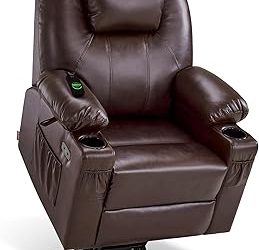
JIKFRIMA Big Man Power Lift Recliner (500 lbs)
This is the most complete package here: a 500-pound rating, power lift assist, extended footrest, heat and massage, plus USB-A and USB-C charging built into flip-arm storage. The lift function makes it the obvious pick for anyone with knee or hip issues who needs help standing.
DYNOX Heavy Duty Tri-Motor Lift Recliner
The reinforced steel frame and tri-motor system are the real story: three independent motors mean you can set the backrest and footrest at any combination rather than fighting a single fixed recline arc. Faux leather wipes clean easily, which is a practical win in high-traffic rooms.
Watson & Whitely Oversized Genuine Leather Power Recliner
Genuine leather over an extra-wide lay-flat frame with a power headrest puts this one ahead on materials and finish. The navy blue reads more like a furniture piece than a medical chair, and real leather stretches and breaks in rather than cracking the way bonded leather does.
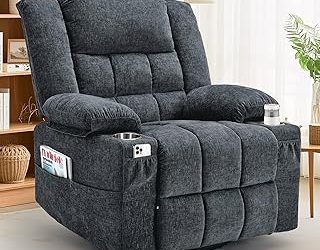
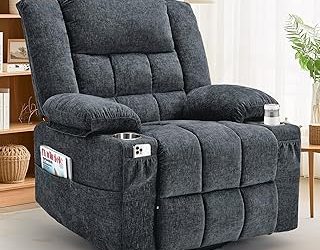
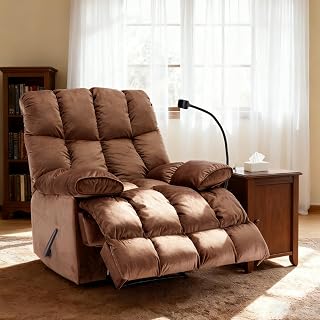
Euthymia Oversized Chenille Recliner (400 lbs)
A manual chair at a 400-pound rating with deep chenille upholstery and a generous seat span. Chenille is more forgiving than leather in cold rooms and hides wear well, though it does need vacuuming rather than wiping.
Manual Adjustable Oversized Recliner with Phone Holder
The simplest option and, mechanically, the one with the fewest failure points: no motors, no wiring, just a heavy-duty manual mechanism rated to 400 pounds. The compact footprint and phone holder make it a strong fit for RVs, nurseries, and second bedrooms.
Frequently Asked Questions
Is the stated weight capacity a static or dynamic rating?
Most manufacturers publish a static rating. Dropping into a chair generates forces well above your body weight, so treat the rating as a ceiling and buy with 50 to 100 pounds of headroom if you can.
Do power recliners fail more often than manual ones?
They have more to go wrong, but the motors themselves are usually reliable. The common failures are the hand control and the wiring harness, both of which are cheap and straightforward to swap yourself.
How much wall clearance do I need?
Traditional recliners want 12 to 18 inches behind them. Lift chairs need more, since many push backward as they extend. Check the manufacturer’s diagram before you commit to a wall position.
Can I reinforce a recliner myself?
To a degree. Adding a plywood platform under the seat cushion spreads load and slows sagging, and re-torquing the mechanism bolts once a year prevents most squeaks. You can’t upgrade an undersized frame after the fact, though.
Final Thoughts
If you want maximum capability and mobility support, the JIKFRIMA 500 lb power lift recliner is the strongest all-rounder, with the DYNOX tri-motor a close second thanks to its steel frame and independent motor control. For anyone who’d rather have a well-made chair than a gadget, the Watson & Whitely genuine leather power recliner is the one that will still look good in a decade.