Key takeaways
- Choose a single-stage press for a clear learning path and modest volume, a turret for a balance of convenience and control, or a progressive if frequent loading justifies its larger footprint and more demanding setup. Verify cartridge compatibility, measure the full operating envelope, and make…
The best reloading press depends on how much you load and how much setup space you can give it
For occasional rifle or pistol loads, a sturdy single-stage press is usually the best starting point; for frequent pistol loading, a progressive press saves time once it is correctly set up; and for a middle ground, a turret press reduces repetitive tool changes. Before choosing, check the press’s stated cartridge compatibility, the room needed for its handle to travel, and whether your bench can support the press without flexing.
These are general equipment-selection guidelines, not loading instructions. Follow the press and component manufacturers’ manuals, use current data from a reputable loading manual, and observe applicable laws and safety practices. A press alone does not make a load safe or consistent.
Our top picks
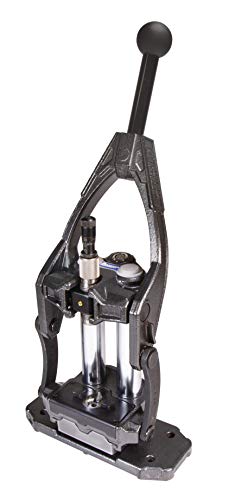


As an Amazon Associate we earn from qualifying purchases at no extra cost to you. Ratings are shown as listed on Amazon.
Quick comparison
| Press type | Best suited to | Typical loading pace | Approximate bench footprint | Setup demand |
|---|---|---|---|---|
| Single-stage | New reloaders, precision-oriented work, occasional batches | Lowest; operations are performed in separate steps | About 6–10 in. wide by 8–12 in. deep | Low to moderate |
| Turret | Regular moderate-volume loading with fewer die changes | Middle; depends on whether the turret indexes manually or automatically | About 7–12 in. wide by 10–14 in. deep | Moderate |
| Progressive | Higher-volume loading by experienced users | Highest after setup and verification | About 10–16 in. wide by 12–18 in. deep | High |
| Handheld | Limited, portable tasks where bench mounting is impractical | Low | No permanent bench footprint | Low, but operation is slower |
Footprints are planning estimates, not dimensions for every model. Leave extra clearance for the operating handle, spent primers, accessories, and your hands. A press that fits on paper may still be awkward if a wall, shelf, or cabinet blocks the handle.
Choose by loading volume and experience
For beginners or occasional batches: single-stage
A single-stage press holds one die at a time, so each operation is easier to see and check. It is generally the simplest type to understand and troubleshoot, and its compact frame can suit a small workshop. The trade-off is more repeated handling and slower output when you load several hundred rounds.
Look for a rigid frame, a handle that feels comfortable through its full stroke, a compatible shellholder system, and a mounting pattern you can fit to your bench. Single-stage designs vary widely: some handle common rifle and pistol cartridges, while compact or specialty presses have narrower compatibility. Confirm the maker’s specifications for the cartridges you intend to load, including any stated limitations.
For regular moderate volume: turret
A turret press keeps several dies in a rotating head, cutting down on repeated die changes. Some models index the turret automatically; others require manual rotation. That distinction affects pace and how much the operator must coordinate, so check the mechanism rather than assuming all turret presses work alike.
Turrets are a useful compromise if you want a more organized workflow without the complexity of a multi-station progressive. They take more bench space than many single-stage presses, and a loaded turret head can add weight when changing setups. Confirm that replacement heads or compatible tooling are available for the cartridges and die arrangement you plan to use.
For high volume: progressive
A progressive press performs multiple operations as the case moves through stations, so it can produce more output per handle cycle after setup. That speed comes with more components to adjust and monitor: station layout, case and bullet feeding, priming systems, and the press’s caliber-specific conversion parts. A changeover may involve more than swapping dies.
Progressives make the most sense when you load often enough to justify the setup time and can give the machine a stable, dedicated place. Their larger footprint and moving parts call for a firm bench and room to reach adjustments. New users should be prepared to learn one process at a time, consult the manual closely, and verify each stage instead of treating production speed as a shortcut.
For portability or no permanent bench: handheld
A handheld press can be carried or stored in a drawer, making it an option when permanent mounting is not possible. Its small size does not make it a universal substitute for a bench press: leverage, supported operations, and compatible cartridges depend on the specific design. Check manufacturer documentation before buying, especially if you expect to use it for larger cases or frequent batches.
Check cartridge compatibility before comparing features
“Supports rifle and pistol” is not specific enough to make a purchase decision. Presses use different frame openings, ram and shellholder arrangements, die threads, and accessory systems. Compare the manufacturer’s cartridge list with the exact cartridges you plan to load, and check whether the required shellholders, bushings, dies, and caliber-conversion parts are included or sold separately.
Large rifle cartridges can need more working clearance than common handgun cartridges. Even when a press is listed as compatible, verify that its frame opening and stroke accommodate the case length and the operation you intend to perform. If you expect to load several calibers, price the complete changeover equipment—not just the press.
Fit the press to your workspace
Measure the bench, not just the press base. A useful starting point is to reserve the press footprint plus roughly 6–10 inches beside it for components and tools, and enough clear space above and in front for the handle’s full travel. These are planning allowances; the model’s manual and actual handle path determine the final fit.
| Workspace check | Planning figure | Why it matters |
|---|---|---|
| Bench depth | About 24 in. is a practical starting point | Allows room for the mounted press and working area; measure the handle path and nearby wall. |
| Clear area around press | Allow roughly 6–10 in. beside the frame | Provides room for cases, tools, and access to controls. |
| Bench stiffness | Use a rigid, securely supported surface | Flex or movement can make operation uncomfortable and interfere with repeatable setup. |
| Mounting height | Set the handle near a comfortable standing or seated reach | Consider the full stroke, seat position, and whether your knees clear the bench. |
A small 10 × 12 ft room can accommodate a reloading station, but only if the press does not obstruct a doorway, walkway, or other work surface. Keep the setup organized and away from food, children, pets, and ignition sources; follow product safety guidance for components and storage. If you rent or cannot drill into a bench, a properly engineered mounting board or a portable press may be more practical, but it must remain stable in use.
Decision guide: which type fits your situation?
| Your situation | Best place to start | Main trade-off |
|---|---|---|
| You are learning and expect small batches | Single-stage | Slower, but operations are easier to separate and inspect. |
| You load several cartridges at a moderate pace | Turret | Costs and occupies more space than a basic single-stage setup. |
| You load frequently and can dedicate time to setup | Progressive | Higher output, with more adjustment and monitoring demands. |
| You have no permanent mounting spot | Handheld or a securely mounted portable arrangement | Less leverage or convenience; compatibility may be limited. |
| You want to prioritize bench precision and simplicity | Rigid single-stage press | More separate handling between operations. |
What to budget beyond the press
Press prices vary by type, configuration, and included accessories. As a broad market guide, basic single-stage presses often fall around $100–$250, turret presses around $150–$400, and progressive presses around $300–$1,000 or more. These are general ranges, not current quotes; kits, specialty models, and accessories can change the total substantially.
Also account for compatible dies and shellholders, mounting hardware, a reliable scale and measuring tools, manuals, and any caliber-change components. A bundle is only a value if it includes equipment you need and is compatible with your planned cartridges. Do not choose a press based on advertised output alone: setup quality, component consistency, and careful inspection matter more than speed.
Bottom line
Choose a single-stage press for a clear learning path and modest volume, a turret for a balance of convenience and control, or a progressive if frequent loading justifies its larger footprint and more demanding setup. Verify cartridge compatibility, measure the full operating envelope, and make sure the bench is rigid before buying. The best reloading presses are the ones that fit your actual workload and workspace—and that you can operate and maintain according to the manufacturer’s instructions.