Key takeaways
- Choose compact if you work in occupied homes, carry tools upstairs, or need to fit between vehicles and furniture. Confirm that your longest tool fits inside without forcing the zipper.
- Choose mid-size if you carry a daily hand-tool kit plus a drill, charger, and small parts cases. This is often the most balanced option, provided the handle and wheels are built for the load.
- Choose large if you routinely move bulky gear and can store and transport the bag upright. Separate heavy power tools from small parts so the extra space does not become a disorganized, overweight compartment.
Best Rolling Tool Bags for Work and Job Sites
The best rolling tool bag for most job sites is a 20–24-inch, reinforced-bottom model with large wheels, a telescoping handle, and a mix of open tool pockets and lockable compartments; choose a compact 15–18-inch bag for service calls or a high-capacity 24–30-inch model when you need to move bulkier equipment.
Capacity alone is a poor way to choose. A bag that holds every tool may be too heavy to lift into a vehicle, too wide for a narrow doorway, or difficult to roll across gravel. Compare the loaded weight, pocket layout, wheel size, handle construction, and packed dimensions against the route the bag will actually travel.
Our top picks


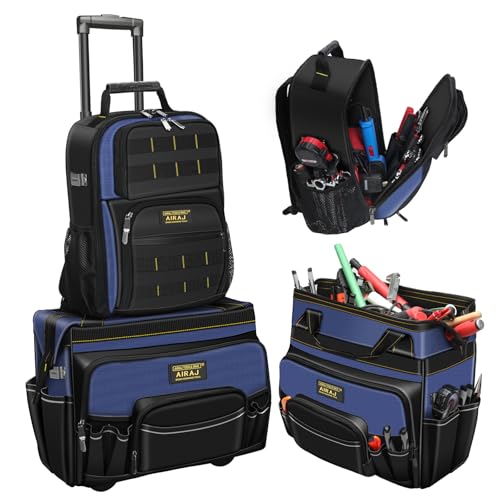
As an Amazon Associate we earn from qualifying purchases at no extra cost to you. Ratings are shown as listed on Amazon.
Quick picks by work situation
| Situation | Useful bag size | Prioritize | Main trade-off |
|---|---|---|---|
| Indoor service calls and stairs | 15–18 in; about 20–35 L | Compact footprint, grab handles, protected tool pockets | Less room for power tools and spare parts |
| Daily electrician or maintenance kit | 18–22 in; about 30–50 L | Vertical pockets, separate meter compartment, 4–6 in wheels | Can become awkward when packed with heavy tools |
| Mixed tools on rough outdoor routes | 20–24 in; about 40–65 L | 6–8 in wheels, reinforced base, sturdy axle and handle | Bulkier to store and lift |
| Large kit or bulky equipment | 24–30 in; about 60–90 L | Wide opening, high load capacity, robust frame | May not fit conveniently in a car or through tight passages |
These are practical size bands, not standardized capacities: brands measure usable volume differently, and long pockets or molded bases can reduce space available for bulky items. Check a product’s external dimensions and stated load limit rather than relying on its inch designation alone.
What matters more than advertised capacity
Pocket layout: organize for access, not just storage
Open exterior pockets make frequently used screwdrivers, pliers, and tape easy to reach, but they can snag on doorframes and expose tools to rain or dust. A deep main compartment is better for a drill, charger, and parts cases; without internal dividers, though, tools can collect in a heavy pile at the bottom. Interior sleeves and removable dividers help separate delicate meters from metal tools.
For an electrical or HVAC kit, look for narrow upright pockets and a compartment that keeps meters or testers from being pressed against heavier equipment. For carpentry and general maintenance, a wide opening and larger central bay may be more useful than dozens of small pockets. Count the pockets you can actually reach when the bag is standing upright, and check whether the opening stays open while you work.
Wheels and handle: match them to the ground
Small wheels roll well on smooth shop floors but can catch in expansion joints, gravel, and uneven thresholds. Wheels around 6–8 inches generally handle rougher paths better than compact 4-inch wheels, though wheel diameter is only part of the story: tread width, material, axle support, and clearance beneath the loaded bag also matter.
A telescoping handle should lock without obvious wobble and retract far enough that it does not obstruct storage. A steel or reinforced handle can add weight but is often preferable for frequent hauling. Check how the handle attaches to the base: a strong tube does not help much if its mounting points or fasteners are flimsy. For stairs, neither large wheels nor a long handle removes the need to lift the bag; grab handles should be well stitched and positioned for a balanced lift.
Construction trade-offs to check
| Construction feature | Benefit | What can wear or disappoint | Best fit |
|---|---|---|---|
| Polyester or nylon fabric body | Flexible pockets and relatively low empty weight | Fabric can abrade or tear at corners; water resistance varies | Indoor work and lighter daily kits |
| Reinforced or molded base | Helps resist punctures, damp floors, and wear from dragging | Adds bulk; a rigid base can be awkward on stairs | Regular vehicle-to-site trips |
| Metal frame or handle supports | Improves structure under heavier loads | More weight, plus joints and fasteners can loosen | Frequent transport of dense tools |
| Large rubber or hard-polymer wheels | Better obstacle clearance or durability, depending on design | Rubber may wear; hard wheels can transmit bumps and noise | Uneven paths when wheel size and axle are adequate |
Fabric denier and a “water-resistant” label are not guarantees against soaking rain. Seams, zippers, and the opening are common paths for water and dust. If the bag will sit on wet ground, prioritize a raised, molded bottom and keep sensitive electronics in a separate protective case.
Measure the route and the loaded bag
Before buying, measure the narrowest doorway, gate, or vehicle opening on the route. A 24-inch bag may be wider at its wheels than its stated bag-body width, and exterior pockets can add several inches when filled. As a planning check, allow about 2 inches of side clearance in a straight passage and more where you must turn the bag; a tight 28-inch doorway can make a bag approaching that width difficult to maneuver.
| Check | Practical planning figure | Why it matters |
|---|---|---|
| Compact bag body width | About 12–16 in | Easier through narrow interior routes; less room for bulky tools |
| Mid-size bag body width | About 16–20 in | More useful capacity, but measure wheels and filled side pockets too |
| Large bag body width | About 20–24 in or more | Check doorway turns, vehicle access, and storage space before purchase |
| Loaded carry weight | Aim to keep routine lifts near or below 35–40 lb when practical | Stairs, curbs, and lifting into a trunk still require carrying, even with wheels |
Widths vary considerably by model; these are screening ranges, not product specifications. Compare the manufacturer’s packed dimensions—including handle, wheels, and protruding pockets—with the tightest point on your route. If you need to lift the bag into a vehicle, check the vehicle opening height as well as its width.
Also consider how a fully loaded bag behaves. Concentrating heavy tools at the top can make it tip; placing them low and close to the axle generally improves stability. Keep the heaviest equipment near the wheel end without blocking access to items used throughout the day. A bag’s stated load capacity is not a recommended lifting weight for every user.
Choosing a size without overbuying
- Choose compact if you work in occupied homes, carry tools upstairs, or need to fit between vehicles and furniture. Confirm that your longest tool fits inside without forcing the zipper.
- Choose mid-size if you carry a daily hand-tool kit plus a drill, charger, and small parts cases. This is often the most balanced option, provided the handle and wheels are built for the load.
- Choose large if you routinely move bulky gear and can store and transport the bag upright. Separate heavy power tools from small parts so the extra space does not become a disorganized, overweight compartment.
Bottom line
When comparing the best rolling tool bags, start with the route and the tools—not the biggest capacity claim. Pick a compact bag for stairs and tight interiors, a mid-size model with a reinforced base for routine mixed work, or a larger bag with substantial wheels for bulky loads and rougher paths. Before ordering, verify external packed dimensions, wheel diameter, handle attachment, pocket access, and the realistic weight you will need to lift.