Key takeaways
- Measure the overhang, not the counter: Work from the underside of your countertop lip down, and aim for 9 to 12 inches of clearance to the seat top. A 36-inch counter usually wants a 24 to 26-inch stool; a 42-inch bar wants 29 to 30 inches. Thick butcher block or waterfall edges eat into that gap fast.
- Inspect the swivel plate spec: A stamped steel ball-bearing plate with four mounting bolts per side is the standard worth holding out for. Riveted plates that can’t be replaced, or plates screwed into engineered wood without threaded inserts, are the ones that develop play after a year of daily spinning.
- Look for a full-loop or wrap-around footrest: On four-leg wooden stools the footrest ring is structural — it triangulates the legs and stops racking. Stools with only a front bar rely entirely on the seat frame to hold geometry, which is exactly where the creaks start.
- Match upholstery to your actual household: Chenille and linen breathe well and hide crumbs but wick liquids into the foam, so plan on a fabric guard treatment. Faux leather wipes clean in one pass but cracks at the seams if it sits near a heat vent or in direct afternoon sun.
- Budget honest assembly time: Figure 20 to 30 minutes per stool with a real screwdriver or a driver set to low torque. Bring your own 4mm and 5mm hex keys — the folded metal L-key in the box gives you no leverage and rounds off the bolt heads it was meant to tighten.
What's inside
Anyone who has ever crawled under a kitchen island with a hex key knows the truth about bar stools: the swivel mechanism is where cheap ones die first. You buy a set, they feel solid for four months, and then the seat starts to wobble on the return, the footrest loosens, and suddenly you’re re-tightening bolts every other weekend. Add a back to the equation and you’ve introduced another stress point, because the backrest is a lever arm that transmits every lean, stretch, and teenager’s slouch straight into the seat plate below.
This guide is written from the perspective of someone who has actually taken these apart. We look at how the swivel plates are constructed, whether the leg-to-seat joinery uses real hardware or particleboard inserts, how much of the assembly you can service later with basic tools, and which upholstery survives spilled coffee and dog claws. Counter height, bar height, adjustable gas-lift models, singles and sets of four — all covered, with honest notes on where each one cuts corners.
As an Amazon Associate we earn from qualifying purchases.


🛒 Best Price Today on Amazon
Prime members get fast, free shipping on everything above, plus member-only deals. New members get a 30-day free trial — cancel anytime.
How to Choose a/an Swivel Bar Stools With Backs (2026)
- Measure the overhang, not the counter: Work from the underside of your countertop lip down, and aim for 9 to 12 inches of clearance to the seat top. A 36-inch counter usually wants a 24 to 26-inch stool; a 42-inch bar wants 29 to 30 inches. Thick butcher block or waterfall edges eat into that gap fast.
- Inspect the swivel plate spec: A stamped steel ball-bearing plate with four mounting bolts per side is the standard worth holding out for. Riveted plates that can’t be replaced, or plates screwed into engineered wood without threaded inserts, are the ones that develop play after a year of daily spinning.
- Look for a full-loop or wrap-around footrest: On four-leg wooden stools the footrest ring is structural — it triangulates the legs and stops racking. Stools with only a front bar rely entirely on the seat frame to hold geometry, which is exactly where the creaks start.
- Match upholstery to your actual household: Chenille and linen breathe well and hide crumbs but wick liquids into the foam, so plan on a fabric guard treatment. Faux leather wipes clean in one pass but cracks at the seams if it sits near a heat vent or in direct afternoon sun.
- Budget honest assembly time: Figure 20 to 30 minutes per stool with a real screwdriver or a driver set to low torque. Bring your own 4mm and 5mm hex keys — the folded metal L-key in the box gives you no leverage and rounds off the bolt heads it was meant to tighten.
The Best Swivel Bar Stools With Backs (2026)s Reviewed
26” Modern Barrel Swivel Counter Stools, Set of 4
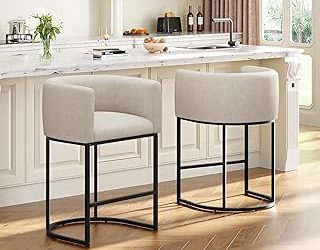
The barrel back on these wraps far enough forward to actually support your ribs when you turn sideways, and the solid wood legs meet the seat frame with metal brackets rather than dowels alone. Buying four at once is the sensible play for a long island, though the beige chenille genuinely needs a spray-on protectant before anyone eats a plate of pasta on them.
Counter Height Bar Stools with Full Back, Set of 2
The full linen back is the standout here — it extends high enough to be a real backrest rather than a decorative crescent, which makes these the pick if people linger at your counter. The metal footrest bolts through the leg tubes instead of clamping to the outside, so it stays put without periodic retightening.
ALPHA HOME 30″ Swivel Bar Stools, Set of 2
This is the most traditionally built set in the group: solid wood legs, a wrap-around footrest that circles all four legs, and a true 360-degree swivel plate. Assembly is straightforward and the dark walnut finish takes touch-up marker well if you nick it during install.
LUE BONA 26.8″ Counter Height Barrel Stools, Set of 2
The 180-degree swivel is a deliberate choice, not a shortcoming — it returns the seat to center on its own, which stops stools from drifting askew in a walkway. Metal legs with a powder-coat finish keep the footprint slim, and the upholstered barrel shape reads more custom than the price suggests.
Yaheetech Adjustable Swivel Bar Stools, Set of 2
The gas-lift height adjustment makes these the flexible answer if you’re between counter and bar height, or furnishing a space where the counter height isn’t final yet. Padded PU leather cleans up in seconds and the 300-pound capacity is backed by a properly gusseted base plate.
Frequently Asked Questions
Why does my swivel stool wobble after a few months?
Nine times out of ten it’s the seat-to-swivel bolts backing out under rotational load, not a failed bearing. Flip the stool, snug all four bolts in a crossing pattern, and add a drop of removable threadlocker or a nylon lock washer to each one.
Can I add a swivel plate to stools I already own?
Yes, if the seat has a flat underside with at least four inches of solid material to bite into. Buy a plate rated above your intended load, drill pilot holes, and use threaded inserts rather than wood screws if the seat is engineered board.
Backless or with backs for a kitchen island?
Backs win for any counter where people eat or work, since unsupported sitting gets uncomfortable in about fifteen minutes. Backless stools only make sense when you need them to tuck fully under the overhang for traffic flow.
How do I stop stools from scratching the floor?
Replace the factory plastic glides immediately — they trap grit and act like sandpaper. Self-adhesive felt pads work on wood, while rubber tips are better on tile where you want the stool to stay put.
Final Thoughts
For most kitchens, the ALPHA HOME 30″ set is the one I’d build a bar around — real wood legs and a wrap-around footrest give it the structural honesty that keeps a stool tight for years. If you’re outfitting a longer island on a budget, the 26″ Modern Barrel set of four delivers the most seating per dollar with genuinely supportive backs, and the Yaheetech adjustable pair remains the smart hedge when your counter height isn’t quite settled yet.