Key takeaways
- Tooth count and grind: A 40–50 tooth ATB combination blade is the sweet spot for hardwood project work. Fewer than 30 teeth clears chips fast but leaves a rough face; 80 teeth gives glass-smooth crosscuts but will bog and burn in a 1″ rip if you feed too slowly.
- Thin kerf vs. full kerf: Under 2 HP, go thin kerf (around 0.098″). Removing less material per pass means less load on the motor and noticeably less burning in dense stock. Full-kerf blades track straighter but need the horsepower to earn it.
- Carbide grade: Hardwood is abrasive, and cheap carbide rounds over fast. Look for high-density micrograin carbide with generous tooth height so the blade survives multiple resharpenings instead of becoming disposable.
- Anti-vibration and expansion slots: Laser-cut slots and copper plugs pull heat and harmonics out of the plate. This is the difference between a blade that stays flat through a long rip and one that starts to flutter and burn halfway down a board.
- Hook angle: A moderate positive hook (roughly 10–20°) pulls the stock through without grabbing. Steeper hooks feel aggressive and fast but tear out on figured hardwood and get twitchy on crosscuts.
Hardwood punishes a mediocre blade. Push a chunk of hard maple through a dull 40-tooth general-purpose blade and you’ll feel it in your shoulders first: the motor drops pitch, the feed stalls, and the offcut comes away with a burn line dark enough to sand through half your thickness chasing it. Dense species like white oak, hickory, and hard maple generate real heat at the tooth, and the wrong grind either scorches the face or chips the edge grain right where a joint needs to close tight.
This guide is written from the sawdust side of the bench, not a spec sheet. Below are the blades that hold up in a home shop running a contractor or hybrid saw — combination blades that rip and crosscut without a swap, plus high-tooth-count finish blades for the parts that show. I’ve flagged which ones make sense for 1.5 HP saws, which want more motor behind them, and where a cheap blade is genuinely the smart buy.
Our top picks




As an Amazon Associate we earn from qualifying purchases at no extra cost to you. Ratings are shown as listed on Amazon.
🛒 Best Price Today on Amazon
Prime members get fast, free shipping on everything above, plus member-only deals. New members get a 30-day free trial — cancel anytime.
How to Choose a Table Saw Blade for Hardwood (2026)
- Tooth count and grind: A 40–50 tooth ATB combination blade is the sweet spot for hardwood project work. Fewer than 30 teeth clears chips fast but leaves a rough face; 80 teeth gives glass-smooth crosscuts but will bog and burn in a 1″ rip if you feed too slowly.
- Thin kerf vs. full kerf: Under 2 HP, go thin kerf (around 0.098″). Removing less material per pass means less load on the motor and noticeably less burning in dense stock. Full-kerf blades track straighter but need the horsepower to earn it.
- Carbide grade: Hardwood is abrasive, and cheap carbide rounds over fast. Look for high-density micrograin carbide with generous tooth height so the blade survives multiple resharpenings instead of becoming disposable.
- Anti-vibration and expansion slots: Laser-cut slots and copper plugs pull heat and harmonics out of the plate. This is the difference between a blade that stays flat through a long rip and one that starts to flutter and burn halfway down a board.
- Hook angle: A moderate positive hook (roughly 10–20°) pulls the stock through without grabbing. Steeper hooks feel aggressive and fast but tear out on figured hardwood and get twitchy on crosscuts.
The Best Table Saw Blades for Hardwood (2026), Reviewed
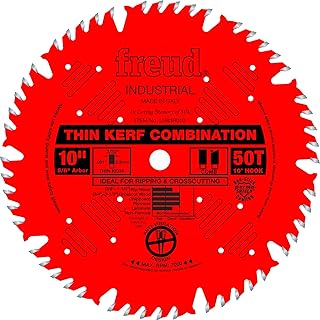
Freud LU83R010 Thin Kerf Combination Blade
This is the blade I’d bolt on and leave there if I only owned one. The thin kerf and TiCo carbide combination let a 1.5 HP saw rip 8/4 maple without the motor complaining, and the crosscut quality off the 50-tooth ATB-plus-raker grind is clean enough to glue straight from the saw.
CMT 256.050.10 Combination Blade
CMT’s 50-tooth combination grind is a legitimate rival to the Freud, with a slightly thicker plate that tracks beautifully in wide rips on a cabinet saw. The orange PTFE coating actually earns its keep in resinous or oily hardwoods, shedding pitch instead of building it up into a burning ring.
Freud LU85R010 Crosscut Blade
When the cut face is the finished face — miters, breadboard ends, exposed shoulders — this is the blade. The high tooth count and full-kerf stiffness produce a surface that needs nothing more than a light scuff, though it’s strictly a crosscutter and will scorch if you try to rip with it.
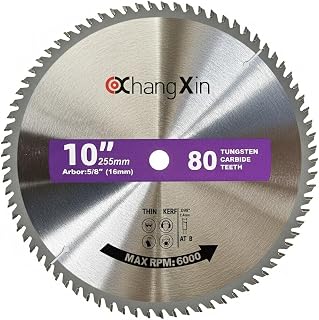
10″ 80T Carbide Crosscut Blade
A budget-friendly ultra-fine blade that punches well above its price on trim, plywood veneer, and hardwood crosscuts. The carbide won’t take as many trips to the sharpener as a premium blade, but for occasional finish cuts it’s a sensible way to keep your good blade off duty.
WEN BL1080 80-Tooth Finish Blade
WEN’s ultra-fine finish blade is an easy recommendation for anyone running both a miter saw and a table saw, since it performs identically on either. Feed slowly and it leaves a burnished edge on cherry and walnut; rush it and you’ll get the burn marks 80-tooth blades are famous for.
Frequently Asked Questions
How many teeth do I need for hardwood?
Forty to fifty teeth handles nearly everything in a furniture shop. Drop to 24–32 teeth only if you’re ripping a lot of thick stock, and reserve 80 teeth for crosscuts and sheet goods.
Why is my hardwood burning?
Usually feed rate, fence alignment, or pitch buildup rather than a dull blade. Clean the blade with resin remover, check that your fence is parallel to the blade, and keep the stock moving steadily.
Is thin kerf worth it?
On any saw under 2 HP, absolutely. You lose a bit of stiffness in deep cuts but gain meaningful power headroom and waste less expensive lumber to sawdust.
Should I buy a multi-pack?
Multi-packs like the 32T/60T/80T three-pack are a practical starting point if you’re outfitting a shop from scratch and want dedicated blades for framing, finish, and ultra-fine work.
Final Thoughts
For most home furniture builders, the Freud LU83R010 thin kerf combination blade is the one to buy first — it does 90% of the work at 90% quality with no swapping. Add the Freud LU85R010 when crosscut finish matters, or step up to the CMT 256.050.10 if you’ve got a cabinet saw with the power to drive a full-kerf plate.