The table saw is the one tool that changes how you build. Once you have a reliable rip fence and a flat cast surface, plywood carcasses stop being guesswork and hardwood stock stops eating your weekend. The trouble is that the sub-$1000 shelf has gotten crowded fast, and a spec sheet with “15 amp” and “5000 RPM” printed on it tells you almost nothing about whether the fence will stay parallel after the third crosscut of the day. Motor amperage is the easy part. Fence repeatability, arbor runout, and how the stand behaves on a sloped garage floor are what separate a saw you keep from one you resell.
I built this guide from the perspective of someone who actually cuts things: face-frame stock, cabinet plywood, the occasional sheet of acrylic. Below you’ll find the models worth your money right now, from proven jobsite workhorses to newer budget entries that punch above their weight. After the picks, there’s a short buying checklist covering the specs that matter and the ones you can ignore, plus answers to the questions that come up most often from readers setting up a first shop.
Our top picks



As an Amazon Associate we earn from qualifying purchases at no extra cost to you.
🛒 Best Price Today on Amazon
Prime members get fast, free shipping on everything above, plus member-only deals. New members get a 30-day free trial — cancel anytime.
How to Choose a/an Table Saw For Under 1000 (2026)
- Fence quality above all: A rack-and-pinion fence that tracks square on both rails will do more for your joinery than any horsepower bump. Test it by locking the fence at 12 inches and measuring front and back of the blade — anything over 1/64 inch of drift means burn marks and kickback.
- Rip capacity you’ll actually use: Anything under 24 inches means you can’t center-rip a sheet of plywood. Thirty-two inches lets you break down full sheets solo with an outfeed roller. If your work is trim, drawers, and small case goods, a narrower table saves floor space.
- Blade diameter and cut depth: A 10-inch blade gives you roughly 3-1/4 inches at 90 degrees, enough for 4×4 stock in a single pass. An 8-1/4 inch saw drops that to about 2-1/2 inches, fine for sheet goods and 2x material but limiting for thick hardwood.
- Stand design and mobility: A rolling stand with a single-lever fold matters more than you’d think in a shared garage. Look for pneumatic tires if you’re crossing a threshold, and check that the saw locks rigid — a stand that racks under a push cut is a safety problem.
- Dust and guarding: A 2-1/2 inch port with a shroud under the blade captures far more than a bare cabinet opening. Confirm the riving knife is tool-free to remove and reinstall, because a knife that’s annoying to reattach is a knife you’ll leave off.
The Best Table Saw For Under 1000 (2026)s Reviewed
DEWALT DWE7491RS 10-Inch with Rolling Stand
This is the benchmark for a reason: the rack-and-pinion fence returns to the same reading again and again, and 32-1/2 inches of rip capacity means full sheet goods without a helper. The rolling stand deploys in one motion and the whole package survives real jobsite abuse, which translates to years of quiet reliability in a home shop.
SKIL TS6307-00 15 Amp 10-Inch Jobsite Saw
SKIL’s rack-and-pinion fence is genuinely good, and the integrated foot-activated stand release is a small ergonomic win you’ll appreciate on setup day. The onboard dust port and the bevel scale are accurate out of the box, making this the value play if you want DEWALT-class fence behavior for meaningfully less.
DEWALT DWE7485 8-1/4 in. Compact Portable Saw
The compact DEWALT trades cut depth and table width for a footprint you can lift onto a bench single-handed. If your projects are drawer boxes, shelving, and plywood casework rather than thick hardwood ripping, this is the smarter buy — the fence mechanism is the same excellent design as its bigger sibling.
DOVAMAN DTS10A 10″ 15A with Stand
The copper-wound motor pulls through 3/4 inch maple without bogging, and the one-side table extension gives you useful support for wider panels. Expect to spend an hour truing the fence and checking blade-to-slot parallel on arrival, after which it performs well past its price bracket.
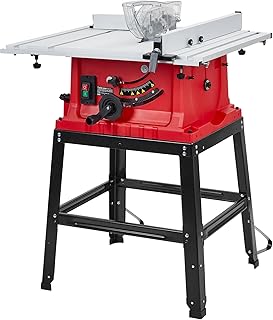
10-Inch 15 Amp 5000 RPM Saw with Stand & Cover
A 36 x 25 inch tabletop is unusually generous at this tier, and the included protective cover is a genuine nicety in a dusty garage. Swap the factory blade for a quality 40-tooth combination blade and this becomes a capable general-purpose saw for wood, plastic, and light non-ferrous work.
Frequently Asked Questions
Is a jobsite saw good enough for furniture building?
Yes, with two caveats. Add an outfeed surface and a crosscut sled, and a quality jobsite saw will produce joinery-grade cuts. What you give up versus a cabinet saw is mass, which means less vibration damping and slower feed rates in thick stock.
Do I need a 10-inch blade or is 8-1/4 enough?
If you regularly rip 4×4 posts or resaw thick hardwood, get the 10-inch. For sheet goods, 2x framing lumber, and typical furniture stock under 2 inches, the 8-1/4 inch saw handles it and saves weight and space.
What should I upgrade first?
The blade. Factory blades are functional but coarse — a thin-kerf 40-tooth combination blade reduces motor strain and cuts sanding time noticeably. After that, build a zero-clearance insert to eliminate tearout on the underside of plywood.
How do I check that a new saw is set up correctly?
Unplug it, then measure from a single blade tooth to the miter slot at the front and rear of the blade — rotate the blade so the same tooth is used both times. Then verify the fence against the same slot and confirm 90 and 45 degrees with a reliable square, not the factory scale.
Final Thoughts
If you want the saw you won’t second-guess, the DEWALT DWE7491RS remains the safest money in this range — the fence and rolling stand justify the premium on their own. The SKIL TS6307-00 delivers close to the same fence precision for less, making it the best value pick for a first serious shop, while the compact DEWALT DWE7485 is the right answer for tight garages and sheet-goods-focused work. Any of the three will outlast several rounds of project ambition.