Anyone who has fed a narrow rip through a table saw knows the feeling: the last four inches of the cut, your fingers creeping toward the blade, and that small voice asking whether this is really the moment to trust muscle memory. The stock push stick that shipped with your saw is usually a flimsy scrap of plastic with a single notch, and it either flexes under pressure or slips off the workpiece entirely right when you need control most. That’s not a safety tool, that’s a token gesture.
A good push stick does two jobs at once. It keeps your hand a fixed distance from the blade, and it holds the stock down and against the fence so the cut stays true and kickback never gets started. Below I’ve pulled together the push sticks and push blocks that actually earn bench space in a home shop, along with what to look for so you can match the tool to the work you do most.
Our top picks


As an Amazon Associate we earn from qualifying purchases at no extra cost to you.
🛒 Best Price Today on Amazon
Prime members get fast, free shipping on everything above, plus member-only deals. New members get a 30-day free trial — cancel anytime.
How to Choose a Push Stick For Table Saw (2026)
- Grip surface: Bare plastic slides on smooth hardwood and melamine. Look for EVA foam, rubber pads, or a deep heel notch that bites into the end grain instead of skating over it.
- Handle geometry: Dual handles let you push forward and press down in two separate motions, which is the whole point. A single vertical grip forces your wrist into an awkward angle on long rips.
- Body thickness and rigidity: Thin stock flexes, and flex means lost control. A stick around 3/8 inch or thicker in glass-filled nylon or hardwood stays stiff under real feed pressure.
- Sacrificial by design: Push sticks get nicked by the blade. That’s normal. Pick something cheap enough to replace without wincing, and never one with metal fasteners near the working edge.
- Multi-tool versatility: If you also run a router table, jointer, or band saw, a set that transfers between machines saves you from buying three specialized gadgets that all do the same thing.
The Best Push Stick For Table Saw (2026)s Reviewed
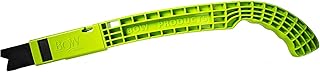
BOW Products PushPRO PP1
The EVA-tipped contact face is the standout here, gripping stock firmly enough that the block moves as one unit with the workpiece instead of chattering across it. That damping also takes a noticeable edge off vibration transfer, which makes narrow rips feel far more planted than they do with a rigid plastic stick.
POWERTEC Deluxe Push Stick 2PK (71338)
Two ergonomic handles give you independent downward and forward pressure, and the molded body is stiff enough that it doesn’t bow when you’re leaning into a long rip in oak. Buying them in pairs is the right call since one lives at the saw and the other at the jointer.
Red Wood Push Stick, 16.5″
Old-school and hard to argue with: a long hardwood stick with a heel notch, painted bright red so you spot it instantly on a cluttered bench. At 16.5 inches it keeps your hand genuinely far from the blade, and if the teeth catch it, you’ve lost a few dollars of wood rather than a knuckle.
POWERTEC Deluxe Push Stick 2PK (71511)
A close sibling to the 71338 with slightly different handle contours that suit larger hands well. The wide footprint makes it particularly good on router tables where you need to keep stock flat against the surface through the entire pass.
POWERTEC Push Block and Push Stick Set 5PK (71009V)
This is the most sensible starting point if you’re outfitting a shop from scratch, mixing blocks for wide panel work with sticks for narrow rips. Five pieces means there’s always one within reach, which matters more for safety than any single feature on the list.
Frequently Asked Questions
What’s the difference between a push stick and a push block?
A push stick is long and narrow, designed to push the trailing end of stock when the cut is too tight for your hand. A push block is broad and sits on top of the workpiece, applying downward pressure across a wide area, which suits panels, jointing, and router table work.
Is it bad if the blade cuts into my push stick?
Not at all. Push sticks are consumables, and light contact with the blade is expected over time. Replace one once it’s badly chewed or the heel no longer holds stock reliably.
Do I still need a riving knife and blade guard?
Yes. A push stick manages your hands and feed pressure; a riving knife stops the kerf from pinching the blade in the first place. They solve different halves of the same problem and neither substitutes for the other.
Can I just make my own from scrap plywood?
Absolutely, and plenty of woodworkers do. A shop-made stick works fine for basic rips, though it won’t match the grip of an EVA or rubber contact face, and thin plywood versions tend to flex more than you’d like under load.
Final Thoughts
If you want the best grip and the most controlled feel on narrow cuts, the BOW Products PushPRO PP1 is the one to reach for. For general shop coverage across saw, jointer, and router table, the POWERTEC 5-piece set (71009V) gives you the widest range for the money, and the POWERTEC Deluxe 2PK (71338) is a solid middle ground if you simply want two reliable sticks and nothing more.