Key takeaways
- Mounting reality check: Pull the cover off your existing fixture before you buy anything. Hardwired sconces need a rated electrical box, and a standard round pancake box won’t fit every backplate. If there’s no box at all, a battery-operated set saves you from cutting drywall and running cable.
- Color temperature: 3000K reads warm and flattering in bedrooms and hallways. 4000K is a neutral working light that suits bathrooms and stairwells. 5000K feels clinical in most living spaces. Adjustable fixtures let you decide after the thing is on the wall, which is genuinely useful.
- Beam direction: Up-and-down sconces throw two narrow washes along the wall and create graphic light lines, but they don’t illuminate a room. Shaded fixtures spread light outward for actual task lighting. Pick based on whether you want ambiance or usable brightness.
- Dimmer compatibility: Integrated LED sconces need a dimmer rated for LED loads, not a legacy incandescent rotary. Check for ETL or UL listing while you’re at it. Replaceable-bulb fixtures like G9 models are easier to troubleshoot years down the line.
- Placement height: Aim for roughly 60 to 66 inches from the floor to the center of the fixture in hallways, and flank bathroom mirrors at eye level to kill shadows. Measure twice before you drill, because sconce backplates rarely cover an old mistake.
What's inside
Wall sconces are one of those upgrades that look simple until you’re standing on a ladder with a voltage tester in one hand and a junction box that’s an inch off-center in the other. The catch isn’t picking something attractive, it’s matching the fixture to what’s actually behind your drywall. Some sconces need a proper hardwired box, some mount over an existing one but hide it poorly, and some skip electrical work entirely. Buy the wrong category and you’re either patching plaster or living with a fixture that sits crooked because the mounting plate never lined up with the studs.
This guide sorts wall sconces the way a maker actually thinks about them: mounting method first, then light output, then looks. I’ve broken down six fixtures across hardwired LED strips, rechargeable battery units, and traditional shaded designs, with notes on what each one demands from your wall. You’ll also find a short buying checklist covering box compatibility, color temperature, and the dimming gotchas that trip up first-time installers.
As an Amazon Associate we earn from qualifying purchases.




![[Hardwired] Wall Sconces Set of Two, Brushed Gold Bathroom Sconces with Clear Glass, Modern Wall Light Fixtures for Bathroom Mirror Vanity, Living Room, Bedroom, Hallway, Stairway, Cabinet, Foyer](https://m.media-amazon.com/images/I/617V7vuedbL._AC_UL320_.jpg)
🛒 Best Price Today on Amazon
Prime members get fast, free shipping on everything above, plus member-only deals. New members get a 30-day free trial — cancel anytime.
How to Choose a/an Wall Sconce (2026)
- Mounting reality check: Pull the cover off your existing fixture before you buy anything. Hardwired sconces need a rated electrical box, and a standard round pancake box won’t fit every backplate. If there’s no box at all, a battery-operated set saves you from cutting drywall and running cable.
- Color temperature: 3000K reads warm and flattering in bedrooms and hallways. 4000K is a neutral working light that suits bathrooms and stairwells. 5000K feels clinical in most living spaces. Adjustable fixtures let you decide after the thing is on the wall, which is genuinely useful.
- Beam direction: Up-and-down sconces throw two narrow washes along the wall and create graphic light lines, but they don’t illuminate a room. Shaded fixtures spread light outward for actual task lighting. Pick based on whether you want ambiance or usable brightness.
- Dimmer compatibility: Integrated LED sconces need a dimmer rated for LED loads, not a legacy incandescent rotary. Check for ETL or UL listing while you’re at it. Replaceable-bulb fixtures like G9 models are easier to troubleshoot years down the line.
- Placement height: Aim for roughly 60 to 66 inches from the floor to the center of the fixture in hallways, and flank bathroom mirrors at eye level to kill shadows. Measure twice before you drill, because sconce backplates rarely cover an old mistake.
The Best Wall Sconce (2026)s Reviewed
Joosenhouse Up and Down LED Sconces (Set of 2)
A clean matte black profile with dual 3000K beams that carve soft light columns up and down the wall, and buying them as a pair means matched output across a hallway. The integrated LED means no bulb swaps, though it also means the whole fixture is the serviceable unit.
Aipsun Black LED Wall Sconce with G9 Bulbs
Nearly identical geometry to the Joosenhouse but sold singly and built around replaceable G9 bulbs, which is the smarter long-term call if you like being able to fix things yourself. Hardwired install is straightforward on a standard box, and the warm 3000K output pairs well with wood and warm paint tones.
Industrial 2-Light Sconce with Linen Shades
The linen shades diffuse light broadly instead of channeling it, so this is the one to pick when you need a sconce that actually lights the room. The industrial hardware suits stairways and bathroom vanities where you want visible structure rather than a minimalist slab.
ASD 10-Inch Bronze LED Sconce
Selectable 3000K, 4000K, and 5000K makes this the most flexible fixture here, and the ETL-listed dimmable driver handles standard LED dimmers without flicker. The bronze finish and 15W output land it squarely in hallway and bedroom territory.
Battery Operated Rechargeable Gold Sconces (Set of 2)
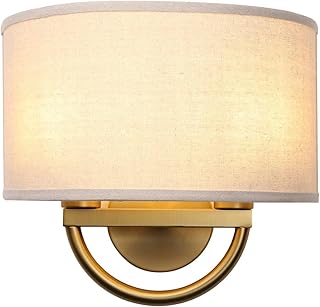
The genuine problem-solver for rentals, brick walls, and any spot with no electrical box, running on 10400mAh rechargeable bulbs with a remote for dimming and ten color modes. Just plan on periodic recharging, since convenience always costs something.
Frequently Asked Questions
Can I install a hardwired sconce without an electrician?
If there’s an existing box and you’re comfortable killing the breaker and verifying with a non-contact tester, most of these are a fifteen-minute wire-nut job. Running new cable through a finished wall is a different project entirely, and local code may require permitted work.
How bright should a wall sconce be?
For ambient hallway light, 400 to 700 lumens per fixture is plenty. Bathroom vanities want closer to 800 lumens per side so your face isn’t lit from a single harsh angle.
Are battery sconces bright enough to be useful?
They’re best treated as accent and ambient lighting rather than task lighting. Rechargeable models like the gold set handle bedside reading and hallway navigation well, but they won’t replace a hardwired vanity fixture.
Do I need to patch the wall if my old box is off-center?
Often no. Check the backplate dimensions against your box location first, since larger rectangular plates on up-and-down sconces cover more sins than a compact round one. If the gap shows, an oversized mounting plate or medallion beats mudding and repainting.
Final Thoughts
For most hardwired installs, the ASD Bronze LED Sconce is the versatile pick thanks to its selectable color temperature and reliable dimming behavior. If you want that graphic up-and-down wash, the Aipsun edges out its competitors on serviceability with replaceable G9 bulbs, and the Joosenhouse set is the better value when you need a matched pair. Renters and anyone facing a wall with no box should go straight to the battery operated gold set.