Key takeaways
- Solid wood vs. veneer: Solid acacia, pine, or rubberwood can be sanded and refinished repeatedly, so a scratch in year three isn’t permanent. Veneer over engineered wood is more dimensionally stable in humid rooms and costs less, but a deep gouge exposes the substrate and can’t be sanded out. Neither is wrong, just pick knowing which tradeoff you’re accepting.
- Tabletop thickness: Anything under an inch will feel springy in the middle of a long span. Look for tops around 1.2 inches or thicker, especially on tables 63 inches and up, or plan on adding a center support cleat underneath.
- Leg and base joinery: Trestle and pedestal bases give you more legroom and fewer knee collisions than four corner legs. Check whether the base attaches with threaded inserts and bolts, or just wood screws into end grain. Inserts hold; end-grain screws work loose and need retightening every season.
- Measure your clearance, not just the table: You need roughly 36 inches between the table edge and the nearest wall or cabinet for chairs to pull out comfortably, 42 to 48 if people walk behind seated diners. Tape the footprint on your floor before you order.
- Finish and food safety: Non-toxic, low-VOC finishes matter on a surface where food lands. Water-based polyurethane and hardwax oils both hold up; oiled tops need a refresh every year or two but repair beautifully with a rag and a little more oil.
What's inside
Shopping for a wood dining table is where a lot of home projects stall out. Photos flatten everything: a table shot from a low angle in a bright studio looks solid, but the listing buries the fact that the top is a paper-thin veneer over particleboard, or that the “solid wood” legs bolt on with two undersized screws. If you’ve ever spent a Saturday assembling a table only to find the top flexes when you lean on it, you know the difference between a table that looks the part and one built to take twenty years of elbows, homework, and holiday casseroles.
I’ve assembled, sanded, refinished, and occasionally reinforced enough of these to know which construction details actually matter. This guide covers six wood dining tables worth considering in 2026, spanning solid acacia and pine builds, veneered farmhouse designs with extension leaves, and trestle-base tables with tops thick enough to feel substantial under your hands. I’ll flag what’s genuinely solid wood, what’s engineered, and where each one earns its keep.
As an Amazon Associate we earn from qualifying purchases.


🛒 Best Price Today on Amazon
Prime members get fast, free shipping on everything above, plus member-only deals. New members get a 30-day free trial — cancel anytime.
How to Choose a Wood Dining Table (2026)
- Solid wood vs. veneer: Solid acacia, pine, or rubberwood can be sanded and refinished repeatedly, so a scratch in year three isn’t permanent. Veneer over engineered wood is more dimensionally stable in humid rooms and costs less, but a deep gouge exposes the substrate and can’t be sanded out. Neither is wrong, just pick knowing which tradeoff you’re accepting.
- Tabletop thickness: Anything under an inch will feel springy in the middle of a long span. Look for tops around 1.2 inches or thicker, especially on tables 63 inches and up, or plan on adding a center support cleat underneath.
- Leg and base joinery: Trestle and pedestal bases give you more legroom and fewer knee collisions than four corner legs. Check whether the base attaches with threaded inserts and bolts, or just wood screws into end grain. Inserts hold; end-grain screws work loose and need retightening every season.
- Measure your clearance, not just the table: You need roughly 36 inches between the table edge and the nearest wall or cabinet for chairs to pull out comfortably, 42 to 48 if people walk behind seated diners. Tape the footprint on your floor before you order.
- Finish and food safety: Non-toxic, low-VOC finishes matter on a surface where food lands. Water-based polyurethane and hardwax oils both hold up; oiled tops need a refresh every year or two but repair beautifully with a rag and a little more oil.
The Best Wood Dining Tables (2026) Reviewed
Signature Design by Ashley Haddigan Extension Table
The self-storing 18-inch butterfly leaf is the real selling point here: it folds into the table body, so you’re not hunting for a leaf in the basement every Thanksgiving. Construction is veneer over wood and engineered wood, which keeps the price reasonable and the top flat, though I’d use placemats and skip the aggressive scrubbing.
Devoko 6 Person Acacia Wood Table
Solid acacia in a walnut brown finish, and acacia’s natural oil content is what makes the indoor/outdoor rating credible rather than marketing. Expect visible grain variation from board to board, which reads as character on a farmhouse table but will bother anyone hoping for uniform color.
Signature Design by Ashley Galliden Trestle Table
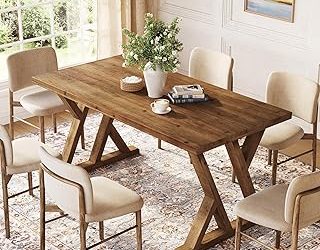
The extra-thick tabletop is the detail that separates this from cheaper farmhouse lookalikes, giving it real visual mass and a top edge that feels solid when you rest your forearms on it. The trestle base frees up corner legroom, so you can genuinely seat someone at the end without them straddling a post.
Little Tree Solid Wood Dining Table, 63-Inch
A straightforward solid wood rectangle that lands in the sweet spot for a family of four with room to squeeze in two more. Assembly is uncomplicated, but snug the leg bolts a second time after a week of use, and add felt pads before you slide it on hardwood.
Plank+Beam Classic 72 Inch Dining Table
The pecan wirebrush finish is my favorite detail on this list: wirebrushing opens the grain for a tactile, slightly rustic surface that hides everyday wear far better than a glassy topcoat. Solid wood construction, non-toxic finish, and at 72 inches you get true six-to-eight-person capacity without an extension mechanism to fail.
Frequently Asked Questions
Is solid wood always better than veneer?
Not always. Solid wood refinishes and lasts longer, but it expands and contracts with humidity, which can cause warping or seam gaps in dry winters or damp basements. Quality veneer over engineered wood stays flatter and costs less; it just can’t be sanded down after deep damage.
How do I stop my table from wobbling?
Ninety percent of wobble is loose leg hardware, so tighten everything in a cross pattern with the table upright and weighted. If it persists, the floor is likely uneven, and stick-on felt or threaded levelers under the short leg will solve it faster than any adjustment to the table.
What size table fits six people?
Budget 24 inches of edge per person, which means a 63-inch rectangle seats six with a bit of shoulder contact and a 72-inch seats six comfortably or eight in a pinch. Extension tables let you live small daily and expand for guests.
How should I care for a wood tabletop?
Wipe spills promptly with a barely damp cloth and dry it immediately; standing water is what causes white rings and lifted veneer. Skip ammonia and silicone-heavy sprays, use trivets under hot dishes, and refresh oiled finishes annually with a thin coat rubbed in and buffed off.
Final Thoughts
If you want the most durable table on this list, the Plank+Beam Classic 72 Inch is the one I’d build a dining room around: solid wood, a forgiving wirebrush finish, and enough length to seat a real crowd. For flexible spaces, the Ashley Haddigan’s self-storing butterfly leaf is hard to beat, while the Ashley Galliden’s thick top and trestle base deliver the substantial farmhouse presence most buyers are actually picturing.