The safe answer to what temperature to cook turkey has two parts. The USDA Food Safety and Inspection Service recommends roasting a whole turkey in an oven set no lower than 325 F and cooking the bird until a food thermometer reads at least 165 F in the thickest part of the breast, the innermost thigh, and the innermost wing. If the turkey is stuffed, its center must also register 165 F. Oven settings and elapsed time alone cannot confirm safety.
Quick Answer: For a conventional roast, use 325 F or higher as your oven setting and 165 F as the minimum measured internal temperature. A larger bird, cold or frozen center, stuffing, and uneven oven heating change how long reaching that target takes. Measure multiple spots before carving, rather than relying on skin color, a pop-up timer, or a fixed minutes-per-pound rule.
As an Amazon Associate we earn from qualifying purchases.
By DIY Ideas 4 Home Editorial Team
Turkey Cooking Temperatures by the Numbers
The USDA FSIS publications “Turkey Basics: Safe Cooking” and “Let’s Talk Turkey” separate the oven’s air temperature from the meat’s final internal temperature. Those numbers do different jobs: one defines an appropriate roasting environment, while the other establishes whether the turkey itself reached the agency’s consumer safety recommendation. The table below is a practical starting point for an ordinary household oven, not a substitute for measuring the meat.
| Situation or Input | Recommended Range or Answer | Why | Exception |
|---|---|---|---|
| Whole turkey, conventional oven | Oven at least 325 F | USDA minimum roasting oven setting | Follow validated appliance or packaging directions for specialized methods |
| Whole turkey, unstuffed | At least 165 F inside breast, thigh, and wing | All checked portions must reach the safe minimum | Some cooks prefer higher temperatures for texture |
| Whole turkey with stuffing | At least 165 F in bird and stuffing center | Stuffing can lag behind the surrounding meat | Cooking stuffing separately is safer and more even |
| Turkey breast or separate pieces | At least 165 F in thickest part | Part sizes differ, but minimum for poultry does not | Avoid bone when placing the thermometer |
| Unstuffed whole bird, 12 to 14 lb | About 3 to 3 3/4 hours at 325 F | USDA planning estimate for a thawed bird | Temperature reading, not clock, decides when done |
| After a fully cooked roast | Stand for about 20 minutes | USDA quality guidance helps carving | Do not use resting to excuse a missing 165 F reading |
165 F Is the Minimum Internal Target
According to the USDA FSIS “Safe Minimum Internal Temperature Chart,” all poultry, including whole turkey, breasts, thighs, wings, and ground turkey, has a recommended safe minimum of 165 F. This is a temperature taken inside the food, not the oven temperature shown on a control panel. A dial set to 325 F cannot tell you whether the center of a thick breast is ready.
Check the breast, inner thigh, and inner wing of a whole bird individually. One location can finish before another because thickness, exposure to hot air, and proximity to the roasting pan differ. If one of the required spots remains below 165 F, continue cooking and check again. This USDA consumer guidance does not ask home cooks to calculate alternative time-and-temperature pasteurization schedules.
Why the Oven Should Be at Least 325 F
The USDA FSIS “Turkey Basics: Safe Cooking” instructs home cooks to set a roasting oven no lower than 325 F. Many standard recipes use 325 F or 350 F, but changing the setting alters browning and timing, not the 165 F minimum inside the meat. A higher oven setting may brown the exterior sooner without bringing every deep portion to temperature at the same time.
Oven displays are estimates of the appliance’s air conditions; some ovens run hot, cold, or unevenly. The USDA specifically lists inaccurate oven temperature and pan size as variables that can change roasting time. If cooking repeatedly takes much longer than a published chart suggests, check the oven against its manual and verify actual cavity temperature with a separate oven thermometer rather than adjusting food-safety targets downward.
Where to Measure the Turkey
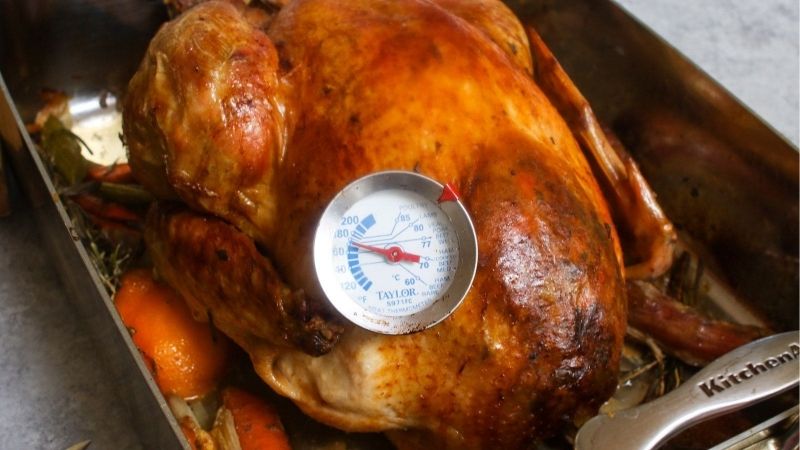
The USDA FSIS guidance on food thermometers calls for the innermost thigh, the innermost wing, and the thickest breast portion on a whole bird. Insert the probe far enough that its sensing section sits in the thickest meat, away from bone. Bone contact or a shallow tip near the hot surface can produce a reading that does not represent the coldest portion.
Take more than one measurement if a large section varies in thickness. Clean the probe according to its instructions after contact with raw or undercooked poultry and before checking ready-to-eat food. Remove the bird only after the necessary locations have reached the minimum. Neither clear juices nor a golden skin color supplies the same evidence as a properly positioned thermometer.
Adjust Cooking Temperature Checks for Your Turkey
A single safe internal target works across ordinary turkey cuts, but the way you approach it should match the bird’s size, whether it contains stuffing, its thawing condition, and the cooking equipment. The USDA timetable is intended to help plan dinner, not to turn the oven clock into a food thermometer. These adjustments keep the safety target fixed while making the method more practical.
Whole, Unstuffed Turkey
For a thawed, unstuffed whole turkey, arrange the bird breast-side up on a rack in a shallow pan, leaving room for hot air to circulate. USDA FSIS suggests a pan roughly 2 to 2 1/2 inches deep. An oversized pan or a turkey pressed against the oven wall can interfere with even cooking. Position the rack so the bird fits comfortably without touching a heating element.
As a planning example, USDA’s 325 F chart allows about 3 3/4 to 4 1/4 hours for a thawed, unstuffed 14 to 18 lb turkey. A different pan, oven, bird shape, or cooking-bag method may change the outcome. Begin checking temperatures as the expected finish approaches, especially in the breast, and continue until thigh and wing measurements also qualify. If skin browns early, a loose foil tent can moderate browning without pretending the center is already cooked.
Stuffed Turkey Needs Another Reading
The USDA advises cooking stuffing separately for more even heating and reduced risk. If you decide to put it inside the turkey, mix it shortly before roasting, fill the cavity loosely, and cook promptly in an oven set to at least 325 F. The stuffing’s middle may remain cooler than the bird itself. Measure that center independently; both the stuffing and the three turkey locations must reach 165 F.
Do not remove stuffing early to finish it casually on a counter, and do not assume that a 165 F thigh reading proves the filling is safe. USDA FSIS “Turkey Basics: Stuffing” emphasizes that bacteria can survive in stuffing that has not reached the recommended temperature. Let a fully cooked, stuffed bird stand for about 20 minutes before removing the stuffing for serving. Handle filling with clean tools to avoid contaminating it after cooking.
Turkey Breast and Smaller Pieces
A bone-in breast, boneless breast, thigh, drumstick, and wing can have very different thicknesses. Their cooking times should therefore follow the cut, method, and manufacturer’s directions rather than a whole-bird schedule. The USDA minimum stays at 165 F for each piece. Push the thermometer into the thickest meat without touching the bone or exiting into the roasting pan.
When baking a tray with mixed cuts, check each piece instead of selecting only the largest or the best-browned one. Smaller pieces may be ready first; remove them once their temperature is confirmed while continuing to cook pieces that remain below the target. To preserve texture, avoid leaving thinner breast slices in the oven simply because a separate large thigh needs more time. Keep cooked and uncooked pieces separate on clean plates.
Frozen or Partly Frozen Turkey
If dinner arrives before a turkey fully thaws, do not substitute a hotter oven for a temperature reading. USDA FSIS “Let’s Talk Turkey” explains that a whole turkey can be roasted from frozen, with cooking taking at least 50 percent longer than its thawed estimate. Frozen cavities can trap giblet packets, so remove them safely with utensils when loosened during cooking. Do not try to force a stuck packet out of an icy bird.
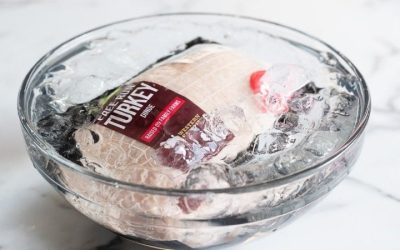
For a conventional oven roast from frozen, keep the oven at 325 F or higher and verify 165 F in all required locations once the center can be probed. The delay can be substantial, so it may be better to adjust the serving schedule than hurry with unsafe shortcuts. Factory-stuffed frozen birds are a separate category: follow their specific package instructions rather than thawing them as ordinary raw poultry. Safe refrigerator, cold-water, and microwave thawing methods are covered separately in our turkey-thawing guide.
Convection Ovens and Cooking Bags
Convection fans and oven cooking bags change the way heat transfers to the bird, often affecting cooking time and exterior browning. Follow the oven or bag manufacturer’s instructions for the equipment you actually use, including bag venting, pan clearance, and permitted temperatures. USDA FSIS recognizes an oven cooking bag as a method that can accelerate cooking, but its safe internal reading remains 165 F.
If a recipe specifies a special oven cycle, do not convert its time into a guarantee of doneness. Measure the meat through the process as instructed by your probe manufacturer, and avoid opening a hot cooking bag toward your face. For deep-frying, smoking, or grilling, follow dedicated USDA method guidance and appropriate equipment instructions; the 325 F roasting-oven rule is not a universal grill or smoker setting.
Products That Help
The OXO Good Grips Chef’s Precision Digital Instant Read Thermometer is a straightforward option for checking several turkey locations. OXO’s product page lists a pivoting readout and a temperature range from -22 F to 302 F; the swivel head can make thigh measurements easier to see. The ThermoWorks DOT Simple Alarm Thermometer adds a leave-in probe and an audible target alert, helpful when a long roast needs monitoring without frequent door opening. ThermoWorks lists an included high-temperature Pro-Series probe and a simple one-channel display.
For quick final checks, the ThermoWorks ThermoPop 2 uses a backlit, auto-rotating display and offers a 4.5-inch probe option with a maker-stated 2 to 3 second response. It is useful when you need to verify breast, thigh, and wing separately after an alarm sounds. Choose an instant-read thermometer if you need a basic first tool; choose a leave-in alarm only if your cooking setup and probe placement justify continuous monitoring. Check current listings for probe length and accessories before buying.
How to Confirm Doneness Without Guessing
Before handling the bird, make sure the thermometer is clean and working according to its manual. If it is a leave-in probe, place it in thick meat as directed, not against the roasting pan or bone, and keep cables away from elements and door hinges. A leave-in alarm can tell you when one selected spot reaches the target; it does not verify every required location. Perform the remaining checks with an instant-read instrument.
When all necessary sites are at least 165 F, remove the turkey using dry oven mitts and a stable work surface. USDA FSIS recommends standing the bird about 20 minutes before carving for easier slicing. This rest follows completed cooking; it is not a substitute for finishing a turkey that was removed too early. Keep raw juices away from the carving board, and refrigerate turkey and stuffing within 2 hours after cooking, using shallow containers for faster chilling.
Frequently Asked Questions
These points address cases where appearance, equipment signals, and timing disagree with the food thermometer. Prioritize the USDA’s measured safety limit over visual cues, and interpret recipe times in the context of your oven and bird.
Can I Remove Turkey at 160 F and Let It Rise?
For ordinary home cooking, follow the USDA consumer guidance of at least 165 F before removing the turkey from the heat source. A claim that carryover heat will make up the difference is not a substitute for measuring the required parts at a safe temperature. Large roasts do retain heat, but the rise is not identical in every piece, and a thermometer is the appropriate way to confirm completion.
Is 350 F Better Than 325 F for Roasting?
Either setting can be used for a conventional turkey roast, provided the oven stays at or above the USDA’s 325 F minimum and every required meat location eventually reaches 165 F. A hotter oven can change browning and cooking pace, but does not lower the safe internal temperature. Match your oven setting to the recipe, the pan and your ability to monitor browning.
Is Pink Turkey Unsafe Even When It Reads 165 F?
Not necessarily. The USDA FSIS publication “Is Pink Turkey Meat Safe?” explains that poultry can remain pink after it reaches the safe minimum temperature because of naturally occurring pigments and cooking conditions. Measure several appropriate sites and confirm the thermometer has been placed correctly. Color alone is not a reliable indicator either of safety or of undercooking.
Can I Trust a Turkey’s Pop-Up Timer?
Use a separate food thermometer to confirm the reading. USDA FSIS “Let’s Talk Turkey” specifically recommends checking the breast, inner thigh, and inner wing with a food thermometer even when the bird has a built-in pop-up indicator. That indicator responds at one installed location, while the coldest portion of a whole turkey can be elsewhere. Independent measurements are the practical final check.
Final Thoughts
Roast a whole turkey in a conventional oven set no lower than 325 F, and serve only after a food thermometer confirms at least 165 F in the thickest breast, innermost thigh, and innermost wing. Include the stuffing center in those checks if the turkey is stuffed. Use USDA time charts to organize the meal, not to certify doneness. For the next roast, check the current OXO instant-read or ThermoWorks ThermoPop 2 listing if you need a thermometer, verify its probe is suitable for a large bird, and keep a clean probe ready for the final checks. Once cooked, rest, carve, and refrigerate leftovers promptly.