The Short Answer
Yes, on one condition: your garage ceiling has accessible wood joists or trusses and at least 9 feet of height. If both are true, a 4-by-8-foot overhead rack in the $130 to $200 range adds 32 square feet of storage that costs you no floor space, no wall space, and about two hours on a Saturday. If your ceiling is 8 feet or lower, or you cannot find and hit the framing, the rack will either hang too low to park under or will not be safely anchored, and you are better off with wall shelving.
What You Actually Get
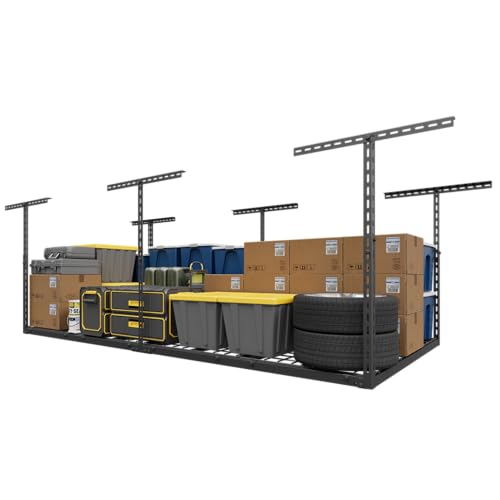
An overhead garage rack is a steel platform hung from the ceiling on four vertical posts. The dominant size is 4 by 8 feet, matching a sheet of plywood and giving you 32 square feet of deck. Smaller 3-by-6 and 4-by-4 versions exist for tight spots, and 4-by-6 is common. The deck is a welded wire grid, typically with 2- to 3-inch openings, sitting inside a perimeter frame of 1- to 1.5-inch steel tube.
Our top picks
 FLEXIMOUNTS 4x8 Overhead Garage Ceiling Storage Rack
- 1200 lbs Tested, 750 lbs Rated: Our overhead…
- Reclaim Your Garage Space: Avoid water damage by…
- Strong and Secure: Buy overhead storage racks with…
As an Amazon Associate we earn from qualifying purchases at no extra cost to you.
The two racks most shoppers compare are close cousins. The FLEXIMOUNTS 4×8 in black runs about $146 and is the model many others copy. A competing 4×8 rack rated for 750 pounds with a 26- to 40-inch height adjustment sells for about $140. Both use the same basic layout: ceiling brackets that bolt into the joists, adjustable vertical posts, and a deck that hangs from them.
The numbers that actually matter:
- Load rating: 500 to 800 pounds distributed evenly across the deck is standard. Evenly is the operative word; putting 400 pounds in one corner is not the same as 400 pounds spread out.
- Drop height: the distance from the ceiling to the deck. Most racks adjust between roughly 22 and 40 inches. This determines how tall an object fits on top and how much headroom remains below.
- Frame gauge: better racks use 14-gauge steel posts and brackets. Thinner 16-gauge frames are lighter to install but flex more when loaded.
- Hardware: you should get lag screws of at least 5/16 by 3 inches (many kits ship 3/8 by 3 inches), a template, and a ceiling bracket that spans two joists. Spanning two joists is what lets a rack work with both 16- and 24-inch joist spacing.
- Weight of the rack itself: 60 to 90 pounds for a 4×8. You will want a second person and two ladders for installation.
A typical 4×8 deck set 30 inches below a 9-foot ceiling leaves 6 feet 6 inches of clearance underneath, enough to walk under and to clear the roof of most sedans and small SUVs. Set at 40 inches, clearance drops to 5 feet 8 inches, which still works over a car hood but not over a pickup or a person of average height.
Pros
- Uses dead space. The volume above the hood of a parked car, above the garage door tracks, or above a workbench is empty in nearly every garage.
- High capacity for the price. Around $140 to $200 buys 500 to 800 pounds of rated storage, which is roughly what a dozen large plastic totes weigh.
- Ideal for seasonal and rarely used items. Holiday decorations, camping gear, luggage, off-season tires, and kids’ outgrown gear go up once or twice a year and stay out of the way.
- Adjustable height. You can tune the drop to fit tall bins on top or to preserve clearance below.
- Frees wall space. Walls stay open for tools, bikes, and shelving you actually reach for every week.
- Keeps stored goods dry and off the floor. Anything up top is safe from a leaking water heater, a wet car, or a flooded driveway.
Cons
- Everything requires a ladder. If you need to get at a bin more than once a month, you will stop putting it up there.
- Installation is not trivial. You must locate joists precisely, drill pilot holes, drive 3-inch lags overhead, and lift a 60- to 90-pound deck into place. Plan on two people and 2 to 4 hours.
- Not compatible with every ceiling. Steel or concrete ceilings, finished drywall with unknown framing, or engineered I-joists all need special anchors or an engineer’s opinion.
- Height loss. In an 8-foot garage, a rack at its minimum 22-inch drop leaves only 6 feet 2 inches underneath, which is unworkable over a car or a walkway.
- Garage door conflict. The rack must clear the door in its fully open position and the opener rail; many people discover the clash after drilling.
- Loading discipline required. Heavy items belong near the posts, not in the middle of the span, and nothing should hang over the edge.
Who Should Buy It
Buy an overhead rack if you have a 9- to 12-foot ceiling, wood framing you can locate with a stud finder or by looking in the attic, and a pile of bins you touch a few times a year. It is especially worthwhile in a two-car garage where the space above the hoods is wasted, and in homes without an attic or basement. Anyone who has run out of wall space but still has a clear rectangle of ceiling above the garage door, once it is open, is the textbook buyer. In 2026 a pair of 4×8 racks side by side, about $280 to $400 total, can hold what would otherwise fill an 8-by-10 storage unit costing $100 or more a month.
Who Should Skip It
Skip it if your ceiling is 8 feet or under and you park inside; the numbers simply do not work. Skip it if your ceiling is finished drywall and you cannot confirm the joist direction and spacing, or if the framing is steel, concrete, or engineered trusses with a manufacturer’s warning against point loads. Renters should skip it unless the landlord approves twelve 3/8-inch holes in the ceiling. And if the items you want to store are things you use weekly, such as sports gear or the shop vac, a rack you need a ladder to reach will become a shelf you resent.
Cheaper Alternatives
| Option | Cost | Trade-off |
|---|---|---|
| Five-shelf steel garage shelving unit (48 x 18 x 72 in) | $70 to $150 | Reachable without a ladder and easy to assemble, but consumes 6 square feet of floor and blocks wall space. |
| Wall-mounted track shelving (two 48-inch shelves) | $60 to $120 | Adjustable and accessible, but lower capacity per shelf (about 100 to 150 lb) and competes with tool storage for wall real estate. |
| Ceiling-mounted tote rails (holds 6 to 8 lidded bins) | $40 to $90 | Cheaper and lighter to install, but only fits standard 27-gallon totes and offers no flat deck for odd shapes. |
| Bike or ladder ceiling hooks (set of 4 to 8) | $15 to $40 | Great for long, awkward items, but each hook holds one thing and nothing lies flat. |
| Plywood deck over garage trusses (attic style) | $40 to $100 in materials | Nearly free space if trusses allow it, but requires attic access, a check that the truss bottom chord can take the load, and the truss maker’s approval. |
| Smaller 3×6 or 4×4 overhead rack | $80 to $120 | Fits over a workbench or in a corner where a 4×8 will not, but holds a third to half as much. |
FAQ
How much weight can an overhead garage rack really hold?
Most 4×8 racks are rated for 500 to 800 pounds when the load is spread evenly and all four brackets are lagged into solid framing. The rack is rarely the weak link; the ceiling is. Each bracket should be fastened to a joist or truss with at least two 5/16- or 3/8-inch lags driven a minimum of 2.5 inches into the wood. If a bracket lands between joists, you must add a cross-block or move it.
What ceiling height do I need?
Plan on 9 feet minimum if you park underneath and 8 feet 6 inches if the rack goes over a workbench or walkway only. Subtract the rack’s drop (22 to 40 inches) from your ceiling height and confirm the result clears your vehicle’s roof by at least 6 inches and any open garage door hardware by at least 2 inches.
Can I install an overhead rack alone?
You can install the ceiling brackets and posts alone, but lifting a 60- to 90-pound deck into place overhead is a two-person job. Some people assemble the deck on the floor, rest one edge on a ladder, and walk the other end up, but a helper and two ladders is faster and much safer.
What should not go on an overhead rack?
Anything you use more than once a month, anything so heavy that lifting it overhead on a ladder is dangerous (roughly 40 pounds per bin is a sensible cap), and anything that cannot tolerate garage temperature swings, such as paint, candles, photographs, and electronics. Keep fuel, propane, and chemicals at floor level where a spill does not rain down on your car.