Key takeaways
- Identify the battery voltage, chemistry, and rated CCA or amp-hour capacity from its label.
- Inspect the case and terminals. Do not test a cracked, leaking, swollen, or frozen battery.
- Charge a discharged battery before judging its condition; a low state of charge can distort the result.
- Use eye protection, remove jewelry, and work in a ventilated area away from sparks and flames.
- Follow the tester’s connection order, load duration, rest intervals, and temperature guidance.
- Stop if clamps or leads become excessively hot, and allow a carbon-pile tester to cool between tests.
The best battery load testers depend on the battery and the job
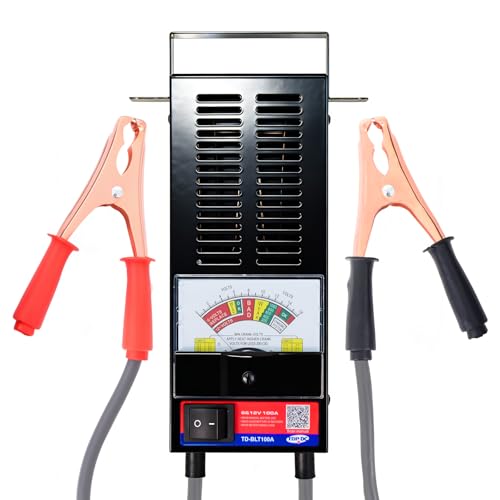
For most car owners, the best battery load testers are 12-volt digital or analog carbon-pile models rated for at least 500–1,000 cranking amps; for larger engines or workshop use, choose a model with higher test-current capacity and substantial clamps. For deep-cycle batteries, prioritize adjustable, lower-current testing and instructions that match the battery’s chemistry and capacity—not a high cranking-amp rating alone.
A load tester applies an electrical load and measures how the battery voltage responds. That makes it more useful than checking resting voltage alone when you need to assess starting ability. It does not, by itself, determine a battery’s exact remaining capacity or explain every charging-system fault.
Our top picks



As an Amazon Associate we earn from qualifying purchases at no extra cost to you. Ratings are shown as listed on Amazon.
Choose by situation
| Battery and use | What to look for | Why it fits |
|---|---|---|
| 12V passenger car, occasional checks | 100–1,000 CCA range, suitable for 12V batteries, clear scale or digital display | Covers common starting batteries without paying for heavy shop equipment. |
| Truck, van, or repair-shop use | At least 1,000 CCA capacity, heavy-duty leads, large insulated clamps | Higher capacity and sturdier connections suit larger starting batteries and repeated use. |
| Deep-cycle battery bank | Adjustable load, 6V/12V compatibility if needed, a procedure appropriate to battery capacity and chemistry | Allows a controlled test rather than applying a starter-battery load indiscriminately. |
| Quick checks across several battery types | Digital model with selectable voltage, battery type, and test rating | Guided settings can reduce calculation and interpretation errors. |
Compare the important specifications
Voltage range: match the tester to the battery
Many basic testers are designed for 12V automotive batteries. If you also service 6V batteries, such as those used in some older vehicles or battery banks, check that the tester explicitly supports 6V operation. For 24V systems, use a tester rated for that system or test each 12V battery individually as the manufacturer directs. Never assume that a tester’s ability to display a voltage means it can safely apply a load at that voltage.
Test-current capacity: match the rating, not just the vehicle
For a conventional starting-battery test, a common method applies roughly half the battery’s rated cold-cranking amps (CCA) for 15 seconds, then checks voltage against the tester’s temperature-adjusted guidance. The tester must be capable of delivering that current. A 600-CCA battery may call for a 300-amp test under this method; a tester that tops out below the required load cannot complete it properly.
Check how the tester expresses capacity: some list a maximum test current, while others show a range of battery CCA ratings they can evaluate. Those figures are related but are not interchangeable. Follow the tester’s instructions and the battery maker’s test procedure, particularly for AGM batteries and other designs with specific requirements.
Analog versus digital: simplicity or guided readings
Analog carbon-pile testers use a dial and manually applied load. They are direct, often durable, and can suit a mechanically confident user who wants control over the test. Their trade-offs are heat, more operator judgment, and readings that may be harder to interpret precisely.
Digital testers display voltage and may guide the user through battery type, rating, and test results. Some use conductance testing rather than a sustained carbon-pile load. That can be convenient and avoids drawing a large current, but it is a different test method; follow the manufacturer’s limits when assessing a deeply discharged or unusual battery. A digital display does not make an incompatible test procedure accurate.
Clamps and leads: the connection affects the result
Look for insulated, spring-loaded clamps with enough jaw opening for the battery posts you service, plus thick, flexible leads and secure strain relief. A clamp that barely grips a corroded or oversized terminal can create resistance, heat, and misleading readings. For workshop use, replaceable leads and robust clamp pivots are worthwhile. Keep the contact surfaces clean and attach the clamps to the battery posts, not to a painted or corroded surface.
What changes for deep-cycle batteries?
Deep-cycle batteries are designed to deliver power over time, while starting batteries are built to provide a brief burst of high current. A cranking-amp load test is therefore not a full measure of deep-cycle capacity. For a deep-cycle battery, use the battery maker’s recommended procedure—often a controlled discharge at a specified current and cutoff voltage if you need an actual capacity assessment. That test can take hours and requires a suitable load and careful monitoring.
A handheld load tester can still help identify a weak or damaged battery, but only if its load settings and instructions suit the battery. Be especially careful with lithium batteries: use equipment explicitly compatible with the battery’s chemistry and battery-management system. Do not apply a generic carbon-pile test unless the battery manufacturer permits it.
Practical checks before and during a test
- Identify the battery voltage, chemistry, and rated CCA or amp-hour capacity from its label.
- Inspect the case and terminals. Do not test a cracked, leaking, swollen, or frozen battery.
- Charge a discharged battery before judging its condition; a low state of charge can distort the result.
- Use eye protection, remove jewelry, and work in a ventilated area away from sparks and flames.
- Follow the tester’s connection order, load duration, rest intervals, and temperature guidance.
- Stop if clamps or leads become excessively hot, and allow a carbon-pile tester to cool between tests.
Which type should you buy?
Choose a compact digital tester if you mainly check 12V car batteries and want clear, guided results. Choose an analog carbon-pile unit if you need a controlled high-current test and are comfortable interpreting a dial. For mixed automotive and deep-cycle work, the best choice is a model with a useful adjustable load and explicit support for the battery types you own; if it cannot test deep-cycle capacity at the required discharge rate, treat it as a screening tool, not a capacity tester.
Basic consumer testers generally cost less than heavy-duty shop models, while higher-current units with sturdier leads and broader voltage support usually cost more. Compare the published test-current range, compatible battery types, clamp construction, and warranty before paying for features you will not use.