Key takeaways
- Confirm the largest pipe size: Use the machine’s stated capacity for the material and threading method you need.
- Check what is included: Identify die heads, dies, cutter, reamer, oiling system, stand, and pipe supports; packages vary.
- Verify power requirements: Match voltage and circuit capacity to the location where you will use the machine.
- Plan for long stock: Arrange stable supports and clear feed-through space so pipe cannot tip or swing into people or furniture.
- Budget for consumables: Include compatible thread-cutting oil and replacement dies in the ownership cost.
- Check serviceability: Confirm that replacement parts and the correct dies are available for the exact model.
Best pipe threading machines: the right pick depends on pipe size and job frequency
The best pipe threading machines are stationary electric models for frequent work on larger pipe, compact machines for occasional repairs in tight spaces, and portable electric threaders when you need power without a full-size stand. Match the machine’s rated pipe capacity and compatible dies to your pipe material first; then weigh portability, setup time, and cutting speed. A fast motor cannot make a machine suitable for pipe sizes it is not designed to thread.
Compare the main machine types
| Machine type | Typical capacity | Best suited to | Practical trade-off |
|---|---|---|---|
| Bench or floor threading machine | Commonly 1/8–2 in.; heavier models may handle larger sizes | Shops, plumbing contractors, and repeated jobs | Fast, supported production, but needs a stable stand, space, and safe handling for long pipe |
| Compact electric threading machine | Often up to 1 in. or 1 1/4 in.; check the exact model | Maintenance work and occasional small-to-medium pipe runs | Easier to store and move than a shop machine, but has less capacity and may need more operator support |
| Portable electric threader | Model-dependent; some systems cover roughly 1/2–2 in. | On-site work where carrying a machine and stand is impractical | Useful in confined locations, but workholding, reaction force, and handling long pipe need careful planning |
| Manual ratcheting die set | Usually small pipe sizes, depending on the set | A few threads, remote repairs, or places without power | Lowest powered-equipment burden, but threading takes more effort and time |
These are broad categories, not guarantees: manufacturers specify capacity by model, and a machine may require separate dies, adapters, or a particular stand. Confirm whether its rating refers to steel pipe, conduit, or another material before buying.
Our top picks


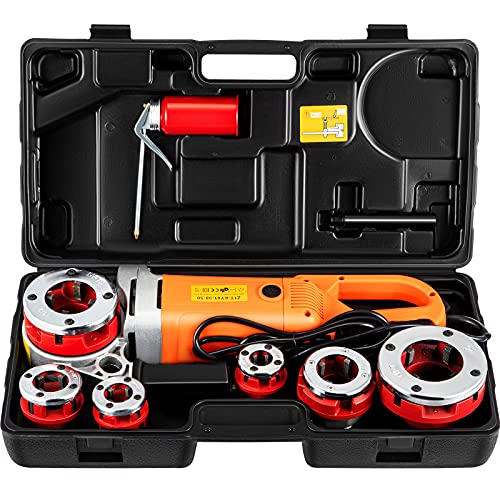
As an Amazon Associate we earn from qualifying purchases at no extra cost to you. Ratings are shown as listed on Amazon.
Choose by the work you actually do
| Your situation | Good starting choice | Why it fits |
|---|---|---|
| Home repair with only a few small threaded connections | Manual ratcheting set or compact electric machine | A large floor machine is hard to justify if it will spend most of its life in storage. |
| Regular work on pipe up to 2 in. in a workshop | Bench or floor machine rated for the full size range | Built-in workholding and a stable setup make repeated cutting more manageable. |
| Service calls in occupied buildings | Portable electric threader, if its capacity covers the job | It can be carried to the work rather than moving long pipe back to a shop. |
| Frequent larger-diameter work | Heavy-duty stationary machine specified for those diameters | Do not assume a portable unit or a standard 2-inch machine can handle larger pipe. |
What to compare before you buy
Threading capacity and compatibility
Start with the nominal pipe sizes you use most and the largest size you expect to thread. The machine’s stated range is only one part of the match: verify that the correct die head and dies are included or available, and that they produce the thread standard your fittings require. Pipe-threading machines commonly cut tapered NPT threads in North America, but not every die set is interchangeable or intended for every standard.
Also check material compatibility. Carbon-steel pipe, stainless steel, and conduit can call for different dies, cutting conditions, or equipment. Forcing the wrong die onto a workpiece can damage the thread and overload the tool.
Portability, footprint, and setup
A portable unit saves trips and floor space, but “portable” does not mean effortless: the machine, die heads, lubricant, and pipe supports still have to reach the job. A stationary machine is a better production choice when it will remain in one place, but needs a rigid work surface or stand, access to power, and room to feed and support pipe. Measure the whole work zone—not just the machine—before committing. Long stock needs clear space on both sides, or a safe way to support it without blocking a walkway.
Die material and replacement cost
High-speed steel (HSS) dies are a useful general-purpose option for many routine threading jobs. Carbide or other specialized dies may be offered for particular materials or higher-duty applications, but check the machine maker’s compatibility guidance rather than treating a harder die as universally better. Dies are consumables: wear, incorrect setup, dirty pipe, and inadequate cutting oil can all degrade thread quality. Compare the cost and availability of replacement sets in the sizes you need, not just the price of the machine.
Cutting speed and job frequency
Manufacturers may list motor speed or threading cycles, but those figures do not tell the whole story. Actual output depends on pipe size and material, die condition, setup, and how often the operator must stop to reposition or deburr. For occasional work, controlled operation and easy setup matter more than a headline speed. For repetitive shop work, look for a machine with dependable clamping, readily available dies, and service support; that can save more time over a week than a small difference in motor speed.
Buying checks that prevent an expensive mismatch
- Confirm the largest pipe size: Use the machine’s stated capacity for the material and threading method you need.
- Check what is included: Identify die heads, dies, cutter, reamer, oiling system, stand, and pipe supports; packages vary.
- Verify power requirements: Match voltage and circuit capacity to the location where you will use the machine.
- Plan for long stock: Arrange stable supports and clear feed-through space so pipe cannot tip or swing into people or furniture.
- Budget for consumables: Include compatible thread-cutting oil and replacement dies in the ownership cost.
- Check serviceability: Confirm that replacement parts and the correct dies are available for the exact model.
Safety and thread quality matter more than raw speed
Clamp the pipe securely, support its free end, and follow the machine’s instructions for guarding, lubrication, and operation. Keep hands, loose clothing, and hair clear of rotating parts; never hold a loose length of pipe by hand as a substitute for proper support. Use eye protection and clean up cutting oil promptly, since it creates a slip hazard. For gas, water, or other regulated piping, use the specified materials and thread standard, and have connections inspected or installed by a qualified professional where required.
Clean, accurate threads depend on a square, properly secured pipe; sharp, compatible dies; and adequate cutting lubricant. A machine that matches your pipe sizes and workload will usually produce better results than choosing the most powerful or fastest model regardless of the job.
Bottom line
For a workshop threading pipe regularly, choose a stationary machine with capacity for your largest routine size and an accessible supply of compatible dies. For service work, prioritize a portable electric model that covers the actual pipe sizes you encounter and can be safely supported on-site. For occasional small repairs, a manual set or compact electric threader may be the more sensible purchase. In every case, verify capacity, thread standard, included accessories, and replacement-die availability before deciding.