Key takeaways
- Steel gauge of the body and shelves — sets the ceiling on everything else. You cannot fix a 24-gauge cabinet with better hardware.
- Construction method — welded frames resist racking far better than bolted flat-pack units of the same gauge.
- Shelf load rating — usually much lower than the cabinet’s advertised total capacity. Always look for the per-shelf number.
- Locking system — determines whether the cabinet is a deterrent or an actual barrier, and whether it can be keyed alike across a bank of cabinets.
- Mobility — casters add 4–6 in of height and a set of failure points, but they turn a fixed wall into a working island.
- Mounting method — wall cabinets free up floor space; floor cabinets carry far more weight; both have hard clearance rules.
The short answer: for most two-car garages the right first purchase is a welded 20-gauge steel base cabinet roughly 36 in high × 30–36 in wide × 18–24 in deep with a 3-point locking handle and shelves rated at 150 lb or more each, and you add wall cabinets or a tall wardrobe cabinet only after you have measured the parking stall and the door-swing zone. If you want the single most flexible configuration, buy a modular system you can extend later rather than a one-piece cabinet you will outgrow in a year.
What separates a cabinet that survives fifteen years in an unheated garage from one that sags, rusts at the seams and jams shut in February comes down to six specifications: steel gauge, weld versus bolt construction, shelf load rating, lock type, mobility, and whether the unit is designed for wall mounting or floor standing. Everything below is organized around those six numbers, because they are the only things on a spec sheet that predict how the cabinet behaves after the novelty wears off.
Our top picks


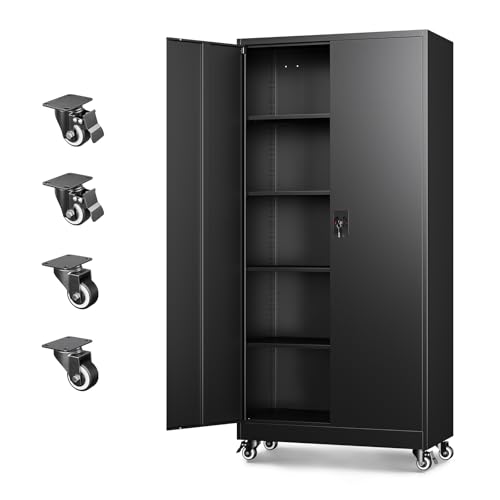

As an Amazon Associate we earn from qualifying purchases at no extra cost to you.
The Six Specs That Actually Decide the Purchase
Garage cabinets are sold on appearance and price, but they fail on engineering. A powder-coated cabinet photographed in a showroom looks identical whether its body is 24-gauge or 18-gauge steel. It looks identical whether the shelves hang from plastic clips or from welded angle flanges. The difference only shows up when you load 200 lb of tools onto a shelf and the cabinet decides whether it will bow, tear at the fastener holes, or hold.
Here is the hierarchy of importance, in order:
- Steel gauge of the body and shelves — sets the ceiling on everything else. You cannot fix a 24-gauge cabinet with better hardware.
- Construction method — welded frames resist racking far better than bolted flat-pack units of the same gauge.
- Shelf load rating — usually much lower than the cabinet’s advertised total capacity. Always look for the per-shelf number.
- Locking system — determines whether the cabinet is a deterrent or an actual barrier, and whether it can be keyed alike across a bank of cabinets.
- Mobility — casters add 4–6 in of height and a set of failure points, but they turn a fixed wall into a working island.
- Mounting method — wall cabinets free up floor space; floor cabinets carry far more weight; both have hard clearance rules.
Two more things belong on the list but are not on most spec sheets: the finish system and the hardware. A powder coat applied over properly phosphated steel will outlast a wet paint job by years in a humid garage. And the hinges, shelf clips and lock cylinders are the parts that actually break first, long before the steel does.
Steel Gauge: The Number That Sets Everything Else
Sheet steel gauge runs backwards — a lower number is thicker. This trips up almost every first-time buyer, who reasonably assumes that “20 gauge” is beefier than “18 gauge.” It is not. Twenty-gauge steel is roughly 0.036 in thick; eighteen-gauge is about 0.048 in, which is a third more material and a dramatically stiffer panel.
In practical terms, the gauge determines three things: how much weight a shelf can carry before it deflects, how much the cabinet resists twisting when you push it across a floor, and how well it survives being hit by a bike handlebar or a lawnmower deck. Thin panels do not fail dramatically — they deflect, the powder coat cracks along the fold lines, and moisture gets into the seam. That is the beginning of rust on a garage cabinet.
| Gauge | Thickness (in / mm) | Typical use | Realistic shelf load | Typical price band per cabinet |
|---|---|---|---|---|
| 24 ga | 0.024 in / 0.61 mm | Light wall cabinets, utility lockers, budget shelving | 40–75 lb | $60–$150 |
| 22 ga | 0.030 in / 0.76 mm | Economy floor cabinets, wall units | 75–100 lb | $120–$250 |
| 20 ga | 0.036 in / 0.91 mm | Standard residential garage cabinets | 100–175 lb | $200–$450 |
| 18 ga | 0.048 in / 1.21 mm | Heavy-duty residential, prosumer modular systems | 175–300 lb | $350–$800 |
| 16 ga | 0.060 in / 1.52 mm | Industrial and shop-grade storage | 300–500 lb | $600–$1,400 |
| 14 ga | 0.075 in / 1.90 mm | Heavy industrial, tool cribs | 500–800 lb | $900–$2,000+ |
| 12 ga | 0.105 in / 2.66 mm | Professional tool chests, roll cabs | 800–1,200 lb | $1,200–$3,500+ |
For a home garage, 20-gauge is the sensible floor and 18-gauge is the comfortable target. Below 20-gauge you are buying a locker, not a cabinet — fine for pool chemicals and holiday bins, wrong for a table saw and a case of oil. Above 18-gauge you are paying for industrial durability that a residential garage rarely needs, unless you are storing engine blocks or running a working shop.
Welded versus bolted: the gauge multiplier
Gauge is only half the story, because a bolted cabinet loses a large share of its theoretical stiffness at the joints. Bolted flat-pack cabinets rely on dozens of small fasteners to hold square. Under load, those fasteners work in their weakest direction and the cabinet slowly racks out of alignment, which is why the doors on a cheap unit eventually rub and stop latching cleanly. A welded cabinet with a one-piece body and welded corner gussets holds its geometry because the load path is continuous steel.
The practical rule: a welded 20-gauge cabinet will generally outperform a bolted 18-gauge cabinet of similar dimensions in stiffness and door alignment. If you can only prioritize one feature, prioritize the weld. A welded 20-gauge unit is usually the better buy than a bolted 18-gauge one at the same price.
There is a middle category worth knowing about: welded frame with bolt-on panels. These are common in modular garage systems, and they are a legitimate compromise because the welded skeleton carries the structural load while the removable panels keep shipping costs and box sizes down. What you want to avoid is a cabinet where the entire body — corners, back panel and shelf supports — is assembled from flat panels with cam locks or sheet-metal screws.
Weight Capacity: The Advertised Number Is Not the Useful Number
Cabinet marketing usually leads with a single big number: “600 lb capacity.” That figure is almost always a total static load spread evenly across the entire cabinet, including the bottom pan, and it tells you very little about whether the top shelf will hold a case of paint. The number you want is the per-shelf rating, and then you want to discount it.
Two rules of thumb help. First, assume the per-shelf rating is a static, evenly distributed load, and derate it by about 30 percent for real-world use where weight lands in one corner. Second, remember that a shelf’s rating assumes the cabinet is level and anchored. A loaded cabinet standing on an uneven slab twists, and a twisted cabinet concentrates load on two corners instead of four.
Here is what garage contents actually weigh, which is the only way to translate a spec sheet into a purchase decision:
| Item | Typical weight | Shelf rating needed |
|---|---|---|
| 5-gallon paint bucket | 40–60 lb | 100 lb |
| Case of motor oil (12 qt) | 22–28 lb | 75 lb |
| 40 lb bag of fertilizer or salt | 40 lb | 100 lb |
| 20 lb propane tank (full) | ~37 lb | 75 lb |
| Loaded hand-tool box | 60–100 lb | 150 lb |
| Portable table saw | 60–90 lb | 150 lb |
| 20-gallon air compressor | 90–130 lb | 200 lb (bottom pan only) |
| Portable generator | 100–200 lb | 200 lb (bottom pan only) |
| Bicycle | 25–30 lb | 75 lb |
| Holiday decoration tote | 30–50 lb | 100 lb |
| 40-pack bottled water | ~40 lb | 100 lb |
| Mounted tire (each) | 25–60 lb | 150 lb |
Notice that almost nothing in a normal garage exceeds 150 lb, and the few items that do — compressors, generators, engine blocks, tile boxes — belong on the floor or the bottom pan of a floor cabinet, never on a shelf. This is why a 20-gauge cabinet with 150 lb shelves handles roughly 90 percent of residential garage storage. If your storage list includes heavy machinery, jump to 16-gauge and accept the price.
The bottom pan is a separate rating
Floor cabinets carry their heaviest loads on the bottom pan, which sits directly on the base and transfers weight straight to the slab. Bottom pans on 20-gauge cabinets commonly handle 300–400 lb, and on 18-gauge units 500 lb or more. If you plan to store a generator, a snow blower, or a stack of tile, the bottom pan rating is the number that matters and the shelf rating is largely irrelevant.
Locking Systems Compared
A garage cabinet lock serves two purposes: it stops casual access and it satisfies an insurance or household requirement that chemicals, tools or firearms be secured. Those two purposes demand different hardware, and most cabinet locks are designed for the first, not the second.
| Lock type | Security level | Keying options | Best for | Typical add-on cost |
|---|---|---|---|---|
| Cam lock (single-bitted key) | Low | Usually unique per cabinet | Child-safety, casual deterrence | Often included |
| Tubular cylinder lock | Low–medium | Keyed alike available | Matching a bank of cabinets | $15–$40 per cabinet |
| Padlock hasp / lockable handle | Medium | Your own padlock | Renters, mixed-brand setups | $10–$30 plus padlock |
| 3-point locking rods | Medium–high | Keyed alike or padlock | Full-height and wide cabinets | Usually built in |
| Electronic keypad | Medium | Multiple user codes | Shared shops, no-key households | $60–$200 |
| Biometric / RFID | Medium | Per-user enrollment | High-traffic pro shops | $150–$400 |
The most important upgrade is not the lock itself but the number of locking points. A single cam lock on a 30 in wide door is a suggestion — a determined person can flex the door panel enough to defeat it. A 3-point system with rods at the top, middle and bottom of the door converts the door into a braced panel and is dramatically harder to pry. If the cabinet is wider than 24 in or taller than 60 in, insist on 3-point locking.
Keyed-alike matters more than you think
If you are buying three or more cabinets, order them keyed alike. A garage with six cabinets and six different keys is a garage where the keys get lost and the cabinets stay unlocked. Most modular garage systems and most industrial cabinet brands offer keyed-alike as a factory option, and it usually costs nothing if you specify it at the time of order — and a great deal of annoyance if you try to fix it afterward by re-keying cylinders individually.
Security reality check
No steel garage cabinet is a safe. An 18-gauge cabinet with a 3-point lock will stop an opportunistic teenager and slow a determined adult for a few minutes. A 16- or 14-gauge cabinet with welded door edges and a shrouded lock is genuinely resistant. If you are storing firearms, jewelry, or anything with real resale value, buy a certified safe and bolt it to the slab — a cabinet is a storage product, not a security product.
Mobility: Casters, Leveling Feet and the Anchoring Question
Mobility is the most over-chosen and under-considered feature in garage storage. A cabinet on casters can be rolled out for cleaning, reconfigured when you buy a new car, and used as a mobile work surface. It also sits 4–6 in higher, has four new failure points, and will roll if you lean on it while cutting a board.
Caster ratings are per caster, and the total is not the sum. Because weight is rarely distributed evenly and because dynamic loads spike when you push a loaded cabinet over a slab joint, the working rule is to size casters so that the total load is carried by three of the four wheels, not four. A cabinet weighing 600 lb loaded needs casters rated at 200 lb each minimum, not 150 lb.
| Caster diameter | Typical per-caster rating | Safe working load (4 casters, derated) | Rolls well on | Notes |
|---|---|---|---|---|
| 2 in | 75–125 lb | 225–375 lb | Smooth sealed concrete | Stops dead at expansion joints |
| 3 in | 150–250 lb | 450–750 lb | Sealed concrete, epoxy | Best all-round for light cabinets |
| 4 in | 250–300 lb | 750–900 lb | Concrete, tile, thresholds | Handles small lips and debris |
| 5–6 in | 350–500 lb | 1,050–1,500 lb | Rough concrete, gravel aprons | Raises cabinet height noticeably |
Wheel material matters as much as diameter. Hard polyurethane wheels roll easily and do not flat-spot, but they transmit every bump into the cabinet and can mark soft flooring. Soft rubber wheels roll quietly and grip better but deform under heavy static loads and develop flat spots if the cabinet sits in one place for a year. For a garage, polyurethane on a steel or cast-iron hub is the standard answer.
Add the caster height to the cabinet height before you buy. A 36 in base cabinet on 4 in casters becomes a 40 in working surface, which is too tall for comfortable use as a workbench for many people. Standard workbench height is 34–37 in; counter height is 36 in. If the cabinet will double as a bench, choose 2 in casters or leveling feet instead.
Leveling feet versus casters
Leveling feet are the right answer for cabinets that will not move. They add only 1–2 in of height, they eliminate the roll-and-tip risk, they let you compensate for a sloped slab, and they distribute load over a larger contact patch. Many modular systems ship with both, and the correct move is to use casters during installation and leveling feet permanently once the layout is settled.
Anchoring is the last mobility decision. Any cabinet taller than about 60 in should be anchored to the wall with an anti-tip strap or bracket, whether it has casters or not. Garage floors are usually sloped toward the door for drainage, typically ⅛ in per foot or more, which means a tall unanchored cabinet leans slightly forward from day one. That lean is harmless until someone pulls a drawer or leans on the open door.
Wall Mounting versus Floor Standing, and the Layout Math
Wall cabinets and floor cabinets are not interchangeable, and the choice is usually settled by arithmetic rather than preference.
The clearance numbers you need before ordering
- Parking stall: a full-size car needs about 9 ft of width and 18–20 ft of length to park and walk around. Compact cars fit in 8 ft.
- Car door opening: 24 in of side clearance lets an adult squeeze out; 30 in is comfortable; 36 in is generous. Cabinets along the driver’s side wall are the most common cause of a garage that “fits two cars but only parks one.”
- Walk aisle: 36 in is the minimum code-style path; 42–48 in is what you actually want between a wall of cabinets and a parked car.
- Base cabinet depth: 18 in for shallow storage, 24 in for deep storage and a full-depth worktop. Add 30 in in front for a comfortable standing work zone.
- Wall cabinet mounting height: bottom edge at 54–60 in from the floor for general storage; 18 in above a countertop if one is present.
- Wall cabinet depth: 12–16 in. Anything deeper becomes a head hazard over a workbench.
- Overhead door track: the horizontal track and torsion spring assembly typically hang 12–18 in below the ceiling and extend 6–8 ft back from the door wall. Keep tall cabinets out of that zone entirely.
- Electrical panel: 36 in of clear working space in front, 30 in wide. Cabinets in front of a panel are a code violation in most jurisdictions.
- Water heater: 18–24 in of clearance is common; check the label and local code before boxing one in.
- Ceiling height: most garages are 8–9 ft; 10 ft is common in newer construction. Tall cabinets run 72–84 in, so they fit under 8 ft ceilings with room to spare but leave an unusable gap above.
Layout plans by garage size
| Garage size | Parking reality | Recommended cabinet plan | Approximate footprint used |
|---|---|---|---|
| 10 × 12 ft (single, compact) | One compact car, tight | Wall cabinets only on the back wall plus one 24 in base cabinet in the corner | 2–3 linear ft of floor, 6 ft of wall |
| 12 × 20 ft (single, full) | One full-size car or truck | One run of base cabinets on the long wall plus wall cabinets above; tall cabinet in the back corner | 8–10 linear ft of floor |
| 20 × 20 ft (two-car) | Two cars, minimal walk space | Wall cabinets on the back wall; base cabinets on one side only, 24 in deep; keep the other side clear | 10–12 linear ft of floor |
| 22 × 24 ft (two-car, generous) | Two cars with room to open doors | L-shaped run: base cabinets along one side wall and the back wall, wall cabinets above both | 16–20 linear ft of floor |
| 24 × 30 ft (three-car) | Two cars plus a work bay | Full L or U of base cabinets, tall wardrobes in the corners, mobile island in the work bay | 24–30 linear ft of floor |
| 30 × 32 ft+ (shop) | Vehicles plus dedicated work area | Full perimeter run with a dedicated mobile tool bank and a separate welding or finishing zone | 30+ linear ft of floor |
The single most common layout mistake is putting deep base cabinets along the wall where the car doors open. Measure the widest door on your vehicle, add 6 in, and treat that strip as permanently empty. If that leaves no floor wall available, go vertical: wall cabinets and tall cabinets on the end wall, nothing at floor level along the parking side.
Size Classes: What Each Cabinet Type Is Actually For
| Type | Typical dimensions (H × W × D) | Mounting | Best use |
|---|---|---|---|
| Wall cabinet | 24–36 × 24–48 × 12–16 in | Wall, into studs | Chemicals, small tools, supplies above a work zone |
| Base cabinet | 30–36 × 24–48 × 18–24 in | Floor, anchored | Work surface plus heavy storage below |
| Tall / wardrobe cabinet | 72–84 × 24–48 × 18–24 in | Floor, anchored to wall | Brooms, ladders, jackets, tall power tools |
| Locker cabinet | 66–78 × 12–18 × 12–18 in | Floor or wall | Personal gear, narrow dead space |
| Bin cabinet | 60–78 × 30–48 × 12–24 in | Floor or wall | Fasteners, fittings, small parts |
| Mobile tool cabinet | 36–46 × 30–60 × 18–24 in | Casters | Tools that travel to the job |
| Modular system | Configurable, 30–84 in heights | Both | Whole-garage fit-out with matching doors and trim |
Wall cabinets are the most space-efficient storage in a garage because they occupy volume you cannot park a car in anyway. The trade-off is a hard weight ceiling — a wall cabinet is limited by its fasteners and your studs, not by the steel. A 24-gauge wall cabinet hung into two studs with 3 in lag screws will realistically hold 100–150 lb total, no matter what the box claims.
Tall cabinets are the most misunderstood. They look like the answer to everything, but an 84 in tall cabinet along a side wall blocks the space where you would otherwise mount wall cabinets, and it creates a 24 in deep obstruction at floor level that a car door will hit. Tall cabinets belong in corners and on end walls.
The Roundup: Metal Garage Cabinets by Type, Spec and Situation
The sections below cover the cabinet families worth considering in 2026, each with the specification that decides whether it fits your garage. Where a specific product line is named, it is because the line is well established and its specifications are published and stable. Prices are general market ranges for new units and vary with width, finish and configuration.
1. Seville Classics UltraHD — best budget tall cabinet
The UltraHD line is the reference point for an inexpensive steel storage cabinet that still uses real steel rather than stamped sheet. Most units in this family are built around 22- to 20-gauge steel with a powder coat finish, a full-height double door, and a keyed locking handle. The tall wardrobe versions typically run about 72 × 30 × 18 in and are the cheapest credible way to get broom, ladder and jacket storage out of the middle of the garage floor.
What makes them work is the combination of a genuinely tall interior, adjustable shelving, and a price that usually lands in the $200–$400 range for the large sizes. What they do not do is heavy weight. Shelf ratings in this class are typically in the 75–100 lb range, so treat them as volume storage, not tool storage. If you need to store a case of oil, a leaf blower and a stack of winter coats, this is the right class. If you need to store an engine hoist, it is not.
Installation notes: these ship flat or semi-assembled in a box typically weighing 60–90 lb, which one person can move but not comfortably lift onto a dolly alone. They anchor to the wall with a single anti-tip bracket and are tall enough that anchoring is not optional.
2. Husky Heavy Duty and Industrial — best mid-tier residential pick
Husky’s garage cabinet lines span the useful middle of the market, from welded ready-to-assemble units up through heavier industrial-style cabinets with 3-point locking and thicker steel. The Heavy Duty base cabinets generally sit in the 20- to 18-gauge range with welded bodies and load ratings that support real workbench use — commonly 600–1,000 lb for the cabinet and 150–200 lb per shelf on the larger units.
The practical reason to choose this tier is the countertop. A 36 in high base cabinet with a 24 in deep worktop gives you a proper standing work surface at a standard 36 in counter height, with drawers and a locking cabinet below. Pair two or three of these along a wall and you have a bench that also stores. Add wall cabinets above at a 54–60 in bottom edge and the wall is fully used without eating floor space.
Price bands are usually $300–$700 for base cabinets and $150–$400 for wall cabinets, depending on width and whether the unit includes drawers. Look specifically for welded construction and a 3-point lock on anything wider than 30 in.
3. NewAge Products Pro Series 3.0 — best full modular system
The Pro Series is the heavy end of NewAge’s residential garage lines, built with welded steel frames and a modular design that lets you build a full wall of matching base, wall and tall cabinets with consistent door styling and a continuous worktop. Frame construction in this class is typically 18-gauge or heavier, and load ratings are published per cabinet and per shelf, which is more transparency than most of the market offers.
The advantage of a modular system over individual cabinets is that the units share a common height, depth and door style, so a run of six cabinets reads as built-in cabinetry rather than a collection of boxes. That matters for resale and for the simple reason that a coherent wall is easier to keep organized. The disadvantage is cost: a full wall configuration typically lands in the $2,000–$5,000 range, and the system locks you into one brand’s dimensions if you want to extend later.
Buy this if you are doing a complete garage fit-out and want the result to look deliberate. Do not buy it if you only need one cabinet, because the value proposition depends on the run.
4. NewAge Products Bold Series 3.0 — best value modular system
The Bold Series uses a lighter gauge and a simpler frame than the Pro line, at roughly half to two-thirds the price, and it is the right answer for a homeowner who wants the modular look without the modular price. Cabinets in this tier typically use 24- to 22-gauge steel with a welded frame and bolt-on panels, load ratings around 300–500 lb per cabinet, and per-shelf ratings in the 100–150 lb range.
The honest trade-off is weight capacity and door rigidity. Bold-class cabinets are excellent for general garage storage — sports gear, chemicals, hand tools, holiday bins — and they are not the right choice for a working shop where the same cabinet will hold 300 lb of steel offcuts. If you are honest about what you actually store, this tier covers most households.
5. NewAge Products Saber Series — best welded heavy-duty modular
Saber sits above Pro in NewAge’s range and is built around welded 18-gauge steel with a focus on high load capacity and full-extension drawer hardware. This is the tier where a modular system starts to behave like a professional tool storage setup: heavier drawer slides, higher per-drawer ratings, and door and drawer faces stiff enough that a 3-point lock is genuinely effective.
Expect pricing in the $700–$1,500 per cabinet range depending on width and drawer count. This is the right class for a home shop with a lift, a welder, or a serious mechanics’ tool collection. For a two-car garage storing bikes and bins, it is over-specification.
6. Gladiator Premier — best welded ready-to-assemble line
Gladiator’s Premier cabinets are welded steel with a powder coat finish, available as wall cabinets, base cabinets, tall gear closets and mobile units, all sharing a common 18- to 20-gauge construction and a consistent design language. The Premier tall gear closet, typically around 72 × 30 × 18 in, is one of the more useful single pieces in the residential market because it combines full-height hanging space with shelving.
Because the line is modular and widely distributed, it is one of the easiest systems to build out incrementally — start with a base cabinet and a wall cabinet, add a tall unit next year, and the styling still matches. Price bands generally run $200–$600 per cabinet. Shelf ratings in this class are typically 100–200 lb, with the heavier ratings on the base and tall units.
7. Gladiator Ready-to-Assemble (RTA) — best budget welded cabinet
The RTA line trades factory assembly for a lower price while keeping welded steel construction, which is the key distinction from the flat-pack cabinets at the same price point. You assemble the unit yourself from a box that is heavy and awkward — expect 80–120 lb for a tall cabinet — but the resulting cabinet is welded where it matters and bolted only at the panel joints.
This is the class to buy if you want welded steel on a budget and are willing to spend 45–90 minutes with hand tools. The trade-offs are a lighter gauge than the Premier line and fewer finish options.
8. Sandusky Lee — best all-steel welded storage cabinet
Sandusky Lee has been making industrial and institutional steel storage for decades, and the line is unusually well specified: published gauge, published shelf capacity, and a choice of 3- or 4-shelf configurations with adjustable heights. Most units are welded 22- to 20-gauge all-steel with a powder coat finish and a keyed handle, and many are available with a padlock hasp instead.
These are not styled garage cabinets — they look like school and factory storage, because that is what they are. What they offer is honest capacity at a fair price, usually $300–$800 depending on size, and a level of consistency that is hard to match in the consumer market. The 72 in tall, 36 in wide, 18 in deep configuration is the workhorse and fits neatly against a garage wall without dominating the space.
9. Durham Manufacturing — best heavy-duty industrial cabinet
Durham builds steel storage cabinets in 16- to 14-gauge steel with welded construction, heavy-duty hinges, and load ratings that start where residential cabinets stop. Many models offer 500–1,200 lb total capacity with individual shelf ratings of 200–500 lb, and options for bin fronts, dividers and locking systems including padlockable handles.
This is the class for a working shop: a cabinet that will hold a transmission, a stack of brake rotors, or a shelf full of loaded tool cases without deflecting. Prices typically run $700–$2,000 and up. The cabinet will outlive the garage. If you are buying once for a lifetime, this is where the argument for over-specification is strongest.
10. Lyon Workspace Products — best for industrial and shop environments
Lyon makes a broad line of steel storage cabinets, lockers and workbenches aimed at manufacturing and maintenance environments, with published gauge, shelf capacity and door construction for every model. Construction is typically 16- to 18-gauge welded steel with reinforced shelves and a choice of keyed, padlockable or electronic locking.
For a home shop, the value here is configurability — you can specify the exact height, width, depth, shelf count and lock type rather than picking from three stock sizes. That is worth the longer lead time if your space is irregular or your storage needs are unusual.
11. Tennsco — best for lockers and bulk storage
Tennsco’s strength is storage density: lockers, bulk storage cabinets, and shelving that make the most of a narrow wall. Their steel storage cabinets are typically 22- to 20-gauge welded with adjustable shelves and a keyed handle, and their locker-style units are useful in a garage where you want individual compartments for family members’ gear.
Locker cabinets are an underused garage solution. A 78 in tall, 15 in wide locker takes a footprint most cabinets cannot use and gives one person a place for boots, a jacket, a helmet and a duffel. A bank of three or four along an end wall handles a whole family’s sports equipment in 60 in of width.
12. Hallowell — best for secure and ventilated storage
Hallowell makes steel storage cabinets with an emphasis on security and airflow options, including ventilated cabinets designed for chemicals and flammables storage. Construction is typically 18- to 20-gauge welded steel, with 3-point locking and reinforced doors on the security models.
This is the class to look at if you store solvents, propane, or lawn chemicals and want them both locked and ventilated rather than sealed in a box where vapors accumulate. Ventilated cabinets typically have louvered panels or perforated doors and cost more than solid-door equivalents, usually $500–$1,200.
13. Homak — best locking tool storage cabinet
Homak builds steel tool storage including wall-mounted and floor-standing locking cabinets in the 20- to 18-gauge range, with a focus on tool organization rather than general storage. Many units include drawer banks, pegboard-ready backs, and keyed locking.
The useful niche here is the wall-mounted locking tool cabinet: a 30 in wide, 24 in tall, 12 in deep unit that mounts above a workbench and keeps hand tools locked but within arm’s reach. Expect $150–$500 depending on size and drawer count.
14. Stack-On — best for secure lockable storage
Stack-On makes a range of steel storage and security cabinets, from small lockable wall cabinets up through tall full-height units. Construction is typically 20- to 18-gauge steel with welded or heavily fastened bodies, keyed locks, and on some models a 3-point locking system.
The line is most useful for people who need a lockable cabinet for a specific purpose — ammunition, chemicals, power tools — rather than a full garage system. Prices typically run $150–$600. As with any steel cabinet, treat the lock as a deterrent and match the gauge to what you are protecting.
15. Montezuma — best mobile tool cabinet
Montezuma builds steel tool storage with a strong emphasis on mobility: roller cabinets, triangle-shaped units designed to fit in corners, and drawer configurations built for mechanics. Construction in the roller cabinet range is typically 18- to 16-gauge with ball-bearing drawer slides and caster sets rated for the loaded weight.
The corner-shaped units are worth knowing about because they solve a specific garage problem: the dead corner behind a parked car. A triangular mobile cabinet rolls into a corner that no rectangular cabinet can use. Prices typically run $400–$1,500.
16. Extreme Tools — best for professional mobile storage
Extreme Tools builds heavy steel roller cabinets and tool storage aimed at professional mechanics, with 16- to 14-gauge construction, high-capacity ball-bearing slides, and caster sets sized for loaded weights in the 1,000–2,500 lb range. Drawer ratings are published and are typically 100–250 lb per drawer.
For a home garage this is over-specification unless you are running a business out of it, but the case for it is the same as for industrial cabinets: buy once. Expect $1,000–$3,000 for a large roller cabinet.
17. Trinity — best stainless and garage-ready mobile cabinets
Trinity makes steel and stainless-steel garage storage including mobile cabinets, worktables and tall storage units, often with a stainless work surface. Stainless units use 430-grade stainless in most residential applications, which resists corrosion but is not the 304 grade used in food-service environments.
The appeal is a cabinet that can double as a potting bench, a grill prep station or a garage sink surround without worrying about water. Prices typically run $300–$900. Check whether the stainless is on the worktop only or on the whole body — a stainless top on a painted steel body is the common configuration.
18. Edsal and Muscle Rack — best ultra-budget steel storage
Edsal and its Muscle Rack line cover the bottom of the steel storage market: light-gauge cabinets and shelving, often 24-gauge or thinner, with bolt-together construction. These are legitimate products for light storage — bins, paper goods, seasonal items — and they are not appropriate for tools, chemicals or anything heavy.
The reason to consider them at all is cost: $100–$250 buys a tall cabinet that keeps clutter off the floor. The reason to avoid them is that at this gauge and construction, a loaded shelf will deflect visibly and the cabinet will not survive being moved. If your budget is tight, buy one 20-gauge cabinet instead of two 24-gauge cabinets.
19. Craftsman — best for tool-first storage
Craftsman’s steel storage range focuses on tool storage: roller cabinets, top chests, and locking wall and floor cabinets with drawer configurations built around hand tools. Construction varies by tier, from light-gauge consumer units up to heavier welded roller cabinets with ball-bearing slides.
The practical use in a garage is as the tool core of the layout: one locking roller cabinet that holds the tools you actually use, positioned so it rolls to the car rather than requiring you to walk to it. Prices typically run $300–$1,200 depending on size and drawer count.
20. Uline — best for spec-driven bulk buying
Uline sells steel storage cabinets with unusually complete published specifications: gauge, shelf capacity, overall dimensions, and lock type for every model, in a wide range of sizes from small wall cabinets to 72 in tall storage units. Construction in the mid-range is typically 22- to 20-gauge welded steel with adjustable shelves and keyed or padlockable handles.
This is the right source when you need four identical cabinets for a wall and want to specify them precisely rather than pick from whatever a retail store stocks. Prices typically run $250–$900 per cabinet. Because they sell direct in volume, it is also one of the few places where you can order keyed-alike as a standard option.
21. Akro-Mils — best bin and small-parts cabinet
Akro-Mils makes steel bin cabinets and small-parts storage with louvered panels that accept hanging bins, typically in 20- to 18-gauge welded steel with a keyed locking door. These are not general storage cabinets — they are for fasteners, fittings, electrical parts and hardware.
The reason they belong in a garage layout is that they eliminate the single biggest source of clutter: small parts in coffee cans. A 36 in wide bin cabinet mounted above a workbench typically costs $300–$700 and holds hundreds of part types in labeled bins.
22. Moduline — best aluminum cabinet system
Moduline builds garage cabinets from aluminum rather than steel, which makes them dramatically lighter — a full-height cabinet that would weigh 150 lb in steel weighs roughly half that in aluminum — and completely rust-proof. The trade-off is that aluminum is softer and less stiff than steel, so the design compensates with extruded profiles and thicker sections.
For a coastal garage, a humid climate, or anyone who has to move cabinets alone, aluminum is a legitimate alternative to steel. Prices typically run $700–$2,000 per cabinet, higher than comparable steel. Load ratings are generally lower than heavy steel cabinets of the same size, typically 100–200 lb per shelf.
Decision Matrix: Match the Cabinet to Your Situation
| Your situation | What to prioritize | Recommended type and spec | Typical budget |
|---|---|---|---|
| 10 × 12 ft single garage, one compact car | Zero floor intrusion | Wall cabinets only, 12 in deep, 24–30 in high, mounted at 54–60 in | $300–$800 total |
| 12 × 20 ft single garage, full-size car | One wall of usable storage | 20-gauge welded base cabinet plus wall cabinets above | $600–$1,500 |
| 20 × 20 ft two-car garage | Keeping the parking bay clear | Wall cabinets on the back wall plus one tall cabinet in a corner | $800–$2,000 |
| 22 × 24 ft two-car with work space | Work surface plus storage | Modular system, base cabinets with a continuous 24 in worktop | $2,000–$4,000 |
| Renter, cannot drill into walls | Reversibility and mobility | Mobile 18-gauge cabinets on 3–4 in casters, no anchoring | $500–$1,500 |
| Kids and pets, chemicals stored | Locking plus ventilation | Ventilated 18-gauge cabinet with 3-point lock, mounted high | $500–$1,200 |
| Flood-prone or humid coastal garage | Corrosion resistance | Aluminum cabinets or galvanized/stainless steel, nothing on the floor | $1,500–$4,000 |
| Home woodshop with heavy tools | Load capacity | 16-gauge industrial base cabinets, 300–500 lb shelf ratings | $1,500–$4,000 |
| Mechanic’s home shop with a lift | Drawer capacity and mobility | 16-gauge roller cabinet, 100–250 lb per drawer | $1,000–$3,000 |
| Back pain or limited mobility | Reach and bending | Wall cabinets at 48–54 in bottom edge, drawers instead of deep shelves | $800–$2,500 |
| Whole-garage fit-out, long-term home | Coherence and resale | 18-gauge welded modular system, matching doors throughout | $3,000–$8,000 |
Material and Construction Trade-Offs
| Material | Weight | Rust resistance | Load capacity | Cost | Best for |
|---|---|---|---|---|---|
| Cold-rolled steel, powder coat | Heavy | Good if coated; rusts at chips | High | Low–high | The default choice for most garages |
| Galvanized steel | Heavy | Very good | High | Medium–high | Humid climates, unheated garages |
| Stainless steel (430) | Heavy | Excellent | High | High | Wet zones, worktops, coastal |
| Stainless steel (304) | Heavy | Excellent | High | Very high | Food-service, wash-down areas |
| Aluminum | Light (about half of steel) | Excellent | Medium | High | Coastal garages, one-person installation |
| Resin / polypropylene | Light | Total | Low–medium | Low–medium | Chemicals, damp floors, no-rust needs |
| Melamine-faced engineered wood | Medium | Poor in damp | Medium | Low | Dry, climate-controlled garages only |
| Plywood or solid wood | Medium–heavy | Poor in damp | Medium–high | Medium–high | Built-in workshop benches, not free-standing storage |
The material decision is usually made for you by the climate. An unheated garage in a cold, wet climate swings in humidity all year, and that is exactly the environment where engineered wood swells, delaminates and loses its fasteners. Steel with a proper powder coat handles it. Aluminum handles it and never rusts. Resin handles it and cannot rust but will sag under sustained heavy loads and can become brittle in extreme cold.
Where steel still wins is the combination of stiffness and cost. A steel shelf spanning 30 in will deflect less than an aluminum shelf of the same dimensions and less than any resin shelf. That stiffness is what keeps the cabinet square over years of loading.
Installation, Assembly and Moving Realities
Box weights and doorway widths
Cabinet boxes are heavier and larger than buyers expect. Approximate shipping weights:
- Wall cabinet, 30 × 30 in: 35–60 lb, box about 34 × 34 × 8 in
- Base cabinet, 36 × 30 in: 80–140 lb, box about 40 × 34 × 26 in
- Tall cabinet, 72 × 30 in: 100–180 lb, box about 76 × 34 × 10 in or two boxes
- Modular system cabinet, 18-gauge welded: 120–220 lb
- Industrial 16-gauge cabinet, 72 × 36 in: 200–350 lb, often shipped on a pallet
Standard interior doorways are 30–32 in wide; exterior and garage entry doors are usually 36 in. A tall cabinet box at 76 in long will not fit through a 30 in doorway at an angle unless the box is under about 30 in in its other dimension — check before delivery day, and if it will not fit, have it delivered to the garage directly. Palletized industrial cabinets cannot be moved without a pallet jack or a few strong people and a furniture dolly.
Wall mounting: studs are the limit
A wall cabinet’s real capacity is set by what it is fastened to. Garage walls are typically 2 × 4 studs at 16 in on center behind ½ in drywall. A 24 in wide wall cabinet will usually catch two studs. Fasten with 3 in long, ¼ in diameter lag screws or heavy-duty cabinet screws rated for the load — not drywall anchors, and not the plastic plugs that come in the box.
If your studs are 24 in on center, or if the cabinet is wider than 32 in, add a plywood mounting rail: a ¾ in plywood strip screwed across at least three studs, with the cabinet fastened to the rail. This distributes load across the wall and makes it possible to mount cabinets anywhere along the run rather than only where studs happen to fall.
Concrete block and brick garage walls need sleeve anchors or wedge anchors, and a hammer drill. Do not attempt to mount a loaded wall cabinet into block with masonry screws alone.
Floor anchoring
Tall cabinets should be anchored to the wall with an anti-tip strap or bracket. Base cabinets should be anchored to the wall too, especially in seismically active regions, and it is worth anchoring a mobile cabinet to the wall if it will sit permanently in one place. If you must anchor into concrete, use a ¼ in wedge anchor; for a wood-framed wall, a lag screw into a stud is sufficient.
Check the floor slope before anchoring. Garages commonly slope ⅛ in per foot toward the overhead door for drainage, which over an 8 ft run is a 1 in drop. Shim the cabinet so it sits level and does not rock, then anchor. A rocking cabinet will loosen its own fasteners.
Assembly time and tools
Welded ready-to-assemble cabinets typically take 45–90 minutes each with a socket set and a screwdriver. Flat-pack bolt-together cabinets take 60–120 minutes and often require two people to hold panels square while fasteners are started. Modular systems with a worktop and leveling feet take a full day for a six-cabinet run.
Plan for the packaging. A six-cabinet modular order arrives as a large stack of cardboard and foam that will not fit in a standard curbside bin in one week.
What Wears Out First
The steel is almost never what fails. In order of typical failure:
- Casters and wheels — flat spots, seized bearings, cracked wheel plates. The first thing to go on any mobile cabinet, especially under sustained heavy loads.
- Lock cylinders — cam locks wear out from being
Affiliate disclosure. As an Amazon Associate we earn from qualifying purchases at no extra cost to you. Prices accurate as of the date shown.Best Metal Garage Cabinets for Every Storage NeedCheck price on Amazon