Key takeaways
- 30-gallon size is manageable for frequent, smaller residential cleanup sessions.
- Spring-loaded opening stays upright while both hands gather scattered leaves.
- Three-inch folded profile fits a narrow garage storage gap.
A leaf collection bag should solve a specific problem: keeping its mouth open while you rake, carrying an awkward pile without tearing, or meeting the rules for curbside yard-waste pickup. Those are different jobs. A spring-loaded bag stays open, a woven sack stages big piles, and paper may be mandatory for pickup. This guide compares six actual products, with particular attention to how they fill, fold, and empty.
Quick Verdict: For routine residential cleanup, the Fiskars Kangaroo 394050-1003 is our Best Overall choice because its 30-gallon opening stays accessible and its spring body compresses to 3 inches for storage. Choose the Gardzen GBT02 three-pack when several large piles need staging at once; choose The Home Depot 30GPLLB20C paper bags when your pickup service requires paper. These recommendations reflect published product documents as of October 2026, not in-house testing. Check today’s price and your local disposal requirements before ordering.
As an Amazon Associate we earn from qualifying purchases.
By DIY Ideas 4 Home Editorial Team
The Best Leaf Collection Bags Reviewed
We compared specified bag volume, mouth support, fabric or paper construction, carrying arrangements, storage footprint, and clearly identified US listings. Reusable models here span 30 to 72 gallons, while the paper option is sold as a 20-count pack. Published capacities describe space, not the weight a homeowner should lift; some advertised load ratings are especially unsuitable as lifting recommendations. Prices below are seller display prices seen in October 2026 and may vary by location.
| Product | Best For | Key Spec | Listed Price (as of October 2026) | Watch Out For |
|---|---|---|---|---|
| Fiskars Kangaroo 394050-1003 | Best Overall: compact reusable cleanup | 30 gal; folds to 3 in | $24.09 | Smaller loads than large woven sacks |
| Gardzen GBT02, 3-Pack | Best for large yards and multiple piles | 3 bags, 72 gal each; 26 in diameter | $22.99 per 3-pack | Hoop setup and 30-in-tall sides |
| DURASACK BB-2028RED | Best for mixed garden debris | 48 gal; 20 x 20 x 28 in | $17.99 | No spring-powered opening |
| BARNEL USA B900 | Best for shoulder-strap transport | 43 gal; 5.28 lb empty | $49.99 | Heavier and pricier than cloth sacks |
| BirdRock Home 11293 | Best for damp clippings and drainage | 30 gal labeled; drainage base | $41.59 | Capacity wording differs within listing |
| The Home Depot 30GPLLB20C, 20-Pack | Best for paper-only curbside pickup | 30 gal labeled; 2-ply paper | $12.81 per 20-pack | Disposable; not waterproof |
Fiskars Kangaroo 394050-1003: Best Overall
Best For: Homeowners who need a grab-and-go container for recurring leaf, weed, and lawn-clipping cleanup.
The Kangaroo earns the leading place because it addresses the annoying part of small and medium cleanup jobs: opening a limp bag each time another armful of leaves arrives. Its spring-loaded body can stand open beside a rake, then collapse into a narrow stored shape without needing a removable rim. Unlike the much taller Gardzen GBT02 sacks, it can be moved around a modest yard without dedicating a large staging area. Its limitation is equally clear: 30 gallons fill sooner during a major fall leaf drop.
The Home Depot’s product listing for Fiskars model 394050-1003 states a 30-gallon capacity, tear- and mildew-resistant construction, and a displayed price of $24.09 in October 2026. These are seller-published attributes, not evidence that a particular bag will survive a fixed number of seasons. A second US seller, Friedman’s Home Improvement, describes the Kangaroo’s pop-up polyester and polyvinyl construction and its resistance to UV exposure. Neither source establishes a comparable maximum safe carrying weight, so avoid filling it with dense, wet debris merely because space remains.
Its folded body measures 3 inches thick according to The Home Depot’s model-specific product page. That reduced storage depth matters for apartment garages and sheds with crowded shelves. A spring frame is convenient until the fabric or seam is damaged, so inspect stitching and any sharp sticks before repeatedly compressing it. This bag is a transfer container: in municipalities requiring biodegradable paper sacks, empty the collected leaves into an approved curbside bag rather than leaving the reusable Kangaroo out for pickup.
Pros:
- 30-gallon size is manageable for frequent, smaller residential cleanup sessions.
- Spring-loaded opening stays upright while both hands gather scattered leaves.
- Three-inch folded profile fits a narrow garage storage gap.
Cons:
- Repeated trips are likely on properties producing many large leaf piles.
- Not a substitute for paper bags where local pickup requires compostable sacks.
Who Should Buy It: Buy the Kangaroo for weekly yard maintenance; choose Gardzen GBT02 when you need three high-capacity stations to hold a heavy autumn cleanup.
Gardzen GBT02 3-Pack: Best for Large Yards
Best For: Households dividing broad lawns into several leaf-gathering zones before hauling debris to compost or disposal.
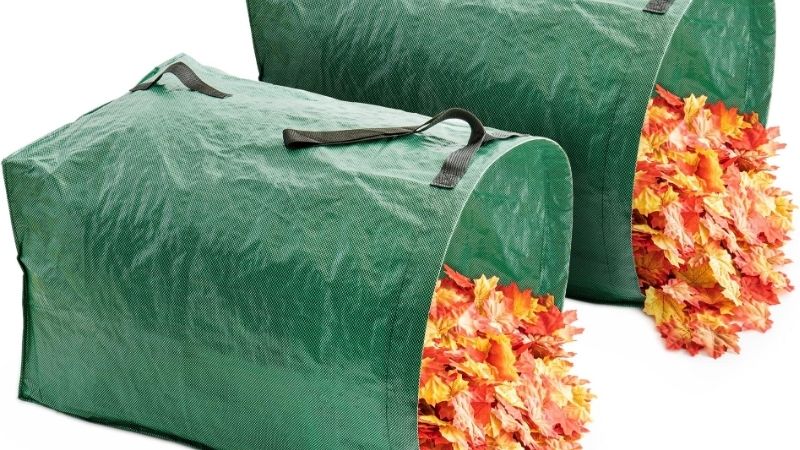
One large bag can become a bottleneck when helpers are raking at opposite ends of the yard. Gardzen solves that workflow problem with three separate 72-gallon woven sacks in the exact GBT02 package. Spread the bags beside different piles, then consolidate debris when everyone has finished gathering. Its appeal is distributed capacity rather than a promise that a single person can comfortably carry a completely full sack. Compared with the Fiskars Kangaroo, loading is better suited to broad jobs, but each container occupies a considerably larger footprint.
Gardzen’s product page identifies GBT02 as the three-pack and displays $22.99 for that package as of October 2026. The same document specifies 150-gram-per-square-meter woven polypropylene with a water-repellent polyethylene coating, a flexible support hoop, and a maker-stated maximum of 110 pounds per bag. That last claim should not be treated as a recommended lifting load. More useful for typical dry leaves is the wide opening and the ability to move several partly filled sacks without a rigid cart.
Each bag measures 26 inches across and 30 inches high, according to Gardzen’s exact product documentation. The maker describes two stitched top handles and an additional lower corner handle for tipping the contents out. You must insert the support hoops correctly; the company’s product-page Q&A links to installation instructions. A tall woven bag can drag against shrubs or fences, so keep abrasive branches away from the seams. At the end of the season, remove accumulated dirt, allow the fabric to dry, and collapse it for storage without leaving damp leaves inside.
Pros:
- Three 72-gallon sacks let separate workers collect leaves simultaneously.
- 26-inch openings accept broad rake loads without repeated hand scooping.
- Bottom corner handles help tip contents into a compost pile.
Cons:
- Thirty-inch height may make emptying into a shorter bin awkward.
- Rim hoops require insertion and attention when packing the bags away.
Who Should Buy It: Choose this set for large seasonal cleanups with a composting area; buy Fiskars Kangaroo 394050-1003 when a lighter single-bag routine matters more than volume.
DURASACK BB-2028RED: Best for Mixed Debris
Best For: Gardeners collecting both loose leaves and the heavier offcuts, mulch, or weeds from periodic maintenance.
A reusable sack needs a different shape when the contents are not just dry leaves. The DURASACK BB-2028RED has a boxier self-standing body than the rounded spring buckets, providing a broad base for mixed loads and an opening that does not rely on a rising metal spring. Its high and low carrying grips are especially useful when tipping a collection into a compost area. The compromise is that it folds and unfolds manually rather than popping up at the first release of a strap.
The Home Depot product page for model BB-2028RED lists a 48-gallon single red woven-polypropylene bag at $17.99 in October 2026. Zoro’s model-specific listing confirms the 48-gallon construction and approximate physical size. The brand also advertises an extraordinary 1,000-pound dry-material load rating. We do not take this marketing figure as an instruction to lift or drag anything close to that weight: safe handling depends on the person, the material, the stitching, and the surface underneath.
Opened, the red bag measures 20 inches wide, 20 inches long, and 28 inches high. The Home Depot product description calls its empty weight less than 2 pounds and gives approximate folded dimensions of 12 by 15 inches. Those proportions work well for storing the sack in a car trunk between gardening sessions, but the 28-inch side walls can hide sharp objects during cleanup. Rinse after muddy use and check the lower corner stitches before lifting a bag containing wet compost material.
Pros:
- Square 20-inch base creates a stable staging area for mixed waste.
- Upper and lower grips assist controlled tipping without grabbing the fabric.
- Retail listing under $20 makes a single reusable sack accessible.
Cons:
- No coil spring to hold an instantly expanded opening during loading.
- Advertised extreme load capacity should not guide real carrying decisions.
Who Should Buy It: Use BB-2028RED for varied garden debris, but select BARNEL USA B900 if an included shoulder strap and spring bucket are higher priorities.
BARNEL USA B900: Best for Strap Carrying
Best For: Gardeners who move gathered material around a property and value a dedicated shoulder strap.
BARNEL’s B900 is a more structured spring bucket than the low-cost woven sacks. Its extra-strong metal spring, mesh-supported PVC walls, and adjustable padded shoulder strap are intended for gathering and moving bulky organic material rather than sealing it for municipal pickup. The strap can make an otherwise awkward container easier to reposition while empty, but it does not make a heavy wet load appropriate to carry on one shoulder. Its construction is more elaborate than the basic Fiskars pop-up, and that shows in both weight and selling price.
Barnel’s product documentation, the Spring/Rope Buckets & Cleanup Tools catalog, identifies model B900 as a 43-gallon collapsible spring bucket, with quick-connector clips, an anti-corrosion-plated spring, and a perforated bottom panel. The Home Depot listing for B900 displayed $49.99 in October 2026. The perforations provide drainage instead of a watertight bottom, which is useful after damp lawn trimming but means muddy runoff may reach a vehicle or indoor floor. These attributes are stated by the manufacturer, not demonstrated by a hands-on comparison in this article.
The same Barnel catalog specifies a 22-inch diameter, 26-inch height, and 84.5-ounce empty weight, approximately 5.28 pounds. The bucket compresses to 3 inches deep when secured for storage. That is notably heavier before loading than the DURASACK, and the shoulder strap should be adjusted to prevent swinging while walking. Examine connectors, spring tension, and the perforated base for wear after repeated wet use; these components matter more to its working life than the nominal gallon rating alone.
Pros:
- Included adjustable padded strap supports repositioning around a larger garden.
- Perforated bottom reduces standing water from rain-damp yard material.
- Three-inch collapsed profile stores despite the 43-gallon open capacity.
Cons:
- At 5.28 pounds empty, it adds noticeable weight before loading.
- Approximately $50 price is steep for occasional dry-leaf collection.
Who Should Buy It: Choose B900 if a draining spring bucket with a shoulder strap is genuinely useful; choose DURASACK BB-2028RED for a simpler, lower-cost hauling sack.
BirdRock Home 11293: Best for Damp Clippings
Best For: Homeowners handling rain-damp grass clippings or garden debris who want a drainable portable leaf container.
The BirdRock Home 11293 differs from the Gardzen woven sack and the DURASACK through its reinforced plastic base with drain holes. That design matters when clippings have retained rainwater and a sealed bottom would hold a pool of liquid until the next emptying. Its detachable shoulder strap and internal spring add portability and automatic opening, creating a practical all-in-one design. The downside is that a plastic base adds weight and is an extra part that could crack if scraped hard across concrete.
The Home Depot’s product page for BirdRock Home model 11293 displayed $41.59 in October 2026, and its product description identifies polyester fabric, professional stitching, a metal spring, and an approximately 30-gallon class of capacity. The listing title says 30 gallons while the detailed description says 31 gallons. That is a genuine source discrepancy; treat it as a roughly 30-gallon bag, not a precisely measured larger container. The listing also shows no manufacturer warranty, a meaningful consideration at this price.
Its listed open dimensions are 18.9 inches in diameter by 25.2 inches high, and the stated empty weight is 3.5 pounds. The internal spring compresses to a reported 4-inch stored thickness. The base’s drainage holes make it unsuitable for collecting fine soil or material that must remain contained in a vehicle. For damp clippings, allow excess water to leave outdoors before moving the container; after use, inspect the stitched junction between the fabric and rigid base for abrasion and trapped debris.
Pros:
- Drain holes help moisture escape from the reinforced plastic bottom.
- Detachable strap provides an alternative to carrying by side handles.
- Four-inch collapsed height keeps the spring bag compact between seasons.
Cons:
- Listing inconsistently calls its capacity 30 gallons and 31 gallons.
- Higher price and rigid base add cost without increasing stated volume.
Who Should Buy It: Consider 11293 for damp garden cleanup near a drainage area; choose BARNEL USA B900 when a larger spring bucket and padded strap are worth the added weight.
Home Depot 30GPLLB20C: Best for Curbside Pickup
Best For: Residents whose city accepts or requires paper lawn-and-leaf bags for collected yard waste.
The Home Depot 30GPLLB20C plays a different role from every reusable container above: it is meant to leave the property with the yard waste when an approved pickup service collects it. The two-ply paper sides can stand up while someone rakes leaves in, and a 20-pack avoids buying a separate plastic or fabric bag just for storage. Unlike the Fiskars or Gardzen, this is a recurring consumable cost, but it can eliminate the step of transferring leaves into a municipally accepted sack.
The retailer’s exact listing for model 30GPLLB20C displayed $12.81 for 20 bags as of October 2026 and identifies two-ply wet-strength paper, self-standing construction, and a labeled capacity of 30 gallons. An internal product description says 32 gallons even though the title and specification table say 30 gallons, so use the labeled 30-gallon size rather than a speculative higher capacity. The retailer’s product Q&A includes a July 2026 response from Pratt Retail Specialties saying the bags are 35 inches tall and a separate response clarifying that wet-strength paper is not waterproof.
At 35 inches in height, the paper walls may need support during first filling, particularly in wind. Avoid leaving partly filled bags where heavy rain can soak the bottom; fold the top once filled and follow the service’s weight and placement limits, which vary locally. Washington, DC’s Department of Public Works explicitly requires paper bags for its yard waste service, while New York City’s Sanitation Department also permits clear plastic bags for extra yard waste under its current curbside composting rules. This product’s usefulness depends on the rules where you actually live, not on a nationwide assumption.
Pros:
- Twenty 30-gallon sacks simplify repeated curbside collection over fall weekends.
- Two-ply wet-strength paper supports moist yard waste better than ordinary paper.
- Self-standing format avoids returning a reusable bag after municipal pickup.
Cons:
- Disposable packs create continuing replacement costs during frequent cleanup.
- Paper is not waterproof and should not sit outside in prolonged rain.
Who Should Buy It: Order 30GPLLB20C after confirming a paper-bag pickup program; use Fiskars Kangaroo 394050-1003 for repeated hauling to your own compost heap.
How to Choose a Leaf Collection Bag
The useful distinction is not simply small versus large. A bag’s collection method, disposal destination, base construction, and real carrying burden determine whether fall cleanup is easier. For example, a 72-gallon sack may hold several rake piles but be harder to tip into a short compost bin than a partly filled 30-gallon pop-up. Decide where the leaves go before comparing brands: your own compost area, a municipal pickup point, or a transfer station.
Match Gallons to the Way You Work
For a modest garden and short sessions, the 30-gallon Fiskars Kangaroo provides a container that can be carried from one flower bed to another without taking over the path. When leaves cover a broad lawn, Gardzen’s GBT02 three-pack offers three separate 72-gallon workstations and reduces waiting for one bag to be emptied. Capacity describes internal space, not safe carrying mass. Waterlogged leaves and soil can make even a partially filled sack unpleasant or unsafe to handle; tip or split the contents rather than lifting to the advertised maximum.
A large bag can still slow the job when the final destination has a narrow opening. Ask whether you will empty into a low compost bay, lift over a cart lip, or pour material directly onto a pile. Gardzen’s lower tipping handle addresses the pouring problem; DURASACK’s high and low grips help with directional emptying. An oversized bag pushed against a narrow garden gate provides little advantage if you cannot move it without spilling loose leaves.
Choose an Opening and Base That Stay Useful
Spring-supported products such as Fiskars 394050-1003, BARNEL B900, and BirdRock 11293 deploy quickly. They reduce the need for someone to hold the opening while another person rakes. A woven sack with a removable hoop, such as Gardzen GBT02, needs an extra setup step but has a broad mouth suitable for sweeping larger piles toward it. A manually opened bag like DURASACK may be preferable when sharp garden tools or bulky trimmings often sit beside the collection area.
Bottom materials are easy to overlook. BARNEL and BirdRock provide drainage rather than waterproof containment, helping moisture escape but allowing dirt or water beneath the bag. DURASACK uses a woven polypropylene construction marketed as water-resistant, which is not a promise of leakproof sealing. If you must carry debris through a finished basement or vehicle, place the bag inside a separate suitable tray or tarp, and do not assume the description of its fabric covers seams and drainage holes.
Compare Carrying Weight and Folded Size
An empty sack can be light or surprisingly substantial. Barnel’s manufacturer catalog puts the B900 at 84.5 ounces, about 5.28 pounds; BirdRock’s listing gives 3.5 pounds for model 11293. By comparison, DURASACK’s retailer copy says BB-2028RED weighs less than 2 pounds empty. Those differences matter after the contents are added. An adjustable shoulder strap can help position a container, but carries should remain short and balanced rather than turning a heavy bag into an unsupported one-shoulder load.
Storage figures are equally concrete. Fiskars says its Kangaroo collapses to 3 inches, Barnel gives a similar 3-inch compressed depth for B900, and BirdRock lists 4 inches for 11293. A woven bag can fold smaller once dirt is removed and support components are managed. Consider where the folded fabric will dry; trapping moist debris inside a bag in the fall makes the next spring cleanup harder regardless of the product’s advertised mildew resistance.
Check Local Yard-Waste Rules Before Buying
Collection programs differ across cities and even by pickup type. Washington, DC’s published DPW yard-waste FAQ calls for paper bags and warns that plastic bags can be left behind. New York City’s DSNY page allows paper bags or clear plastic bags for extra leaf and yard waste in its curbside composting program. Those two official rules cannot be combined into a single national answer. Some areas collect loose material in carts instead, and schedule-specific rules or weight limits may apply.
A reusable leaf bag should normally be thought of as a tool for gathering and transfer unless the disposal provider explicitly says otherwise. If pickup requires paper, a 20-pack of the 30GPLLB20C is more suitable for the final curbside step than a premium spring bucket. If you compost at home, reusable fabric avoids recurring paper-bag purchases. Read your current city’s acceptable-container list before loading leaves, rather than discovering on pickup day that the collection truck will not take the chosen bag.
Frequently Asked Questions
These are the practical questions that come up after choosing a bag: how far it can be filled, how to keep the opening usable, and what happens to bagged leaves at collection time. Bag volume and city rules are separate limits, and neither can be assumed from a photograph of a product in use.
Can a reusable leaf bag go out with curbside yard waste?
Not necessarily. A reusable fabric or plastic sack is primarily a collecting container, and a city may decline to collect it. Washington, DC’s Department of Public Works says yard waste for its service belongs in paper bags, while New York City DSNY permits specific bag options for extra yard waste. Check the accepted-container and pickup-day instructions for your address. If paper is required, transfer debris from a reusable collection bag into approved paper before putting it out.
How do I stop a leaf bag from collapsing while filling it?
Choose a spring-open frame, a supported rim, or a self-standing square base. The Fiskars Kangaroo’s internal spring keeps its mouth accessible; Gardzen uses a flexible hoop, while DURASACK’s broad base is designed to stand upright. Position any bag on level ground, aim the rake toward the rim instead of pushing against a single fabric wall, and avoid loading heavy branches into the opening. If the supporting ring or spring is damaged, do not force it back into shape while it is under tension.
Can I leave wet leaves inside a reusable garden bag?
You can collect damp leaves briefly, but long storage is a poor idea. The Gardzen product page describes water-repellent coated woven polypropylene, while Barnel and BirdRock show draining bases. Neither feature prevents damp organic material from decomposing, smelling, or staining the bag. Empty promptly, shake out soil, and let both sides dry before folding. For paper bags, The Home Depot’s supplier confirms that wet-strength paper tolerates some moisture but is not waterproof, so avoid leaving full paper sacks in sustained rain.
Is a 72-gallon leaf bag better than a 30-gallon bag?
Only when larger collection stations match your workflow. A 72-gallon Gardzen bag can stage more dry leaves in one place, but its 30-inch height and broad 26-inch opening may be awkward to transport or empty. A 30-gallon Fiskars bag needs more trips but folds into a 3-inch stored profile and is simpler to move between beds. When the final destination is a curbside pickup requiring paper, even a reusable 72-gallon container may still need to be emptied into smaller approved sacks.
Final Thoughts
The Fiskars Kangaroo 394050-1003 remains our Best Overall leaf collection bag for ordinary home cleanup because its 30-gallon spring-loaded shape solves loading and its 3-inch collapsed thickness reduces off-season clutter. The decision changes if several people rake large sections simultaneously, when Gardzen GBT02 provides three spacious bags, or if the final destination is municipal pickup that requires The Home Depot 30GPLLB20C paper sacks. Before buying, identify whether the bag is your working container or your disposal container, then confirm your city’s current rules and the exact pack size and price on the listing.