Key takeaways
- Manufacturer documents an IP65 enclosure for humid growing environments.
- 115-watt input supports one maker-rated 2-by-2-foot plant area.
- Compact aluminum board leaves flexibility around greenhouse framing.
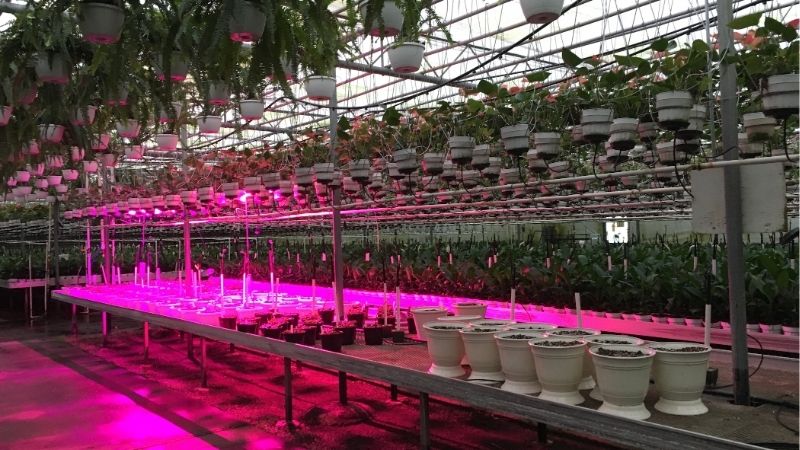
A cloudy October afternoon can leave greenhouse seedlings short of usable light even when the building looks bright. The most useful greenhouse grow lights supplement that missing sunlight without creating an electrical hazard around condensation and irrigation. For a small greenhouse, fixture shape and a credible moisture rating matter at least as much as the wattage printed on a listing. These six products cover compact mixed-crop bays, longer propagation benches, and sheltered seed-starting shelves.
Quick Verdict: For most small humid greenhouse bays, the AC Infinity IONBOARD S22 is our Best Overall pick: its 115-watt draw, 2-by-2-foot maker-rated coverage, and IP65 enclosure claim form a practical combination. For a long bench, choose the Spider Farmer Glow80 two-bar kit instead. These are editorial judgments from published specifications as of October 2026, not in-house tests. Check current prices and confirm that your intended mounting location complies with the fixture’s instructions.
As an Amazon Associate we earn from qualifying purchases.
By DIY Ideas 4 Home Editorial Team
6 Greenhouse Grow Lights Reviewed
We selected identifiable US-market models using manufacturers’ product pages, manuals, wattage data, dimensions, and moisture claims; light-output figures are identified as manufacturer statements rather than site measurements. Among these six choices, displayed maker prices ranged from $41.99 for a four-bar kit to $119.00 for a compact board in October 2026. Price alone does not settle greenhouse suitability. The University of California Riverside’s Basic Electrical Safety guidance calls for moisture-appropriate equipment and GFCI-protected outlets in greenhouses; a sealed light head does not make an exposed plug waterproof.
| Product | Best For | Key Spec | Listed Price (as of October 2026) | Watch Out For |
|---|---|---|---|---|
| AC Infinity IONBOARD S22 | Best Overall: humid 2-by-2-foot bay | 115 W; maker-stated IP65; 2-by-2-ft coverage | $119.00 | Operating humidity range and dry connections still apply |
| Mars Hydro FC-E1500 | Best for Fruiting Crops | 150 W; 420 umol/s PPF claimed | $104.99 | Verify greenhouse damp-location suitability before mounting |
| Spider Farmer Glow80, two bars | Best for Long Benches | 80 W combined; two 43.3-in bars; IP65 claim | $69.99 | Light distribution depends on bar spacing |
| ViparSpectra P1000 | Best for Linked Dry Bays | 100 W; dimmable, linkable board | $69.99 | Current model’s moisture and physical ratings need confirmation |
| Barrina T5 MF10 5000K, four-pack | Best for Seed Shelves | Four 10 W, 2-ft bars; 40 W total | $41.99 | Use only in an installation permitted by its dry-area rating |
| Spider Farmer SF1000, 2026 | Best for Small Dry Canopies | 100 W; 249.21 umol/s PPF claimed | $69.99 | Do not assume an IP65 rating for this exact model |
AC Infinity IONBOARD S22: Best Overall
Best For: Gardeners supplementing one small, humid greenhouse crop bay who want dimming and a documented enclosure rating.
This board solves a specific greenhouse problem better than the less expensive dry-location panels here: AC Infinity expressly describes an IP65 enclosure for higher-humidity growing environments. Its compact form also leaves more space between adjacent structures than a long bar, which matters when rafters and glazing already shadow plants. It is not a blanket recommendation for spraying the lamp or submerging connections; the power outlet remains a separate point of risk. A two-foot-square bay is the realistic starting layout, not an entire greenhouse.
AC Infinity’s product page for the IONBOARD S22 identifies model AC-IBS22, a 115-watt input, 272 Samsung LM301H chips, a maker-stated efficacy of 2.7 micromoles per joule, and 2-by-2-foot coverage. The same product listing showed $119.00 in October 2026, making it the premium-priced compact fixture in this selection. Its control knob adjusts output across the stated 0-to-100-percent range, while optional UIS controllers add scheduling; those accessories are not included in the base light. Compare its actual overhead clearance with your plant heights before paying extra for automation.
The board itself measures 11.81 inches wide and 11.81 inches long, with a thickness of 0.43 inch; AC Infinity lists separate driver dimensions of 7.16 by 1.57 inches. That small panel is straightforward to position above a single working area, but the driver and cable routing still require attention. The company’s specifications limit operation to 35 to 85 percent relative humidity and 32 to 140 degrees F, so persistently wetter conditions can exceed the claimed operating envelope despite the IP65 description. Follow its IONBOARD Series manual and keep plugs above wet benches.
Pros:
- Manufacturer documents an IP65 enclosure for humid growing environments.
- 115-watt input supports one maker-rated 2-by-2-foot plant area.
- Compact aluminum board leaves flexibility around greenhouse framing.
Cons:
- Its $119.00 listing exceeds every other fixture price here.
- Humidity above the published 85-percent limit remains a concern.
Who Should Buy It: Choose the S22 for a compact protected greenhouse bay; use the Spider Farmer Glow80 when a four-foot bench needs lengthwise coverage instead.
Mars Hydro FC-E1500: Best for Fruiting Crops
Best For: Growers giving tomatoes, peppers, or other relatively light-hungry crops one concentrated, sheltered supplemental zone.
The FC-E1500 answers a different need than the S22. Where one fruiting bed needs more artificial-light contribution during short days, Mars Hydro’s 150-watt bar-style fixture delivers the highest published system draw among our six selections. The brand publishes a photon-output figure as well, useful for planning though not directly comparable with another manufacturer’s PPFD chart taken at a different distance. Its spread-out LED bars may distribute output more comfortably over a compact foliage canopy than an intense central point. The main limitation is installation suitability, not basic illumination.
Mars Hydro’s product page for the FC-E1500 identifies SKU MH-FC-E1500-C2, a 150-watt nominal system draw, 420 micromoles per second of manufacturer-stated photosynthetic photon flux, and a maximum 2.5-by-2.5-foot coverage claim. The page lists $104.99 against a higher regular price as of October 2026. For a greenhouse crop, treat the 2.5-foot claim as a planning footprint rather than an assurance of uniform crop-level photons. This is not the same device as larger FC-E fixtures, and specifications from other variants must not be substituted. A suitable timer or controller can fill winter light gaps without treating every day like a sunless indoor grow.
Mars Hydro’s FC-E1500 specifications give a fixture size of 16.4 by 15.7 by 2.8 inches, and the manufacturer’s product FAQ reports a 6.17-pound weight. Check whether the roof framing can safely carry its suspension hardware without shifting under ventilation or wind. The US listing does not provide a sufficiently clear damp-location approval for us to endorse exposed installation around spray heads; keep this choice in a dry, protected installation and obtain exact suitability guidance from Mars Hydro first. Its five-year warranty statement is useful, but exclusions and water exposure conditions deserve a read before purchase.
Pros:
- Published 150-watt draw offers greater nominal output capacity here.
- Mars Hydro lists 420 micromoles per second of PPF.
- Manufacturer provides a specific 2.5-by-2.5-foot coverage estimate.
Cons:
- Dry protected placement is prudent without clear damp-use approval.
- Six-pound fixture needs sound overhead anchoring above crop beds.
Who Should Buy It: Select the FC-E1500 for one bright, protected fruiting zone; favor the AC Infinity IONBOARD S22 where the fixture enclosure faces greenhouse humidity.
Spider Farmer Glow80: Best for Long Benches
Best For: Propagators lighting a row of seedlings or leafy starts spread along a narrow greenhouse workbench.
One square board can leave the ends of a long propagation bench comparatively dim. Glow80 takes the opposite approach: two slim fixtures can run along the crop row, with adjustable separation based on tray width. Spider Farmer publishes an IP65 description for this specific two-bar set, giving it a more convincing humid-greenhouse use case than the dry-area shelf strips below. The distinction is length and installation flexibility rather than maximum power. If a tall, dense fruiting canopy needs higher light intensity, the Mars Hydro FC-E1500 is the more targeted choice.
Spider Farmer’s product page for the 2026 Glow80 specifies 80 watts total, supplied as two 40-watt bars, with a claimed 4-by-2-foot coverage zone and light efficacy of 2.0 micromoles per joule. The two-bar kit carried a $69.99 listed price in October 2026. Its SF-Glow user guide is named on the product page, which also specifies how many bars may be linked by supply voltage; this does not authorize linking arbitrary extension cords. Treat the advertised footprint as an overhead design starting point, then check leaf-level light across the full bench before relying on the end positions.
Each Glow80 bar measures approximately 43.3 inches long, and Spider Farmer lists the two-bar product at about 3 pounds. The page specifies a 59.1-inch power cord plus an interconnect cable; routing those lines cleanly may be the deciding logistical detail if your outlet is at the far end of a greenhouse bench. The narrow housings cast less concentrated shade than a broad panel at the same mounting position, though actual shading depends on solar angle and roof framing. Even with the claimed IP65 enclosure, protect the plugs and follow the brand’s installation instructions around condensation.
Pros:
- Two 43.3-inch bars distribute light over a longer row.
- Product page explicitly advertises an IP65 fixture enclosure.
- 80-watt pair costs $69.99 on the checked maker listing.
Cons:
- Lower efficacy claim than the Spider Farmer SF1000 board.
- Separate long bars take more planning for stable mounting.
Who Should Buy It: Use Glow80 above several trays in a row; choose Barrina T5 MF10 only for protected, dry seed shelves needing independently switched strips.
ViparSpectra P1000: Best for Linked Dry Bays
Best For: Owners creating several separately managed, dry greenhouse sections with matching dimmable fixtures on a planned circuit.
Some hobbyists expand a greenhouse one crop bay at a time rather than buying a high-wattage fixture immediately. ViparSpectra’s P1000 is a straightforward 100-watt panel with a daisy-chain feature for compatible P-series lighting setups. It makes sense where the mounting area stays sheltered from moisture and the gardener wants a repeatable panel pattern. That is a narrower recommendation than a blanket claim of greenhouse ruggedness. For an actively misted propagation station, AC Infinity’s documented IP65 S22 is the better starting point.
ViparSpectra’s product page for the current P1000 showed $69.99 in October 2026 and describes dimming, a daisy-chain connection, and a full spectrum using 660-nanometer red, 730-nanometer far-red, and 3000K and 5000K white components. The manufacturer’s older P-series specification article reports 100 watts and a 2-by-2-foot flowering footprint at a specified 14-inch hanging height; that is historical configuration information, not proof of the dimensions or exposure ratings of every current revision. Confirm the exact current-unit specification and maximum permitted link count in its supplied instructions before constructing a row.
The older ViparSpectra P-series product-parameter table gives the P1000 a 12-inch by 11.2-inch housing and a 5-pound listed weight. Since the updated P1000 page does not reproduce those physical measurements, ask the seller to confirm them for the presently shipped version before ordering hangers or building fixed brackets. Do not interpret a silicone-coated LED face in historical marketing as approval for exposed, wet, or sprayed greenhouse installation. Its fanless construction removes a fan-cleaning chore, yet the heatsink still needs unobstructed airflow away from plastic film and other contact surfaces.
Pros:
- Current P1000 listing names a built-in compatible daisy-chain function.
- Adjustable dimming helps isolate varying needs in crop bays.
- $69.99 maker offer puts this 100-watt panel below S22.
Cons:
- Updated model dimensions are not reproduced on its sales page.
- No present damp-location suitability was established for this revision.
Who Should Buy It: Buy P1000 for linked, sheltered dry bays after checking the current manual; use Spider Farmer Glow80 for a long and humid bench.
Barrina T5 MF10 4-Pack: Best for Seed Shelves
Best For: Seed starters using several short, dry shelves who prefer multiple low-power fixtures to one intense overhead board.
A multi-tier seed shelf is a poor fit for a rigid central panel: the top shelf catches the light while trays below remain shaded. Barrina’s MF10 four-pack supplies independent short lamps that can be distributed one shelf at a time, then switched as trays germinate or move outdoors. It is the least expensive complete kit here, but price is not permission to mount it in an open, wet greenhouse. Barrina markets the strips for plant shelves and cabinets; use them only where the installation is allowed by the supplied electrical instructions and protected against greenhouse moisture.
Barrina’s product page for the T5 MF10 5000K identifies four 10-watt LED fixtures, each 2 feet long, with a combined 40-watt draw and 120-volt AC input. The checked four-pack price was $41.99 in October 2026. The description mentions individual switches and a manufacturer linking limit of 16 lamps for the compatible product family. That link limit does not alter the safety requirements of a protected outlet or the supplied rated interconnects. Barrina’s product page describes 5000K light and mounting clips, but provides no comparable fixture-wide photon-output figure at crop height; do not assume a generic ‘high PPFD’ claim predicts the same result as a published panel map.
Each MF10 housing runs 2 feet long, and the package includes four short fixtures plus mounting hardware, two switched power cords, and connecting leads. That layout is easy to reorganize with changing seedling numbers, but each connection creates another point to inspect for water exposure and strain. If trays sit under an overhead sprinkler, change the arrangement or choose a fixture explicitly approved for that moisture exposure instead of wrapping plugs in improvised waterproofing. Keep the shelf hardware clear of leaves and inspect the cables before every spring restart.
Pros:
- Four independently controlled 2-foot strips suit multi-level seed shelves.
- 40-watt total draw avoids an oversized high-output single panel.
- The $41.99 checked four-pack includes mounting clips and leads.
Cons:
- Product listing lacks a comparable numeric crop-level photon map.
- Wet greenhouse mounting needs a separate documented suitability check.
Who Should Buy It: Choose MF10 for a dry, protected seed rack; buy the AC Infinity IONBOARD S22 for a single humid greenhouse growing bay.
Spider Farmer SF1000: Best for Small Dry Canopies
Best For: Gardeners wanting documented photon-output figures for a compact, sheltered plant canopy without paying for integrated controls.
The SF1000 offers another useful path when you have a small dry mounting bay and want more information than generic brightness language. Spider Farmer publishes a total photosynthetic-photon-output figure for the 2026 Bridgelux version alongside its draw, while several competing low-cost listings emphasize wattage alone. That documentation helps shortlist an appropriate lamp before measuring light at the plants. It is not a substitute for a waterproof rating, and its square-board footprint does little to illuminate the far end of a long propagation bench.
Spider Farmer’s product page for the 2026 SF1000 identifies Bridgelux LEDs, a nominal 100-watt power draw, and a manufacturer-stated 249.21 micromoles per second of PPF. The same page gives a 2-by-2-foot core coverage footprint and showed a $69.99 offer in October 2026. Those are better-defined comparison inputs than a claim that one fixture ‘replaces’ a much larger conventional lamp. The page also identifies dimming and a five-year warranty, although shoppers should confirm the variant on the checkout page because older Samsung-diode versions have circulated under the same family name.
The 2026 SF1000 is listed at 12.8 inches by 11.42 inches by 2.32 inches and weighs about 2.8 pounds. That smaller overhead load may suit a lightweight beam where a heavy bar fixture is inconvenient, provided the structural attachment is secure. Spider Farmer does not establish an IP65 or damp-location rating for this exact SF1000 in the cited product documentation, so use it only in a genuinely dry, approved installation and keep all connectors clear of irrigation. During cleaning, disconnect power first and avoid blocking the passive cooling surface.
Pros:
- 2026 listing specifies 249.21 micromoles per second of PPF.
- Small 12.8-inch housing is straightforward to position above pots.
- Maker lists a five-year warranty for the SF1000.
Cons:
- Core 2-by-2-foot area will not span elongated crop benches.
- Its cited specification does not confirm an IP65 greenhouse enclosure.
Who Should Buy It: Select SF1000 for a documented 100-watt dry canopy; choose Mars Hydro FC-E1500 when the protected fruiting area needs a 150-watt fixture.
How to Choose a Greenhouse Grow Light
Greenhouse lighting should begin with the amount of sunlight your crop already receives. University of New Hampshire Cooperative Extension’s Supplemental Lighting Run Time Worksheet explains why a greenhouse’s transmitted daylight and the fixture’s measured crop-level PPFD both determine supplemental runtime. A grow-tent ‘coverage’ number is not the same thing as a proven outdoor-season crop-lighting plan, especially under glazing that changes with weather.
Start With Daily Light, Not Watts Alone
Actual input wattage is valuable for circuit loading and running-cost estimates, but it cannot reveal how many useful photons reach every leaf. These kits range from Barrina’s combined 40 watts to Mars Hydro’s 150 watts; they also distribute light through very different shapes. Purdue University’s Measuring Daily Light Integral in a Greenhouse explains that some crops can be managed at substantially different DLI levels, so a generic light intensity target is unreliable. Use a suitable PAR meter to measure the plant canopy with and without the supplemental lights when possible, then adjust intensity and timing according to crop and season.
Match Fixture Shape to the Growing Area
Start by drawing the bench and crop rows from above. A roughly 2-by-2-foot board is useful above a cluster of pots, while the two long Glow80 bars span a row more naturally. Four short Barrina strips can cover separate dry seed shelves where one larger fixture would cast a severe shadow. Mounting height changes both the intensity directly underneath and the area receiving usable light; a manufacturer footprint derived in a reflective tent may look different under translucent greenhouse roofing. Leave enough room to raise the fixture as plants grow and account for supports that already block winter sun.
Verify Moisture Ratings and Circuit Protection
An IP65 marking describes a level of enclosure protection but does not approve unsafe extension cords, submerged plugs, or direct spray at a nonrated connector. The AC Infinity IONBOARD S22 and Spider Farmer Glow80 have explicit IP65 manufacturer claims; the SF1000, MF10 and current P1000 cannot be assumed equivalent on the evidence reviewed. Check the exact model’s location rating, operating humidity range, connector instructions and temperature limits. University of California Riverside’s Basic Electrical Safety guidance calls for appropriate moisture-rated lighting, GFCI protection and protected outlets in greenhouse areas. Have a qualified electrician establish permanent greenhouse wiring rather than improvising from an indoor power strip.
Price the Whole Lighting Setup
For October 2026, the checked prices are individual manufacturer offers, not promises of a stable market price. An inexpensive shelf kit may also need approved mounting rails, replacement connectors or a separate protected power circuit; the S22’s optional app control likewise changes the total cost. Factor in hours of supplemental operation during cloudy weeks, not just the headline watts, and consider whether the manufacturer supports replacement components and warranty service in the United States. If the season brings high sunlight to your greenhouse, turning down or switching off electric light can be more sensible than running all fixtures for a fixed daily schedule.
Frequently Asked Questions
These questions come up most often after a gardener has settled on a fixture shape but still needs to decide how it should behave in a greenhouse, not an indoor grow tent. The useful answer depends on daylight, crop growth stage, and the electrical environment.
Should greenhouse grow lights run all night?
No, constant overnight operation is not a sensible default. University of Minnesota Extension’s Starting Seeds Indoors guidance describes a common 12-to-16-hour daily light period for seedlings and explains that plants need a dark interval. In a greenhouse, those hours include natural sunlight, so the artificial portion may be shorter or unnecessary on bright days. A timer can extend short winter days while preserving a regular dark period for crops that respond to day length.
Does red and blue light beat white LEDs for vegetables?
Not automatically. White full-spectrum fixtures can provide the wavelengths used for photosynthesis and allow you to spot leaf discoloration more easily. Missouri Extension’s 2025 Controlled Environment Agriculture: Understanding Grow Lights guide distinguishes light spectrum, light quantity, and crop response rather than treating a particular diode color as a universal winner. Compare actual plant-level light and your crop’s goals; the terms ‘full spectrum’ and ‘high output’ are not independently standardized performance tests.
Can a grow light compensate for a shaded greenhouse wall?
Yes, sometimes, but only if light actually reaches the shaded plants at a useful intensity. A tall shelf or neighboring crop can create a shadow that a bright ceiling panel never fills. Move a fixture to illuminate the affected row, then measure the canopy rather than relying on the lamp’s peak reading below its center. Removing avoidable shade from stored equipment or rearranging benches may solve part of the problem without another electrical load.
When should greenhouse lights be replaced?
Replace a fixture when it fails, loses useful output relative to your crop needs, or develops damaged wiring or an unsafe enclosure, not simply because a speculative number of years has passed. Manufacturers publish projected LED lifetimes, but those are operating estimates rather than guarantees of greenhouse service life. Compare the affected unit with its manual and warranty, inspect for corrosion or moisture entry with power disconnected, and stop using damaged electrical equipment until it is properly repaired or replaced.
Final Thoughts
For a single small growing bay that may experience greenhouse humidity, AC Infinity IONBOARD S22 remains the Best Overall purchase from this set because its 115-watt output class, compact mounting size and manufacturer-stated IP65 enclosure answer the most relevant combination of needs. A long seedling bench changes the decision toward Spider Farmer Glow80; a dry, sheltered fruiting zone may justify the higher-draw Mars Hydro FC-E1500. Before ordering, check the exact fixture’s moisture instructions, your greenhouse’s nighttime condensation pattern, and the current listing price, then plan the GFCI-protected power connection before hanging the light.