Key takeaways
- Seven distinct air and room indicators, including radon
- Battery or USB-C placement options
- Screen and connected historical data
An indoor air quality monitor can help you spot changes after cooking, opening a window or running the HVAC fan, but it cannot prove a room is safe. Some models track particles and carbon dioxide, while others add radon, humidity or chemical indicators. The US EPA cautions that consumer monitors sense only the pollutants for which they are designed and must not replace smoke or carbon monoxide alarms.
Quick Verdict: The Airthings View Plus 2960 is our Best Overall choice for a household needing radon, PM2.5 and CO2 together; it also shows VOCs and room conditions for $329.99. For a less expensive multi-pollutant instrument, the AirGradient ONE I-9PSL at $230 merits attention. Confirm the exact sensors and current price before buying.
As an Amazon Associate we earn from qualifying purchases.
By DIY Ideas 4 Home Editorial Team
The Best Indoor Air Quality Monitors Reviewed
This comparison starts with the particular pollutants each instrument can detect, then evaluates screens, power and current US price. We do not turn a consumer air-quality score into a health certification, and we separate carbon dioxide sensing from listed carbon monoxide safety alarms.
| Product | Best For | Key Spec | Listed Price (as of October 2026) | Watch Out For |
|---|---|---|---|---|
| Airthings View Plus 2960 | Best Overall for broad home tracking | Radon, PM2.5, CO2, VOC, temperature, humidity, pressure | $329.99, Airthings | CO2/VOC sensors need initial calibration |
| AirGradient ONE I-9PSL | Best value for detailed multi-sensor data | NDIR CO2, PM2.5, VOC and NOx indexes; USB-C | $230, AirGradient | Power adapter not included; no radon sensor |
| IQAir AirVisual Pro | Best large-screen PM2.5 and CO2 monitor | PM2.5, CO2, temperature, humidity and AQI display | $329.99, IQAir | Does not measure radon or VOCs |
| Awair Element | Best straightforward five-factor dashboard | PM2.5, CO2, VOC, temperature and humidity | $299, Awair | Plug-in power; no radon sensing |
Airthings View Plus 2960
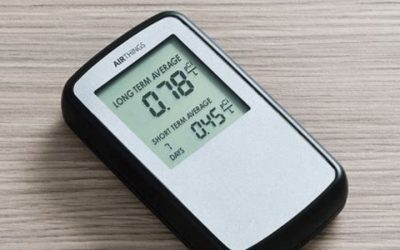
Best For: Best Overall for broad home tracking. It includes the radon measurement absent from the other three devices.
View Plus 2960 is designed for someone who wants one place to examine several distinct environmental patterns. A particle spike after frying and a sustained carbon dioxide rise in a closed meeting room call for different responses; putting both channels on one screen makes it easier not to confuse the two. Radon adds another reason to keep the instrument in a stable location over time. The broad set of sensors is useful only if readings lead to practical actions such as source control, appropriate ventilation and proper follow-up testing.
Airthings lists the View Plus at $329.99 as of October 2026. The model measures seven categories: radon, PM2.5, carbon dioxide, volatile organic compounds, temperature, relative humidity and air pressure. Those are not seven interchangeable measures of danger. The View Plus 2960 product page says the CO2 and VOC functions need around seven days of initial calibration. A buyer expecting immediately mature chemical trends from an unboxed device may misread the earliest data. Relative trends often deserve more attention than a single colored status icon.
The View Plus case measures about 6.7 by 3.5 by 1.3 inches, and its official specifications support six AA batteries or USB-C power. That flexibility helps with shelf placement, but avoid moving the device constantly if you want to compare radon trends. Wi-Fi needs a 2.4 GHz network. Airthings publishes detailed sensor ranges and calibration conditions for this specific 2960 model; review those before treating small variations as meaningful. This instrument is not a listed CO alarm and should never be used as one.
Pros:
- Seven distinct air and room indicators, including radon
- Battery or USB-C placement options
- Screen and connected historical data
Cons:
- Higher cost than the AirGradient ONE
- Calibration period can confuse impatient buyers
Who Should Buy It: Buy View Plus 2960 if radon coverage is non-negotiable; the IQAir AirVisual Pro is a simpler alternative when visible PM2.5 and CO2 are your priorities.
AirGradient ONE I-9PSL
Best For: Best value for detailed multi-sensor data. Open documentation and local integration suit owners who want to understand the measurements.
AirGradient ONE I-9PSL is compelling for a buyer who wants to inspect sensor data without being limited to a single branded interface. It combines a particle sensor with a nondispersive infrared carbon dioxide channel, temperature and humidity, plus VOC and nitrogen oxide indexes. The words index matter: the NOx function is not a laboratory measurement of each gas concentration in parts per million. The monitor suits an enthusiast checking how airflow and indoor activities influence readings, not someone seeking a certified assessment for every possible contaminant.
AirGradient publishes a $230 price for the fully assembled I-9PSL. Its product page also lists a lower-priced kit, but that kit is a different purchase with assembly and warranty implications; the recommended model here is the ready-built version. A 2-meter USB-C cable is supplied while the compatible 5 V power plug is not, so allow for that extra item if you have no spare adapter. Home Assistant integration and documented sensor details add value for the right user but can become unnecessary complexity in a household that wants only a traffic-light display.
According to the AirGradient ONE I-9PSL technical specification sheet, the enclosure is around 130 by 130 by 35 millimeters, or roughly 5.1 by 5.1 by 1.4 inches. The same documentation specifies 2.4 GHz Wi-Fi and a small OLED display. Read the model version carefully: assembled and kit sensor performance claims are not identical. There is no radon measurement here, and a VOC index does not identify a chemical source. For a battery-powered and radon-capable display, select the Airthings View Plus instead.
Pros:
- Published NDIR CO2 and optical particle sensor details
- Local smart-home integrations and open documentation
- Lower price than the two $300-plus picks
Cons:
- Requires a separate compatible USB power adapter
- No radon sensor; VOC/NOx data are not chemical diagnoses
Who Should Buy It: Choose AirGradient ONE I-9PSL if you will use detailed multi-channel data or Home Assistant; select the Airthings View Plus 2960 if radon needs to appear beside the other metrics.
IQAir AirVisual Pro
Best For: Best large-screen PM2.5 and CO2 monitor. The built-in screen keeps the two most actionable everyday readings highly visible.
AirVisual Pro is a strong choice for people tracking fine-particle events such as wildfire smoke infiltration or smoke from a cooking session. A visible PM2.5 history gives a reason to check whether an air purifier or an exhaust fan changes the conditions, while the carbon dioxide figure can reveal patterns of insufficient ventilation in an occupied room. IQAir’s displayed air-quality index adds context, but index labels are not a replacement for inspecting the underlying particle concentration. This is a focused monitor rather than a do-everything detector.
IQAir’s product page for AirVisual Pro lists AirVisual Pro at $329.99 in October 2026. The main justification for paying that much is the large display and IQAir app ecosystem, rather than a longer list of gases measured. IQAir specifies PM2.5, CO2, temperature and relative humidity and shows an air-quality-index display. Buyers who want VOC tracking should compare the Awair Element; buyers who want radon must choose a different device. Do not infer that a visible number covers pollutants absent from the published sensor list.
The unit is roughly 7.2 by 3.2 by 3.9 inches based on IQAir’s published metric dimensions, making it larger than the AirGradient unit in one direction and better suited to a shelf or desk. IQAir’s documentation describes a built-in rechargeable battery for temporary mobile use as well as connected app reports. Check the included regional plug type on the exact US listing. Like other inexpensive optical sensors, the particle channel reports an estimate influenced by conditions; use trends and source checks rather than expecting a regulatory reference instrument.
Pros:
- Large color display for quick room checks
- PM2.5 and carbon dioxide shown in one place
- App provides current and historical readings
Cons:
- No radon or VOC channel at this price
- Larger desk footprint than compact sensor boxes
Who Should Buy It: Buy AirVisual Pro when easy-to-read PM2.5 and CO2 trends outweigh added sensors; choose AirGradient ONE I-9PSL if chemical indexes and open integration offer greater value.
Awair Element
Best For: Best straightforward five-factor dashboard. Its focused mix of household indicators works well when nobody wants to configure an enthusiast platform.
Awair Element appeals to occupants who want to associate air changes with everyday activities. The combination of fine dust, carbon dioxide, volatile organic compounds, temperature and relative humidity helps distinguish a cooking particle event from a stuffy gathering or a humidity problem. Awair also shows a simplified air-quality score. That score is a communication tool, not a claim that all possible pollutants have been sampled, so look at the individual sensor readings before choosing a response.
Awair’s product page for Element lists $299 in October 2026. Awair publishes the CO2 range as 400 to 5,000 ppm and its particulate channel as PM2.5; the VOC data represent a chemical indicator rather than precise identification of a substance. The device uses an external AC adapter and 2.4 GHz Wi-Fi. A buyer who values a ready-made consumer app may consider that simpler than configuring AirGradient, but at this price it still omits radon. The View Plus costs somewhat more and covers that important additional category.
Awair’s official Element product specifications include its sensor ranges and a physical external AC power connection; the Awair Element housing measures 6.30 by 3.54 by 1.97 inches according to the official specification PDF. Leave room around the air inlet when placing it on a shelf. An optical PM2.5 reading taken immediately next to cooking steam or a humidifier needs context. This unit does not act as a carbon monoxide alarm, despite the similar-looking abbreviations CO2 and CO that often confuse shoppers.
Pros:
- Five useful room conditions in one interface
- Manufacturer-published CO2 sensor range
- Consumer-focused app and simplified trend display
Cons:
- No integrated radon measurement
- Needs mains power and a compatible Wi-Fi network
Who Should Buy It: Choose Awair Element for a direct consumer dashboard with VOC information; buy the AirGradient ONE I-9PSL if lower cost and open integrations are more important.
How to Choose a Indoor Air Quality Monitor
The most important buying decision is which pollutant you actually need to follow. From there, choose a readable interface and a placement that will provide consistent readings over weeks rather than one eye-catching afternoon.
Buy sensors for the pollutant you can act on
A monitor cannot alert you to a contaminant it does not measure. View Plus includes radon, while IQAir AirVisual Pro and Awair Element omit it. PM2.5 is useful for observing fine particles from smoke, cooking and outdoor pollution; it is not a way to identify carbon monoxide. CO2 can support conversations about room ventilation, but its reading alone does not establish that a space is free of viruses, mold or combustion hazards. Relative humidity can help you notice excessive moisture, yet a high value does not confirm the location of a hidden leak.
The EPA’s guidance on low-cost air pollution monitors explicitly states that such products show only selected parameters and are not life-safety warning systems. Keep listed carbon monoxide and smoke alarms installed. For a potentially serious indoor pollutant, professional testing may be required even when the consumer monitor looks reassuring. Choose the smallest sensor list that covers your actual question, and avoid treating brand-specific overall scores as if different manufacturers used identical formulas. Check whether a VOC field is an index or a calibrated concentration before interpreting the digits.
Review measurement limits and initial calibration
Fine-particle monitors commonly use optical light scattering rather than collecting laboratory-grade filter samples. Aerosol type, humidity and placement can affect the relationship between a reading and true mass concentration. Sensors are useful for comparing similar conditions in the same room, but one device should not be assumed numerically interchangeable with a neighbor’s different model. Manufacturers may publish accuracy under limited temperature and humidity conditions, so look for those test conditions instead of shopping by sensor quantity alone.
Carbon dioxide deserves similar attention. AirGradient identifies the NDIR module installed in its assembled model; Airthings lists an initial calibration period for View Plus CO2 and VOC measurements of around seven days. Move a monitor frequently between rooms and it becomes harder to judge a stable baseline. When a reading changes after an intervention, repeat the observation under similar occupancy and activities before drawing a strong conclusion. An expensive dashboard with no documented sensing range may be less useful than a simpler product with understandable limitations.
Fit the room, power and monitoring routine
A monitor near a stove, a bathroom exhaust outlet or an active humidifier can show very different readings from one placed in a representative occupied area. Follow the model manual for ventilation around the sensing inlets and keep it away from direct water and mechanical damage. Decide if you want to glance at a local screen or review a chart. IQAir’s large display is convenient for households; AirGradient’s developer-friendly integrations suit a user who plans to collect data. None of these instruments measures the entire house from a single desktop position.
Account for wiring before committing to a product. The AirGradient ONE uses USB-C and ships without the final power plug, while Awair Element uses an AC adapter. View Plus accepts AA batteries or USB-C, which can simplify a well-chosen placement. Prices here range from $230 for the assembled AirGradient ONE to $329.99 for View Plus and AirVisual Pro; the extras should correspond to a use case rather than an appealing marketing graphic. For a long-term room comparison, consistency of placement and logging often matters more than extra decorative charts.
Frequently Asked Questions
These answers clarify the limits that often go missing from product advertising. For alarming or persistent indoor-air concerns, follow EPA guidance and consult qualified help instead of relying only on a consumer display.
Can an air-quality monitor detect carbon monoxide?
Not unless the exact device is designed and listed for that gas and purpose. CO2 is carbon dioxide, not carbon monoxide. The US EPA warns that household air monitors are not substitutes for emergency CO alarms. Use a properly listed UL 2034 carbon monoxide alarm in the home according to placement and testing guidance, and never wait for a CO2 monitor to warn you of a combustion problem.
What does PM2.5 mean on these monitors?
PM2.5 refers to fine particulate matter with an aerodynamic diameter of roughly 2.5 micrometers or less. Cooking, smoke and air coming from outside can change levels. The optical sensor estimates the particle concentration, often in micrograms per cubic meter. A changing number is useful for checking ventilation or filtration, but humidity and particle composition can influence consumer sensor response. A PM2.5 reading does not measure odors, radon or CO.
Is a low VOC reading proof that cleaning products are safe?
No. VOC channels in consumer devices often respond to groups of volatile compounds and sometimes report an index rather than a chemically specific concentration. A low displayed value should not override the product label, ventilation instructions or symptoms in the space. The EPA emphasizes pollutant source control and appropriate ventilation. If there is a suspected exposure or persistent health concern, use qualified guidance instead of depending on a single consumer indicator.
Should I put one monitor in every room?
That depends on the decision you are trying to make. One instrument can help characterize the room where it normally sits; it cannot guarantee matching readings in a different floor, basement or kitchen. A temporary comparison can be instructive if you allow readings to settle and document the changed position. For radon, follow separate testing guidance because location and measurement duration are especially important. Prioritize the room and pollutant that motivated your purchase before buying multiple devices.
Final Thoughts
Choose Airthings View Plus 2960 when radon and daily particle and ventilation signals need to live in one instrument. Choose AirGradient ONE I-9PSL when open monitoring tools and a $230 assembled price make more sense. IQAir AirVisual Pro favors screen readability, while Awair Element favors a consumer dashboard for five room indicators.
Before checkout, confirm the exact sensor list, whether power accessories are included and where the monitor can sit. Treat the resulting numbers as measurements to investigate and act on, not a guarantee of indoor safety.