Key takeaways
- 32-1/2-inch right-side rip capacity accommodates wider cabinet and shelving components.
- Rolling stand is included in the DWE7491RS retail configuration.
- Rack-and-pinion fence and narrow-rip support improve repeatable setup options.
A dependable table saw should cut the board widths and thicknesses you actually use, hold its fence securely, and come with the protective equipment needed for controlled cuts. For most portable-shop buyers, the DEWALT DWE7491RS balances a 32-1/2-inch right-side rip capacity with an included wheeled stand. Buyers prioritizing contact mitigation should also examine SawStop’s more expensive compact model. Blade guards, riving knives, suitable push devices, and proper stock support remain necessary regardless of which saw you choose.
Quick Verdict: Choose the DEWALT DWE7491RS for its 32-1/2-inch rip capacity, 3-1/8-inch maximum depth at 90 degrees, and rolling stand. The Bosch GTS15-10 cuts deeper at 90 degrees, while the SawStop CTS-120A60 adds a flesh-sensing braking system. These are editorial selections from published manufacturer documents and US listings as of October 2026, not hands-on tests. Check current pricing and confirm the exact saw-and-stand package before ordering.
As an Amazon Associate we earn from qualifying purchases.
By DIY Ideas 4 Home Editorial Team
6 Best Table Saws Reviewed
Our selection starts with real US-market model numbers, then compares right-side rip capacity, maximum cutting depth, guards, stand arrangements, and the costs of buying a complete working setup. DEWALT’s DWE7491RS product page, Bosch’s GTS15-10 specifications, SawStop’s CTS documentation, SKIL’s TS6307-00 listing, RIDGID’s R4518 product page, and Milwaukee’s 2736-21HD product documentation supply the technical figures. Posted US prices ranged from $329.99 to $899 as of October 2026; retailer promotions and bundle contents can change. Before using any of these saws, follow its operator’s manual and OSHA guidance on guarding, push sticks, and kickback prevention.
| Product | Best For | Key Spec | Listed Price (October 2026) | Watch Out For |
|---|---|---|---|---|
| DEWALT DWE7491RS | Best Overall: panel-width ripping with rolling mobility | 32-1/2 in right rip; 3-1/8 in at 90 degrees | $599 at Home Depot | About 110 lb including the rolling assembly |
| SKIL TS6307-00 | Best Value: entry-level shop setup | 25-1/2 in right rip; 3-1/2 in at 90 degrees | $329.99 at SKIL | Fold-up legs, not a wheeled cart |
| SawStop CTS-120A60 | Best for skin-contact mitigation | 24-1/2 in right rip; 3-1/8 in at 90 degrees | $899 at SawStop | Optional stand; no dado stack capability |
| Bosch GTS15-10 | Best for deep cuts and wheeled transport | 32-1/8 in right rip; 3-9/16 in at 90 degrees | $649 at Home Depot | Listed 91 lb weight; bulky transport footprint |
| RIDGID R4518 | Best for registration-based service coverage | 27 in right rip; 3-3/8 in at 90 degrees | $359 at Home Depot | Service agreement requires timely registration |
| Milwaukee 2736-21HD | Best for sites without convenient outlets | 24-1/2 in right rip; 2-1/2 in at 90 degrees | $749 at Home Depot | 8-1/4 in blade; stand sold separately |
DEWALT DWE7491RS: Best Overall
Best For: Remodelers and workshop owners ripping cabinet panels who also move their saw between work areas.
The DEWALT is our all-around choice because its generous fence travel addresses common plywood and shelving work without forcing the buyer into a stationary cabinet saw. A rolling stand is already part of the DWE7491RS package, unlike SawStop’s compact unit. Its limit is cutting thickness: Bosch offers more depth at a right-angle setting, so owners frequently working with thicker material should compare both before purchasing.
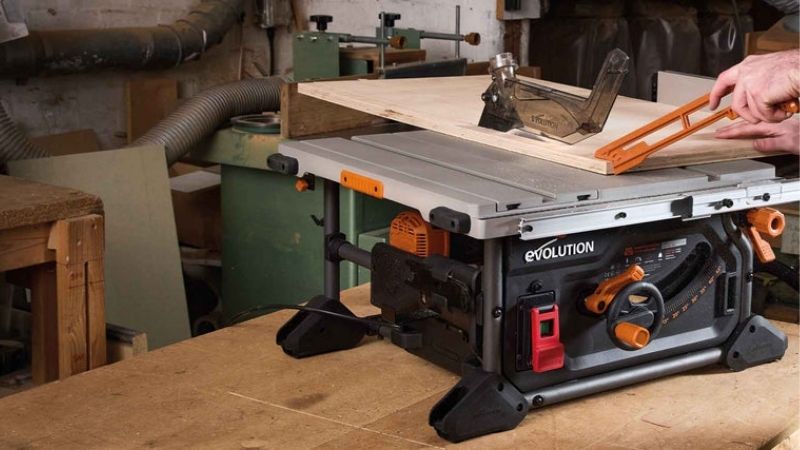
DEWALT’s product page for the DWE7491RS documents a 15-amp, 120-volt corded motor, 32-1/2-inch right-side rip capacity, and maximum depths of 3-1/8 inches at 90 degrees and 2-1/4 inches at 45 degrees. The manufacturer also specifies a rack-and-pinion telescoping fence, a riving knife, and tool-free guarding adjustments. Home Depot listed this exact rolling-stand model at $599 in October 2026, making it a mid-range purchase rather than the cheapest saw in our group.
The working table measures approximately 21-7/8 by 26-3/8 inches according to DEWALT’s product description; Home Depot lists the complete setup at about 110 pounds. Wheels help with transport but do not remove the need for a level, stable working position or outfeed support for large sheets. The included blade is a 24-tooth carbide model; budget for a task-specific blade if finished plywood edges are a priority. DEWALT publishes a three-year limited warranty, with conditions explained in its product warranty materials.
Pros:
- 32-1/2-inch right-side rip capacity accommodates wider cabinet and shelving components.
- Rolling stand is included in the DWE7491RS retail configuration.
- Rack-and-pinion fence and narrow-rip support improve repeatable setup options.
Cons:
- 3-1/8-inch right-angle cut depth trails the Bosch GTS15-10.
- Approximately 110-pound packaged working setup is awkward for frequent lifting.
Who Should Buy It: Choose this model for repeated sheet-goods work with a rolling base; choose the Bosch GTS15-10 if thicker single-pass stock is more important than the slight rip-width advantage.
SKIL TS6307-00: Best Value
Best For: DIY woodworkers setting up a first garage shop where folded storage matters more than wheels.
The SKIL offers a practical route into straight ripping and occasional angled cuts without the additional cost of a full rolling cart. Its folding legs turn the saw itself into a storable work unit, and the fence uses rack-and-pinion rails rather than a basic clamp-only arrangement. The right-side rip limit is smaller than DEWALT’s, so it is less convenient for large cabinet components, but smaller projects may never approach that limit.
SKIL’s TS6307-00 product page lists a 15-amp motor, a 10-inch blade, 25-1/2 inches of right-side rip travel, and 3-1/2 inches of cutting depth at a zero-degree bevel. It specifies 2-1/2 inches at 45 degrees, a 4,600 RPM no-load rating, parallel blade alignment adjustment, and an anti-restart switch. SKIL offered the model for $329.99 in October 2026, the lowest posted price in this six-saw comparison and sufficiently below the $599 DEWALT listing to support the value label.
The manufacturer gives a 24-by-25-inch tabletop and a 14-1/4-inch folded table height. SKIL support also stated that the TS6307-00 weighs about 51.15 pounds, which matters when shelving the saw after weekend projects. Its supplied accessories include a blade guard, anti-kickback pawls, riving knife, and push stick. Folding legs still require a suitable level surface. Buyers planning grooves must use the correct insert and verify the manual’s specified dado limits, rather than assuming every 10-inch saw takes the same stack.
Pros:
- At $329.99, its documented purchase price is this roundup’s lowest.
- 3-1/2-inch maximum depth suits thicker right-angle stock than some rivals.
- Integrated legs fold under a tabletop measuring 24 by 25 inches.
Cons:
- 25-1/2-inch right rip range is narrower than RIDGID and DEWALT.
- No built-in wheels for moving the saw across rough jobsites.
Who Should Buy It: Select the TS6307-00 for a compact first shop and a documented sub-$350 list price; choose the DEWALT DWE7491RS when a wheeled stand and wider ripping are worth the additional spend.
SawStop CTS-120A60: Best for Skin-Contact Safety
Best For: Small-shop users who place extra value on automatic blade braking during accidental skin contact.
SawStop stands apart because its system is designed to stop and retract the rotating blade on detection of skin contact. That is a meaningful differentiator, but not permission to work without guards, ignore kickback hazards, or place hands near the cutting path. The higher price buys a specific injury-mitigation mechanism rather than larger sheet capacity. Buyers chiefly seeking wide ripping can obtain more fence travel for less with the DEWALT.
SawStop’s Compact Table Saw product page for CTS-120A60 lists a 15-amp motor, a 10-inch blade, 24-1/2 inches of right-side rip capacity, 3-1/8 inches of depth at 90 degrees, and 2-1/8 inches at 45 degrees. The manufacturer’s October 2026 US list price was $899 for the base saw. SawStop says its blade-contact system stops the blade in under five milliseconds, subject to proper setup and operating conditions. It explicitly states that this compact model does not accept dado blade stacks.
The saw itself weighs 68 pounds, and SawStop publishes an overall body footprint of about 14-1/4 inches high, 23-1/2 inches wide, and 27 inches deep. An optional folding stand was listed separately at $139, so compare installed cost, not just the base saw’s tag. The included brake cartridge is a replaceable part and has an ongoing replacement cost after activation; SawStop’s own configurator listed a 10-inch brake cartridge at $119. Confirm blade compatibility and consult the owner’s manual before fitting alternative accessories.
Pros:
- Manufacturer’s skin-contact response is specified at under five milliseconds.
- 24-1/2-inch rip capacity remains useful for common cabinet panels.
- 68-pound body is comparatively compact for moving between benches.
Cons:
- Base $899 price excludes the optional $139 folding stand.
- Compact SawStop mechanism cannot accommodate a dado blade stack.
Who Should Buy It: Buy the CTS-120A60 if the blade-contact brake justifies the premium and you can work within its dimensions; choose the SKIL TS6307-00 if price and ordinary straight-cut capacity dominate your decision.
Bosch GTS15-10: Best for Deep Cuts
Best For: Carpenters cutting thicker stock at right angles who also need a wheeled stand.
The Bosch is the stronger candidate when maximum right-angle cutting depth is the deciding technical requirement. Its electronic speed regulation and included Gravity-Rise stand distinguish the configuration from a bare benchtop saw. The DEWALT provides nearly the same broad class of rip capacity for a lower listed price, so the Bosch premium is harder to justify if you mostly reduce thin sheet materials rather than thicker wood.
Bosch’s GTS15-10 technical-data page and its named operating manual specify a 15-amp, 120-volt saw with a 10-inch blade, 32-1/8-inch maximum right rip, and 3-9/16-inch cut depth at 90 degrees. The depth at 45 degrees is 2-1/2 inches; no-load speed is 3,800 RPM. Bosch describes the Smart Guard System as incorporating a riving knife, anti-kickback pawls, and a barrier guard. Home Depot posted the GTS15-10 saw-and-stand package at $649 in October 2026.
Bosch lists the GTS15-10 at 91 pounds and gives tool dimensions of approximately 28.1 inches long, 27.8 inches wide, and 13.53 inches high. The included GTA50W Gravity-Rise stand has eight-inch wheels and a foot-release mechanism, useful when the saw is moved frequently but not a substitute for securing its working position. Its dado-compatible setup requires Bosch’s specified insert and blade arrangement, rather than simply installing a wider cutter. Maintain unobstructed offcut clearance, particularly at a busy remodeling site.
Pros:
- 3-9/16-inch depth at 90 degrees exceeds the other listed models.
- 32-1/8-inch right rip handles substantial wide-panel cutting tasks.
- Included Gravity-Rise stand uses eight-inch wheels for transport.
Cons:
- At $649, it costs more than the similarly wide DEWALT.
- Listed 91-pound assembly still requires care around stairs and loading.
Who Should Buy It: Choose the Bosch for a documented deep-cut requirement and wheeled transport; choose the DEWALT DWE7491RS when its 3-1/8-inch depth already meets the job and saving money matters more.
RIDGID R4518: Best for Service Coverage
Best For: Homeowners who want a folding-stand saw and can complete RIDGID’s registration requirements promptly.
The RIDGID is unusual in this lineup because its main purchasing distinction is the registration-dependent Lifetime Service Agreement, not an especially wide fence or cordless convenience. It provides greater nominal rip width than the SKIL, but both are geared toward space-conscious, lower-cost work. The agreement may help a buyer who expects long ownership, provided the precise covered components and eligibility terms fit their situation.
RIDGID’s R4518 model product page documents a 15-amp motor, 27-inch maximum right-side rip, 3-3/8-inch maximum cut depth at 90 degrees, and 2-1/2 inches at 45 degrees. RIDGID states 5,000 RPM no-load and describes a blade brake that stops rotation in under four seconds; this conventional stopping brake should not be confused with SawStop’s skin-contact detection. Home Depot listed R4518 at $359 in October 2026, slightly above the manufacturer’s posted price for the SKIL alternative.
The R4518 operator’s manual warns that the removable saw body weighs approximately 55 pounds; RIDGID customer support has described the saw-and-stand setup at roughly 75 pounds. The stand separates from the saw, which can simplify lifting into a vehicle but adds a setup task. Included accessories comprise the blade guard, anti-kickback pawls, push stick, and rip fence. RIDGID states that Lifetime Service Agreement eligibility depends on registering the tool within 90 days of purchase; retain purchase documentation and read the covered-service terms rather than assuming unconditional lifetime warranty protection.
Pros:
- 27-inch nominal rip width exceeds the SKIL’s 25-1/2 inches.
- Manufacturer specifies a sub-four-second conventional blade stopping brake.
- Service agreement eligibility is available with qualifying 90-day registration.
Cons:
- Folding stand lacks the wheeled transport of the Bosch package.
- Lifetime service benefits require registration and agreement conditions.
Who Should Buy It: Consider R4518 if post-purchase service registration is a priority; choose the SKIL TS6307-00 if a lower up-front price and integrated leg design matter more.
Milwaukee 2736-21HD: Best for Cordless Sites
Best For: Remodelers working away from convenient outlets who already maintain an M18 battery tool system.
Milwaukee is the outlier because its cordless design changes the workflow rather than merely changing a fence dimension. You can set it up where long power leads are inconvenient, and ONE-KEY provides equipment tracking and tool-lockout features. In return, the 8-1/4-inch blade has less maximum depth than the 10-inch corded alternatives, and battery endurance changes with material, blade, and cutting load. It is not an automatic replacement for continuous shop production.
Milwaukee’s product page for the M18 FUEL 2736-21HD kit specifies an 18-volt platform, a 24-1/2-inch right-side rip limit, a brushless motor rated at 6,300 RPM, and an included HD12.0 battery with a rapid charger. Milwaukee’s model-specific technical announcement records 2-1/2-inch cut depth at 90 degrees and 1-3/4 inches at 45 degrees. Milwaukee advertises up to 600 linear feet per charge under its stated test conditions, not a guarantee for every hardwood project. Home Depot listed the 2736-21HD battery-and-charger kit at $749 in October 2026, without a bundled stand.
The manufacturer lists about 45.8 pounds for the saw with its battery and about 42.5 pounds for the bare tool. That difference matters when lifting it onto a bench repeatedly, but a secure stand or bench remains essential. Unlike the corded saws, a replacement battery can be a significant future expense, especially for full-day work away from charging facilities. The included riving knife, guarding, and pawls still need to be fitted correctly, and power should be isolated by removing the battery before servicing the blade.
Pros:
- Included M18 HD12.0 battery avoids dependence on an immediate outlet.
- 24-1/2-inch right rip supports moderate plywood and trim tasks.
- Listed 45.8-pound battery-installed weight favors repeated bench setup.
Cons:
- 2-1/2-inch maximum depth at 90 degrees limits thicker stock.
- $749 kit does not include a dedicated rolling saw stand.
Who Should Buy It: Purchase the 2736-21HD for off-grid remodeling or existing M18 battery investment; choose the Bosch GTS15-10 for regular outlet-powered cutting of thicker lumber.
How to Choose a Table Saw
Pick the actual cut first, then the machine. A saw that fits a plywood rip may still be inadequate for thick lumber, while a high-capacity model can take up too much storage space for a garage shop. The most useful purchase checks are the manufacturer’s measured rip width, blade-depth limits, included guard system, stand configuration, and cost of blades and accessories. These published specifications describe potential capability rather than cut quality demonstrated by field testing.
Match Rip Capacity to Sheet Width
Right-side rip capacity is the maximum fence-to-blade distance with the fence in the designated position, not the width of the tabletop. DEWALT specifies 32-1/2 inches, Bosch 32-1/8, RIDGID 27, SKIL 25-1/2, and SawStop and Milwaukee 24-1/2. A nominal 24-inch panel may fit within several capacities, but accurate repetitive narrow strips also depend on fence adjustment and appropriate auxiliary support.
For cabinet sheets and shelving panels, compare both fence reach and outfeed clearance before selecting a saw. A wider rip figure does not make an unsupported full sheet safe to handle alone. For particularly bulky material, breaking the sheet down first with a track saw or another appropriate guided saw can make later table-saw operations more manageable. Follow the manufacturer instructions for material handling and do not improvise a rip-fence extension.
Check Cut Depth and Blade Size Together
Maximum blade height matters when crosscutting dimensional lumber or thick shop stock. Bosch publishes 3-9/16 inches at 90 degrees, SKIL 3-1/2, RIDGID 3-3/8, DEWALT and SawStop 3-1/8, and Milwaukee 2-1/2. At 45 degrees, the published maximums generally drop; that is why the table includes right-angle depth as a concise comparable figure rather than a promise about all bevel settings.
Do not assume a 10-inch replacement blade suits every saw in the comparison: Milwaukee’s 2736-21HD uses an 8-1/4-inch blade. Verify arbor diameter, blade-body specifications, maximum rated speed, riving-knife compatibility, and the manual’s approved dado arrangement before spending on accessories. SawStop explicitly disallows dado stacks in the CTS compact model. For sheet goods, tooth geometry and a sharp, suitable blade often influence edge tear-out more directly than a higher no-load RPM listing.
Keep the Guarding System Complete
Table saws carry risks from both direct blade contact and kickback. OSHA’s table-saw woodworking guidance calls for suitable guarding and push sticks when handling small stock, while the US Consumer Product Safety Commission’s table-saw standards discussion identifies riving knives and blade guards as central protective features. Check that the exact retail box includes the listed riving knife, guard, pawls, and push stick. Unplug a corded saw or remove its battery before changing blades or making adjustments near the cutting edge.
A riving knife travels behind the blade to reduce the chance of a closing kerf pinching the blade, but it does not prevent every kickback. Follow the saw manual’s instructions for fence alignment, blade height, feed direction, stable support, and appropriate eye and hearing protection. Never rip freehand or reach over a spinning blade to retrieve offcuts. SawStop’s contact-activated brake adds a separate mitigation measure; conventional blade-stop functions on other machines do not offer equivalent skin sensing.
Price the Whole Working Setup
A listed price can conceal differences in transport equipment and future consumables. In the October 2026 figures checked here, SKIL was $329.99 and RIDGID $359 with folding stands, while DEWALT cost $599 and Bosch $649 with wheeled arrangements. SawStop’s $899 base price did not include the optional $139 folding stand. Milwaukee’s $749 kit included one HD12.0 battery and charger, but no stand. Always inspect the current retailer’s box contents because package listings may change.
Also consider blade replacements, dust extraction hoses and adaptors, suitable push blocks, and sufficient infeed and outfeed support. RIDGID’s registration-based agreement is not interchangeable with DEWALT’s published three-year limited warranty or SawStop’s two-year registration warranty. Keep receipts and check service eligibility while the registration window is open. Where the saw will live matters: integrated folding legs may be preferable in a narrow garage, while wheels save effort when the tool must cross a jobsite repeatedly.
Frequently Asked Questions
These questions address common purchase decisions not fully answered by comparing rip capacity alone, including workshop power supply, cutting materials, dust management, and whether a first saw needs premium equipment.
Do I Need a 10-Inch Table Saw for DIY Projects?
No. An 8-1/4-inch model can handle many trim and sheet-goods cuts if its documented 2-1/2-inch right-angle depth is sufficient. A 10-inch option generally gives more depth and a wider selection of compatible blades, but shop space, guarding, and stock support remain decisive. Compare your thickest intended cut with the manual’s permitted settings before buying.
Can I Run a 15-Amp Saw on a Shared Circuit?
Not without checking the circuit and competing loads. Most of the corded models in this comparison are rated 15 amps at 120 volts, so other tools or appliances sharing the branch circuit can cause nuisance trips or overload concerns. Consult the saw’s electrical instructions for suitable circuits and permitted cord gauges. If the power setup is uncertain, have a qualified electrician assess it instead of relying on an undersized extension lead.
Will a Shop Vacuum Capture All Table-Saw Dust?
No. A suitable dust collector or vacuum can capture some chips and fine material through a compatible port, but airborne dust may still escape above the tabletop. Use the saw manufacturer’s hose and guard-port recommendations, inspect connections for restrictions, and maintain ventilation and respiratory protection as appropriate for the material. A dust port alone does not establish that a saw meets a particular exposure limit.
Is a Blade-Contact Brake Worth the Extra Cost?
It may be when reducing the consequences of accidental skin contact is your highest purchasing priority. SawStop’s CTS-120A60 includes that specific response mechanism, but its $899 base price is substantially above the lower-priced SKIL and RIDGID saws. The brake does not eliminate kickback or justify bypassing guards. Consider the extra expense alongside operator training, safe work methods, and the cost of replacement brake components.
Final Thoughts
The DEWALT DWE7491RS remains the best overall purchase in this set for buyers who need a 32-1/2-inch rip range and an included rolling stand, provided its 3-1/8-inch cut depth covers their stock. Choose the Bosch GTS15-10 when single-pass depth takes priority, or SawStop CTS-120A60 when its skin-contact brake justifies the extra outlay. Before checkout, measure the route from storage to the cutting area, check the saw’s exact stand bundle, and confirm that required guarding and outfeed support will fit your shop. Recheck the current listing price and model number rather than relying on an earlier promotion.