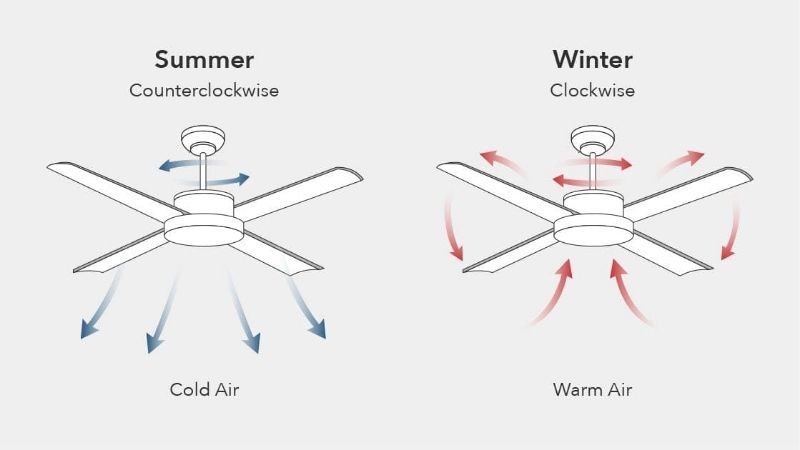
A ceiling fan should normally rotate clockwise at its lowest speed during winter, as seen by someone standing beneath it and looking up. The question which way should ceiling fan spin in winter has a practical reason behind it: a gentle updraft can circulate warm air collected near the ceiling without producing a cold breeze on your skin. This applies to conventional reversible residential fans; the instructions for your particular model take priority.
Quick Answer: Face the fan from below, set its reverse control to clockwise, and choose low speed. Let the blades stop completely before changing a physical switch. If you feel a strong downward draft while sitting in the room, lower the speed or confirm the direction using your owner’s manual.
As an Amazon Associate we earn from qualifying purchases.
By DIY Ideas 4 Home Editorial Team
Winter Ceiling Fan Direction by the Numbers
ENERGY STAR’s Ceiling Fan Installation and Usage Tips recommend clockwise rotation at low speed in winter, compared with counterclockwise rotation for a summer cooling breeze. Direction is judged from underneath the fan, not while looking down from above. Use the table as a starting point, then judge whether the room feels more comfortable rather than assuming that running a fan creates heat.
| Situation or Input | Recommended Range or Answer | Why | Exception |
|---|---|---|---|
| Typical occupied room in winter | Clockwise, lowest speed | Encourages a mild updraft and mixes ceiling-level warmth | Follow unusual model-specific airflow instructions |
| Occupied room feels breezy | Lower the speed or stop the fan | Air moving over skin can feel cool | Do not force a high setting merely to move more air |
| Summer cooling | Counterclockwise, comfortable speed | Creates a direct downdraft | Blade design can affect the sensation |
| Unoccupied room | Turn the fan off | A running fan still uses electricity | Building-specific air-circulation controls may differ |
| Ceiling height and clearance | At least 7 ft above floor; 18 in from walls | ENERGY STAR’s installation guidance for blade clearance | Consult the model’s mounting requirements |
Why Clockwise Rotation Moves Warm Air
Indoor heating commonly leaves air near the ceiling warmer than air close to the floor, especially in a tall room with slow natural circulation. A conventional fan running clockwise draws air upward through the area beneath its blades, nudging ceiling air outward toward the walls. Air then moves downward around the room, mixing the warmer layer with the air people occupy. The U.S. Department of Energy describes this effect in its winter energy-saving advice published in 2022 and updated in 2023.
The blades do not produce heat, and the fan does not increase the heating system’s rated output. It redistributes some warmth that already exists. That distinction matters when someone expects a fan to make a room hotter on a thermometer: the result depends on ceiling height, insulation, the location of the thermostat, the heat source, and where occupants sit. Mixing air can improve comfort without changing the total heat entering the home.
Why Low Speed Is the Winter Setting
Speed determines whether circulation feels gentle or like a draft. Hunter Fan’s ceiling-fan direction guide says to run its conventional winter setting clockwise at low speed because faster rotation may produce noticeable air movement against occupants. Begin at the lowest available setting and wait long enough for the room to settle. Sitting at your usual chair or desk provides a more useful comfort check than standing directly beneath the blades for a few seconds.
Do not equate a higher fan speed with more heating efficiency. In some rooms, faster mixing may reduce ceiling-to-floor differences, but the moving air can still make people feel colder. If the fan’s low speed is uncomfortably strong, switch it off instead of changing a thermostat immediately. ENERGY STAR specifically advises turning ceiling fans off when the room is empty, because circulation devices use power even when nobody benefits from the comfort effect.
How to Tell Which Way Yours Is Turning
Switch on the fan at its slowest setting and look up from a safe location beneath the blades. Track one blade through a complete circuit and note whether its travel is clockwise from your viewpoint. If it is difficult to see, turn the unit off and look at the reverse control described in the manual. On common pull-chain models, a small slide switch on the motor housing selects the motor’s direction; some remote or app-controlled fans use a dedicated reverse function instead.
When changing a physical direction switch, turn off the fan and wait until every blade has stopped. Hunter’s published reversing directions and the Westinghouse Quince owner’s manual both call for a full stop before changing direction. Never reach toward spinning blades, climb on unstable furniture, or attempt to rewire a nonreversible motor. A visual check of direction is sufficient; there is no reason to touch the blades while the fan runs.
Adjust Your Ceiling Fan for Your Room
The usual clockwise rule is a starting setting, not a promise of lower bills. Before changing anything, identify the control method, observe the room’s draft patterns, and check whether air near the ceiling is meaningfully warmer than the occupied area. Different ceiling heights, fan locations, and heating systems can make the same setting feel quite different.
Rooms With High or Vaulted Ceilings
A taller room can allow a larger warm-air layer to accumulate above the living area. In that case, low-speed recirculation may be particularly noticeable, provided the fan is sized and installed correctly. Westinghouse Lighting’s ceiling-fan direction information describes clockwise operation as a way to move ceiling-level warmth back through the occupied zone. Give the airflow time to circulate rather than judging the effect from a single short heating cycle.
Mounting height influences the result. ENERGY STAR’s Ceiling Fan Basics page recommends locating blades approximately 8 to 9 feet above the floor where ceiling height allows, while maintaining at least 7 feet of floor clearance. A vaulted-ceiling installation may need a manufacturer-approved longer downrod or an angled mounting kit. This is an installation decision, not a reason to improvise an extension or work on live electrical wiring.
Low Ceilings and Small Bedrooms
Airflow feels more direct when the fan is close to the seating or sleeping area. A low-profile fan may suit a room where a standard downrod would reduce blade clearance, but a flush mount does not automatically meet every height requirement. Compare the ceiling height, blade sweep, bed position, and the product’s stated mounting profile before making a replacement decision.
As a sizing reference, ENERGY STAR’s Ceiling Fan Basics guidance lists a 44-inch fan for rooms of approximately 144 to 225 square feet and a 50- to 54-inch fan for spaces around 225 to 400 square feet. These are general selection ranges, not permission to ignore a particular fan’s installation manual. If even the lowest speed creates a chilly feeling at a desk or bed, try using the fan only when the room is occupied and the heating system is actively warming the space, or simply leave it off.
When a Reverse Switch Seems Missing
A small slide switch may be concealed above a light kit or high on the motor housing. Other models provide a reverse command through a remote or connected control. Hunter’s direction guide describes different methods for pull-chain, handheld-remote, and connected fans, but a remote that adjusts speed is not necessarily able to reverse every motor. Consult the manual for your exact model rather than trying button combinations intended for another product.
If no reverse function is listed, the fan may not support it. Some specialized fans also have directional conventions that differ from the familiar household clockwise rule. Never modify the wiring, blade pitch, or electronics to create a reverse setting. When the reverse mechanism is unresponsive, the safest next step is to ask the manufacturer about the correct replacement control or arrange service rather than opening a powered motor housing.
Check for Comfort Before Lowering the Thermostat
Reversing the blades alone does not guarantee an energy saving. ENERGY STAR advises pairing year-round fan use with an appropriate thermostat adjustment because savings depend on what the heating system does afterward. Start with your normal thermostat setting and compare occupied-room comfort on similar weather days. If circulation makes the room comfortable enough to use a lower heating setpoint, that may reduce heating demand; if it merely adds a draft, there is no reason to keep the fan running.
Note whether the fan runs near a thermostat, fireplace, or supply vent. A thermostat exposed to an unusually warm or cool stream may respond differently from one in a more representative spot. Rooms with persistent cold corners can have insulation gaps, air leakage, or poorly distributed heat that fan direction cannot repair. For those cases, investigate the building envelope and heating setup before spending money on new fans.
Products That Help
For someone replacing a nonreversible fan in a small room, the Hunter Dempsey Low Profile 44-inch fan, model 59445, is one specific option. Hunter’s specification sheet for 59445 identifies a reversible AC motor, three-speed operation, a handheld remote, and a 44-inch blade span. The low-profile design is intended for close-to-ceiling mounting; check the model instructions for how direction is changed, because the included speed remote does not by itself prove that the reverse command is remote-operated.
For a larger conventional room where a straightforward motor-housing reverse switch is preferred, the Westinghouse Contractor’s Choice 52-inch fan, model 7802100, has three speeds and a reversible switch according to Westinghouse’s product page. That page describes a 52-inch span and gives a standard 8-foot-ceiling room as an intended use case. Either model is a replacement choice rather than a required winter purchase: if your existing fan reverses correctly and runs quietly, keep it and use the manufacturer’s instructions.
Frequently Asked Questions
Once the winter direction is set, most remaining questions concern what the airflow feels like, whether the fan should run constantly, and how to interpret an unexpected result. These distinctions help prevent a useful circulation setting from turning into an unnecessary heating expense.
Can a Ceiling Fan Heat a Room by Itself?
No. A ceiling fan circulates air; it does not supply space heating in the manner of a furnace, heat pump, or electric heater. The Department of Energy’s 2022 winter advice makes the important distinction between moving warm air from ceiling level and changing the room’s overall heat input. If heating equipment is off and the space is cooling, running the fan cannot replace it.
Should I Run My Ceiling Fan All Night in Winter?
Only if the room is occupied, the circulation is comfortable, and the fan’s instructions allow normal overnight operation. ENERGY STAR says to turn fans off in unoccupied rooms. In a bedroom where air movement feels chilly while sleeping, low speed may still be too much. A separate fan schedule or manual switch-off is more useful than assuming continuous operation will cut the heating bill.
Can I Reverse a Ceiling Fan While It Is Moving?
No, not when using a physical reverse switch. Stop the fan first and wait for the blades to come to a complete halt, as Westinghouse’s Quince owner’s manual and Hunter’s published instructions specify. Electronic reversing methods also vary by manufacturer; follow the sequence for your remote or app instead of assuming every fan reacts to the same button press.
Why Do I Still Feel Cold With Clockwise Rotation?
Clockwise rotation is not a cure for a leaky or under-heated room. A low ceiling can make the airflow perceptible; poor insulation or a cold window can create a separate draft. Try turning the fan off briefly while keeping the thermostat steady. If the cold feeling remains, check building air leakage and heating distribution rather than increasing fan speed to compensate.
Final Thoughts
For a conventional reversible fan, the answer to which way should ceiling fan spin in winter is clockwise on low speed, viewed from below. Before turning that setting into a daily habit, check the owner’s manual and sit where you normally spend time. If the air movement feels neutral or more comfortable, keep the low setting while occupied; if the room stays drafty, turn the fan off and look for the actual source of cold air. Replacing a working reversible fan is unnecessary simply to obtain a winter mode.