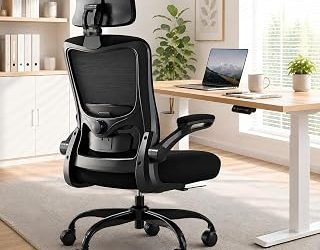
Key takeaways
- Base material and diameter: Skip nylon entirely. Look for a one-piece steel or cast aluminum five-star base, ideally 28 inches or wider — the extra footprint lowers the tipping moment when you lean back or reach sideways.
- Gas cylinder class: Class 3 is the minimum for heavy-duty use; Class 4 is better. The spec sheet won’t always say, so treat a stated 500 lb+ capacity plus a metal base as your proxy, and check the cylinder diameter (50mm beats 38mm).
- Seat frame construction: Welded steel tube under the cushion is what separates a real big-and-tall chair from a padded one. Press down hard on the front edge of the seat during assembly — any flex there means the plate is carrying load it shouldn’t.
- Cushion type: Pocket-spring seats hold their shape far longer than single-density foam, which compresses to a hard pancake within months under sustained weight. High-density foam over springs is the sweet spot.
- Casters and floor contact: Rubber-coated or dual-wheel casters with 60mm+ diameter roll under load without gouging hardwood. Cheap hard nylon wheels are the first thing worth replacing, and they’re a five-minute swap.
What's inside
If you’ve ever heard that dry crack from underneath a desk chair, you already know the failure pattern: it’s rarely the upholstery that gives out. It’s the nylon base spidering at the spokes, the gas lift losing pressure until you sink an inch every ten minutes, or the seat plate flexing where four undersized bolts were asked to carry a 300-pound dynamic load. Standard office chairs are built to a 250 lb static rating, and static is doing a lot of work in that sentence — nobody lowers themselves into a chair gently at 4pm.
I’ve torn down enough budget chairs to know which parts matter, so this guide looks at big and tall seating the way you’d inspect a workbench: base material, cylinder class, frame welds, and how the seat pan is actually fastened. Below are six chairs rated from 400 to 650 lbs, with notes on what you’re really paying for and what you’ll want to check during assembly.
As an Amazon Associate we earn from qualifying purchases.


How to Choose an Office Chair For Heavy People (2026)
- Base material and diameter: Skip nylon entirely. Look for a one-piece steel or cast aluminum five-star base, ideally 28 inches or wider — the extra footprint lowers the tipping moment when you lean back or reach sideways.
- Gas cylinder class: Class 3 is the minimum for heavy-duty use; Class 4 is better. The spec sheet won’t always say, so treat a stated 500 lb+ capacity plus a metal base as your proxy, and check the cylinder diameter (50mm beats 38mm).
- Seat frame construction: Welded steel tube under the cushion is what separates a real big-and-tall chair from a padded one. Press down hard on the front edge of the seat during assembly — any flex there means the plate is carrying load it shouldn’t.
- Cushion type: Pocket-spring seats hold their shape far longer than single-density foam, which compresses to a hard pancake within months under sustained weight. High-density foam over springs is the sweet spot.
- Casters and floor contact: Rubber-coated or dual-wheel casters with 60mm+ diameter roll under load without gouging hardwood. Cheap hard nylon wheels are the first thing worth replacing, and they’re a five-minute swap.
The Best Office Chair For Heavy People (2026)s Reviewed
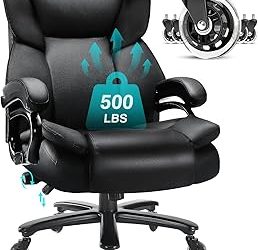
500lbs Big and Tall High Back Executive Chair
This is the balanced pick: pocket-spring cushion, adjustable lumbar block you can dial to your own curve, and quiet rubber casters that don’t telegraph every movement to the room below. The 500 lb rating leaves genuine headroom for daily use rather than sitting right at the limit.
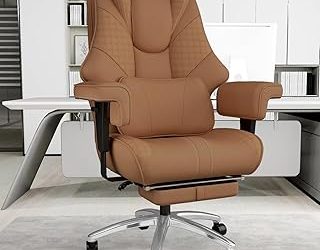
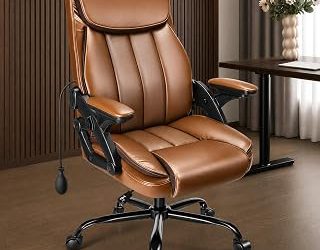
650lbs Large Big and Tall Leather Executive Chair
Built for eight-hour days, with the widest seat pan and thickest padding stack in this group — worth it if you’ve outgrown chairs that squeeze at the hips. The 650 lb rating means the base and cylinder are meaningfully overbuilt, which is exactly what you want in a component that fails without warning.
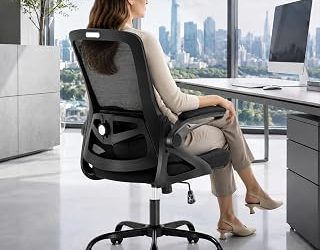
600lbs Heavy Duty Chair with 5D Flip Arms
The 5D armrests adjust in height, width, depth, angle, and pivot, then flip up so you can pull tight to a desk or shift to a keyboard tray. Pocket springs and dual rubber wheels round out a chair that feels engineered rather than assembled from catalog parts.
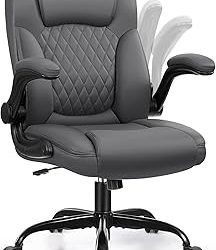
400lbs Executive Chair with Flip-Up Armrests
The value option, with breathable PU leather that runs cooler than bonded vinyl and flip-up arms for tight desk clearances. At 400 lbs it’s the lightest-duty chair here, so treat that rating as a real ceiling rather than a suggestion.
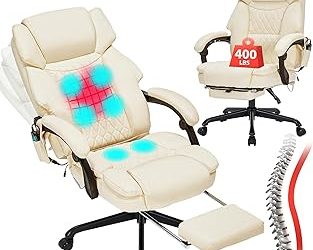
Massage Office Chair with Foot Rest
Six vibration points plus heat won’t replace a proper recovery routine, but the lumbar heat genuinely helps on long sedentary stretches. The retractable footrest and deep recline make it the best pick if your office doubles as a reading chair.
Frequently Asked Questions
Are stated weight capacities honest?
Treat them as static ratings tested under lab conditions. Buy 100–150 lbs above your weight so the gas cylinder and base handle the dynamic load of sitting down, leaning, and shifting.
How hard is assembly?
Expect 30–45 minutes and a lot of hex bolts. Hand-thread everything first, seat the cylinder by sitting on the chair once, then torque the seat-plate bolts in a cross pattern.
Will these damage hardwood floors?
Rubber-coated casters are fine on sealed hardwood. Under a 600 lb chair I’d still add a low-pile rug or a hard-floor mat to spread the point load.
Can I repair one instead of replacing it?
Yes — cylinders and casters are standardized and swap out with a rubber mallet and pliers. A cracked base or bent seat frame is not worth saving.
Final Thoughts
For most buyers the 500lbs Big and Tall High Back Executive Chair hits the right mix of pocket-spring support and real steel underneath. If you want maximum margin, the 650lbs Large Big and Tall Leather Executive Chair is the one I’d trust for eight-hour days, while the 600lbs Heavy Duty Chair with 5D Flip Arms is the better call if adjustability matters more than raw capacity.